The Tuareg; Sons and Daughters of Sahara

You can plan your travel around interesting natural, historical, and artistic sites, but at the end of the day it is the local people that make or break your stay.

The most beautiful and impressive place can be significantly marred by unfriendly people (I am pointing at you Paris and Barcelona!) yet even a rather average locale can be elevated by welcoming and kind folk.

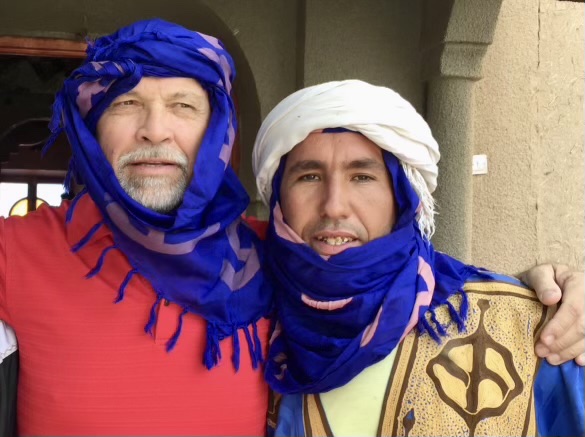
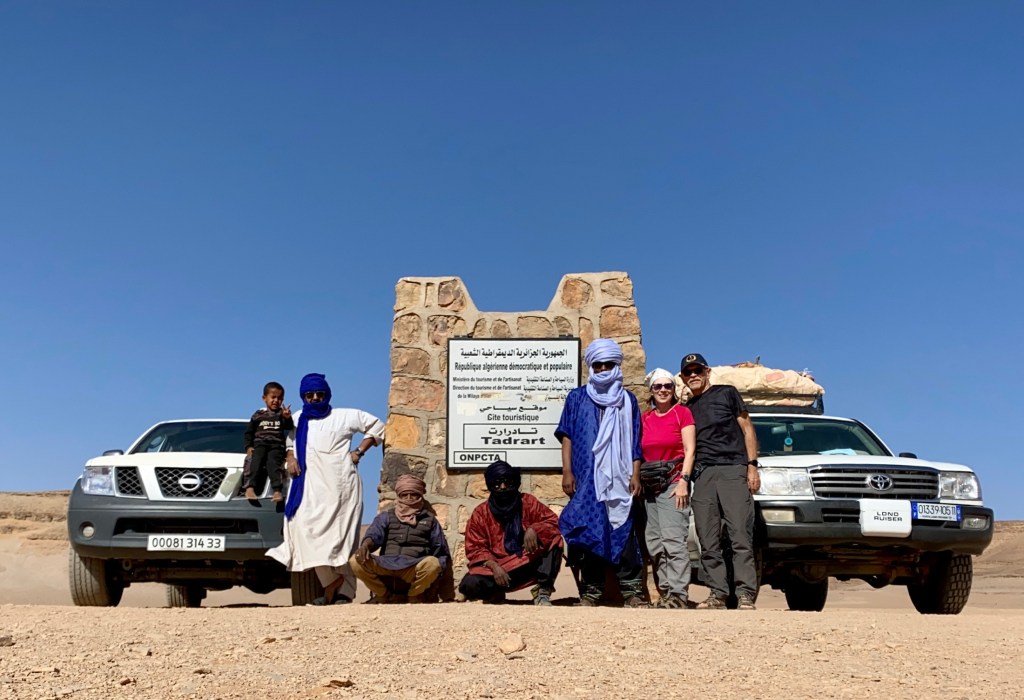
Mirek with our Algerian Tuareg car mates Youssef and his brother Abass

Luckily Algeria has nothing to fear. The local people we encountered were exceptionally friendly, welcoming and downright thrilled to see us. The few other travelers we met all mentioned in the very first exchanges how warm their reception was everywhere they went.

Our unfettered exposure to the local people was a bit curtailed as we were nearly always accompanied by Youssef, which cut a fine and tall figure in various colorful outfits that brought us extra attention in the coastal cities of the North.

Yet repeatedly people went out of their way to express their surprise and delight that we were visiting their homeland. Only Iranians could beat Algerians at the welcome game. There we felt like real celebrities every single day.

Big smiles
And handshakes
And flowers for the lady

While random encounters and exchange of a few friendly sentences are so very pleasant, the advantage of having a local guide with an excellent command of English and willingness to engage in real cultural exchange, sharing opinions, and answering exceedingly more personal questions is very important. Only thus can one get a true insight and at least some level of deeper understanding?

Spending many hours in the car chatting together but also watching the interaction of our desert team taught us a lot about the Tuareg culture. While we were served our own meals, the team always ate from a communal bowl starting their meal with a thick soup.

We were even so lucky as to be invited to Youssef’s home to break the Ramadan feast with the family.
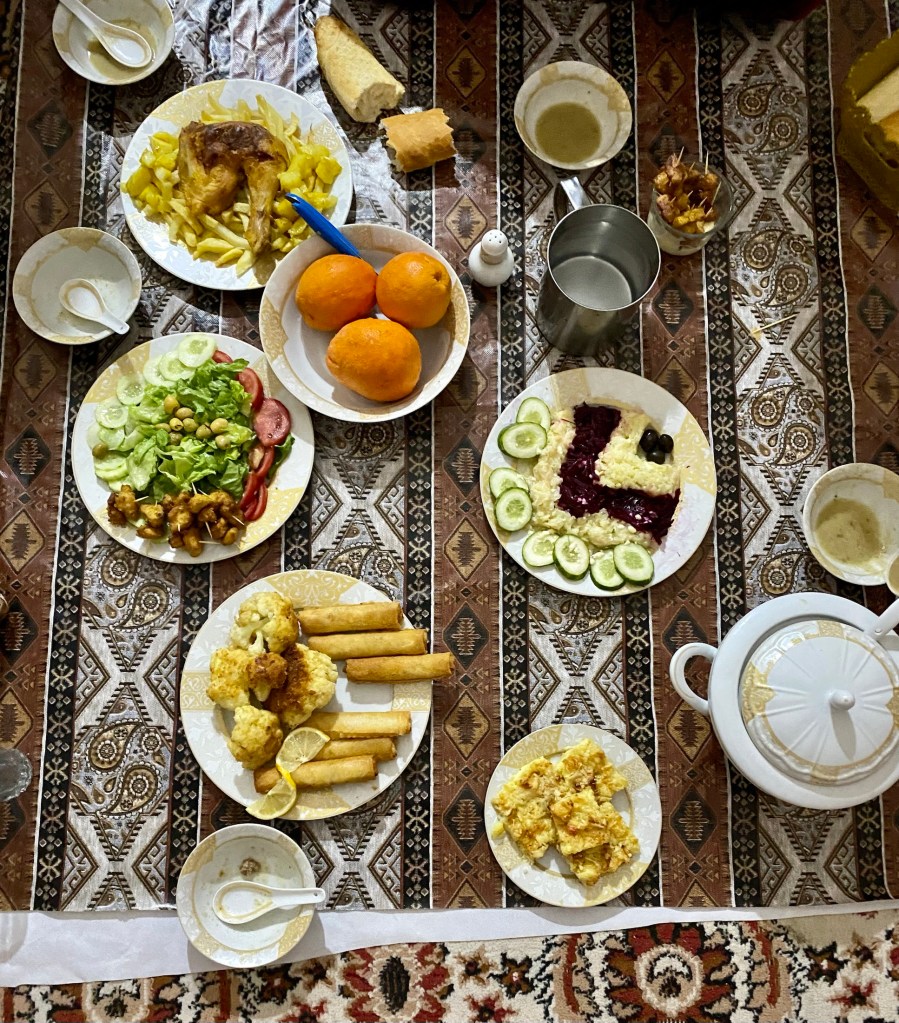
Ladies and gents eat separately in different rooms. Despite the limited language skills ladies always have more fun!

Pictures of children and grandchildren are shared. And designs on hennaed hands admired.

Interesting to note that children are not allowed to eat with adults but are relegated to dining in the kitchen. But a gaggle of giggly granddaughters was encouraged to show their school books and practice counting in English while finishing touches were put on the dinner dishes.

My translator for this occasion was Youssef’s cousin Zahra. Recently graduated from university with a law degree she surprised her cousin upon pick up when she showed up covered from head to toe. He was far from pleased as it is not a Tuareg tradition at all, but a new influence of strong conservative Islamic trends. As a matter of fact in Tuareg culture it is the men that veil their face and women don’t.

Beneath the serious garb was a funny laughing personality

She was very excited to be out and about when we went to see an old ksar in her home city. Seems like she has never been there before.
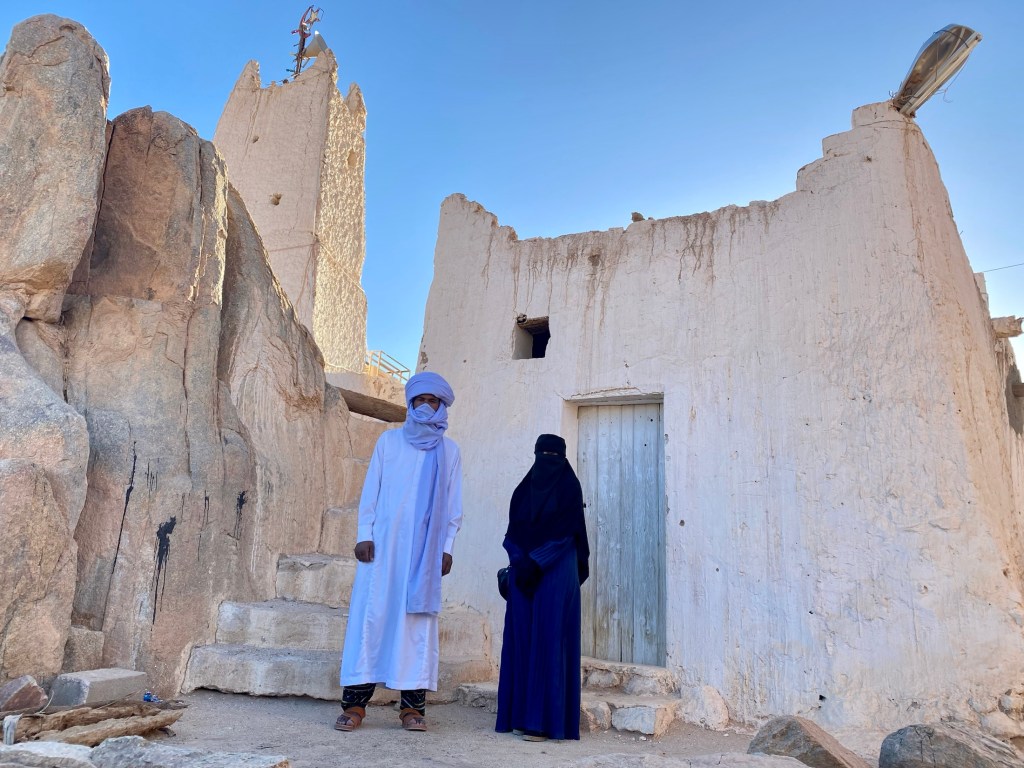
She was also excited to introduce me to her grandmother living across the street. It was sweet to see the close, loving relationship. The elders are still very respected in Tuareg culture, and they will always be taken care of in old age. Youssef also took us to visit his other grandma living in a compound of his uncle.
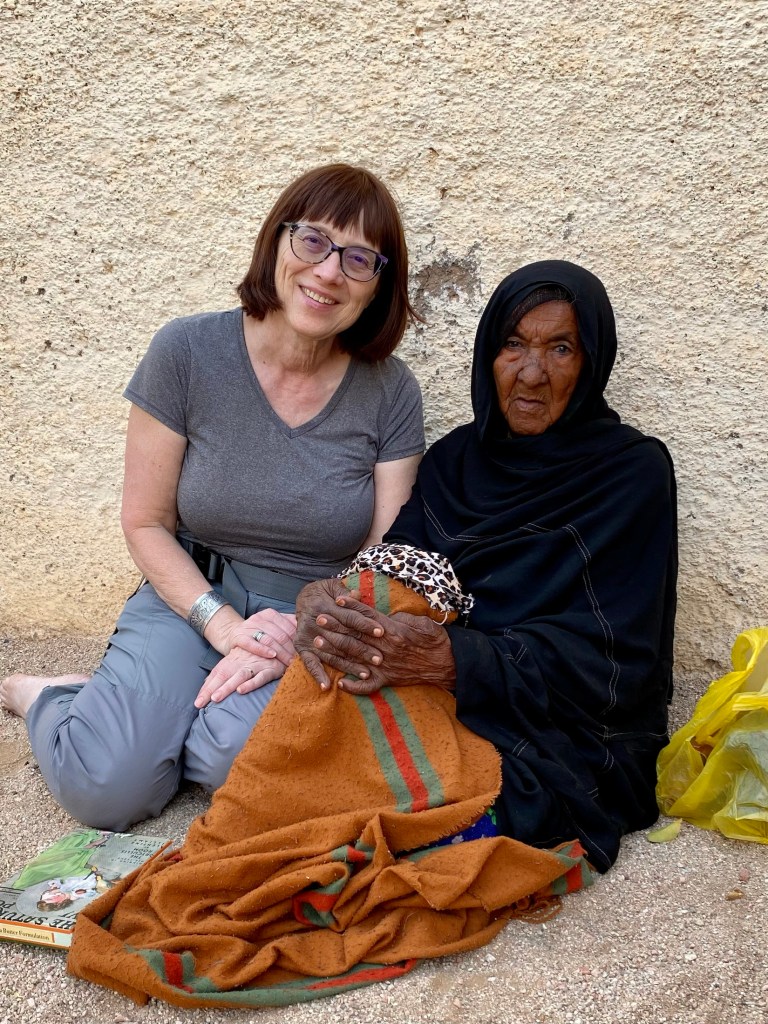
He was proud to tell us that she knows tifinagh, an old consonantal alphabet. We saw an older precursor to tifinagh carved on the walls of some desert rocks and were surprised that nobody could read it or decipher the inscriptions.
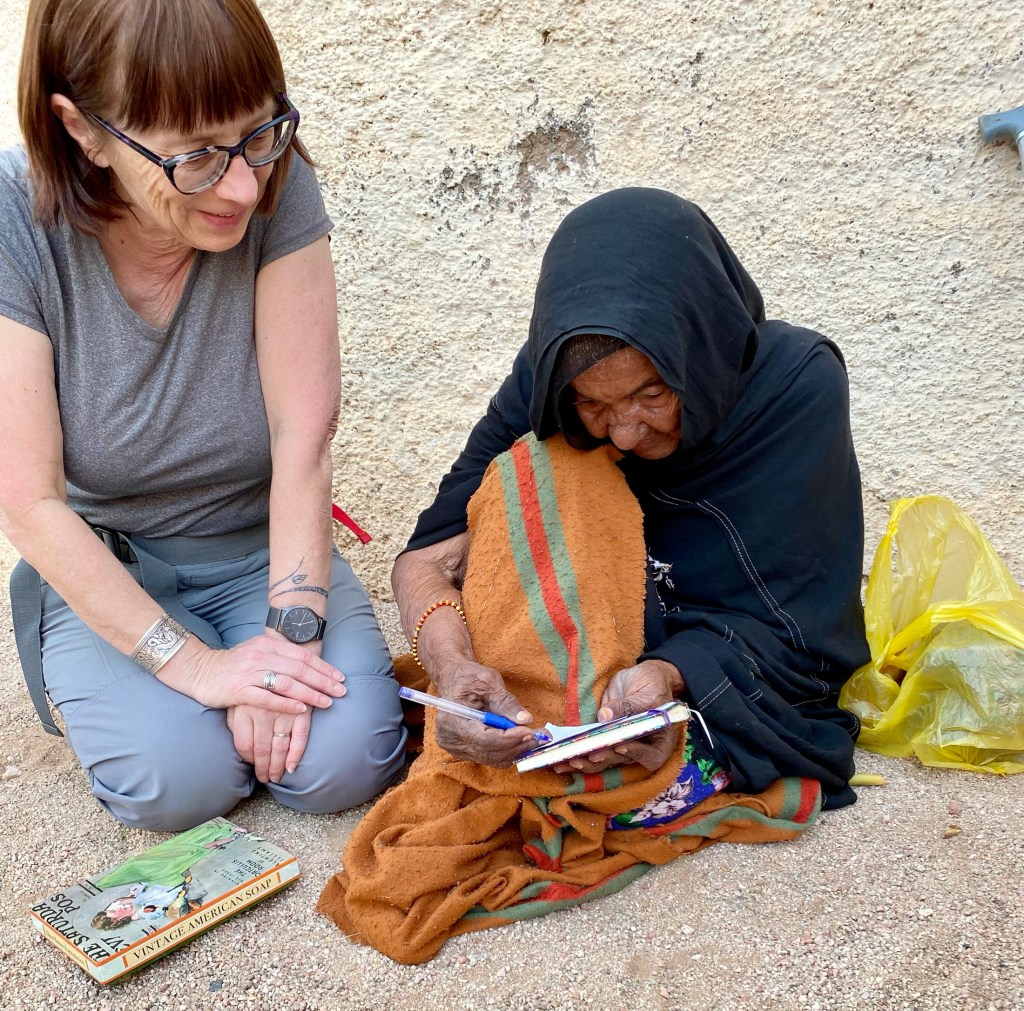
Grandma writing my name

Who are the Tuareg? On a grand scale the Tuareg are semi-nomadic herders and traders living in Northern Mali, Niger, Burkina Faso, Libya, and Algeria.

A Tuareg craftsman from Mali at the Djanet market

They are descended from Berbers (=Amazigh), the indigenous population of North Africa and speak different dialects of a Berber language: Tamasheq.

The close cousins of Algerian Tuareg are Morrocan Berbers.
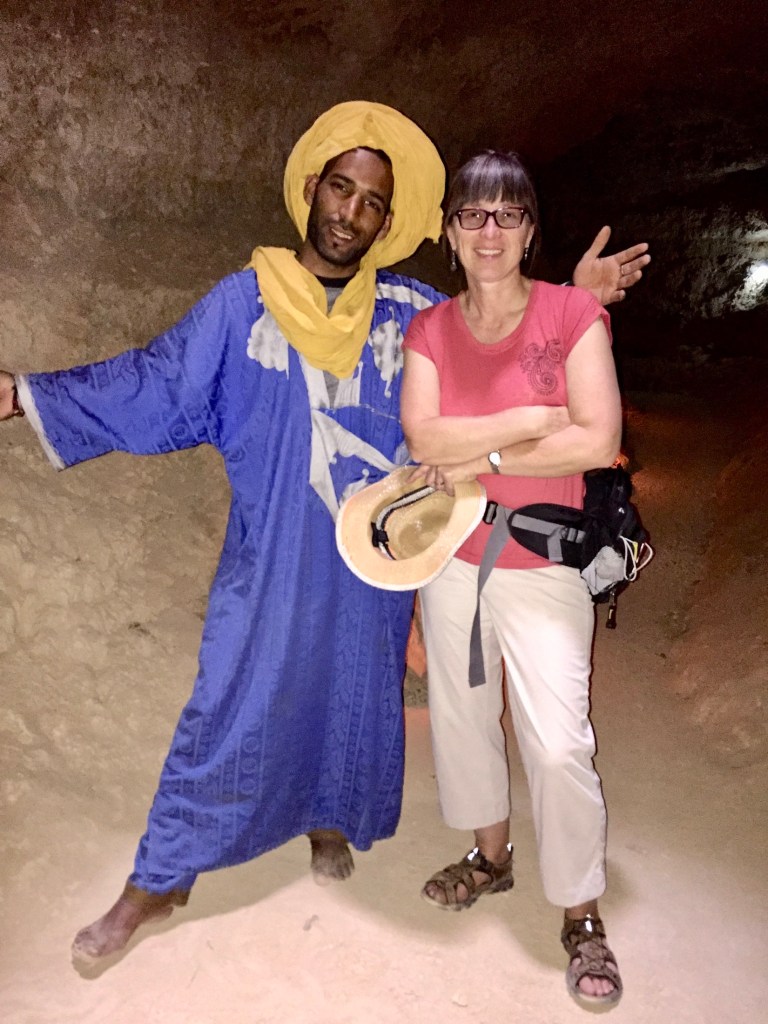
Ksenija with a Morrocan Amazigh April 2016
Mirek and a Berber friend in Morroco April 2016

Though most Algerians are descendants of ancient Amazigh groups who mixed with various invading peoples, of whom Arabs had the most influence, only some one-fifth of the Algerians now consider themselves Amazigh.

There are 4 Amazigh subgroups in Algeria: Kabyle, Shawia, Mʾzabites and lastly the Tuaregs from the southern desert.

Incidentally the little hotel we stayed in (and gratefully showered in) in between our two forays into the desert was owned by a Kabyle family from the North of Algeria. The lovely daughter Celia (another young woman with a law degree) who often manned the reception was particularly helpful answering some of my more feminine cultural questions. Her English (and French and Arabic) was perfect and she did not shy away from any topic.
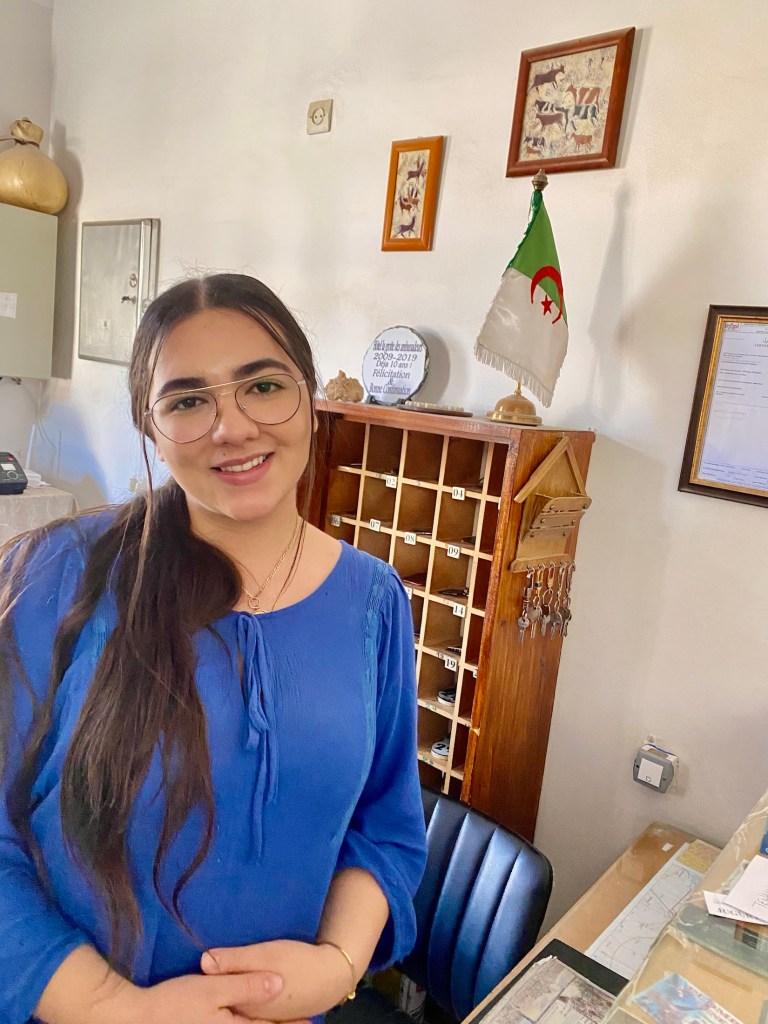
Celia’s dream is to start her own high quality travel agency

The Tuareg are also called the “blue men of the sahara” for their traditional blue tagelmust (veil and turban in one). The long and loose gown worn by the Tuareg and the tagelmust were once died blue with indigo and while swetting under the hot desert sun the blue color rubbed off the clothes and into the skin- hence blue men.

We spotted men in gowns and tagelmusts of different colors but alas most younger people now opt for jeans and T-shirts. More convenient and cheaper. Definitely not as charming and attractive.

How about the ladies Tuareg fashion? Well, you are in luck as I was treated to a special preview when we visited a remote Tuareg community in Tasili n’Ajjer area.

The ladies of the house, or I should rather say very very poor compound had a lot of fun dressing me up in a traditional costume. The kids were practically dumbstruck to see such sport (… and the dish ran away with the tea spoon).

Yes, cell phones are everywhere even in the poorest places of the world. No one will invest in water or electricity but someone will always put up cell phone towers to make money.

I took advantage of the spectacle and had a few girls join me up on the center stage so we could get some lovely photos.
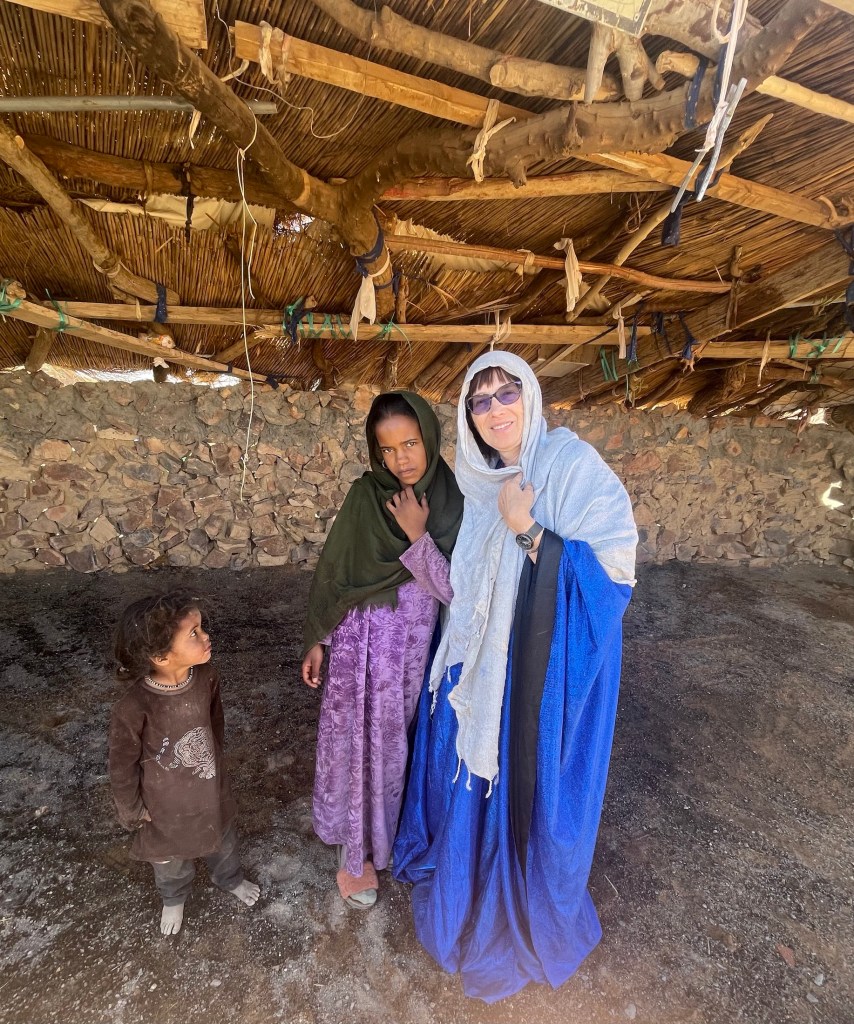
This very shy girl visiting the settlement from a nomadic family reminded me of the famous Nat Geo photo of the Afgani girl.

The children from this very poor community of former nomads were going to a nice newly built school.

Selfies are the best way to break the ice

But in the desert winter they were very cold so we fundraised (through http://www.lanternprojects.org) to bring them heaters for all the classrooms.

A number of local officials were present

That night we camped in the rock outcrops outside of the village and in the morning one of the local men took us on a most rewarding hunt for secret rock art.

Prehistoric communal grinding flour pits

But first he introduced us to his family who was the only one still living in a traditional Tuareg tent. Two to be precise.
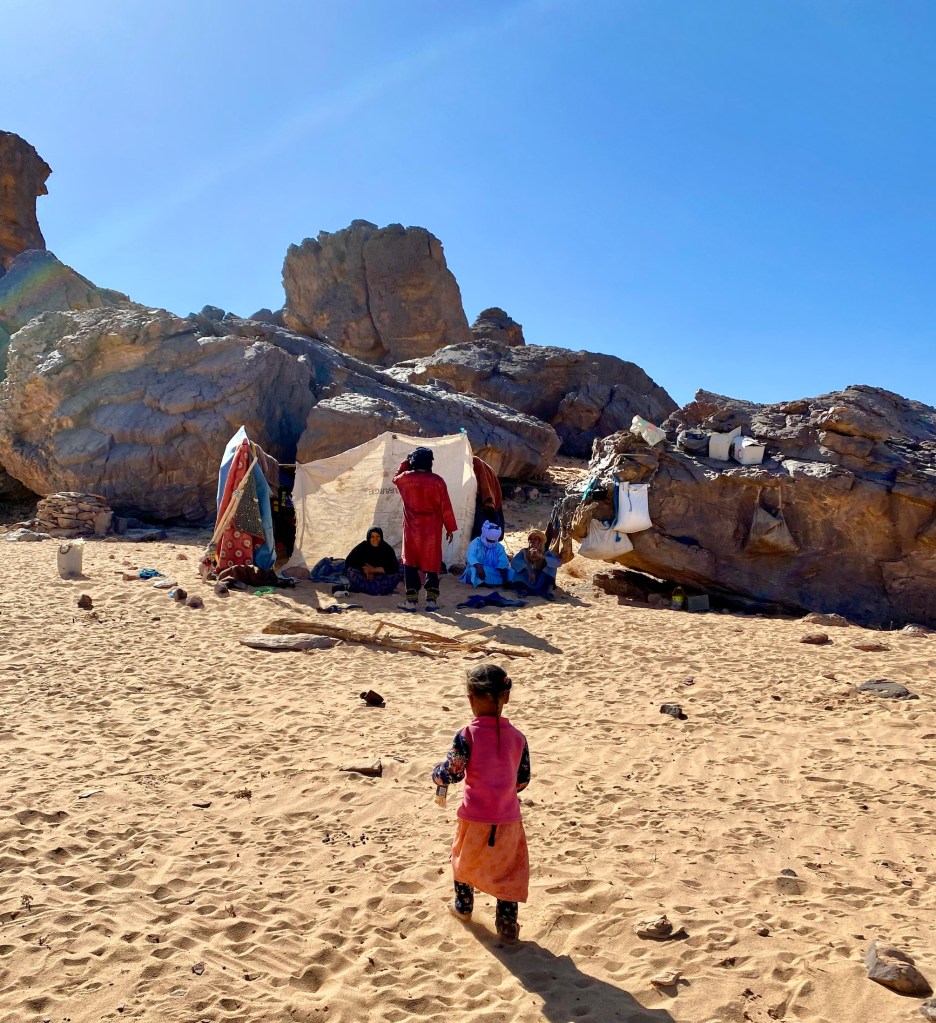
They were making a living as goat herders. With encouragement from the government, the rest of the families gave up their semi-nomadic life and struggle very much with no source of income.
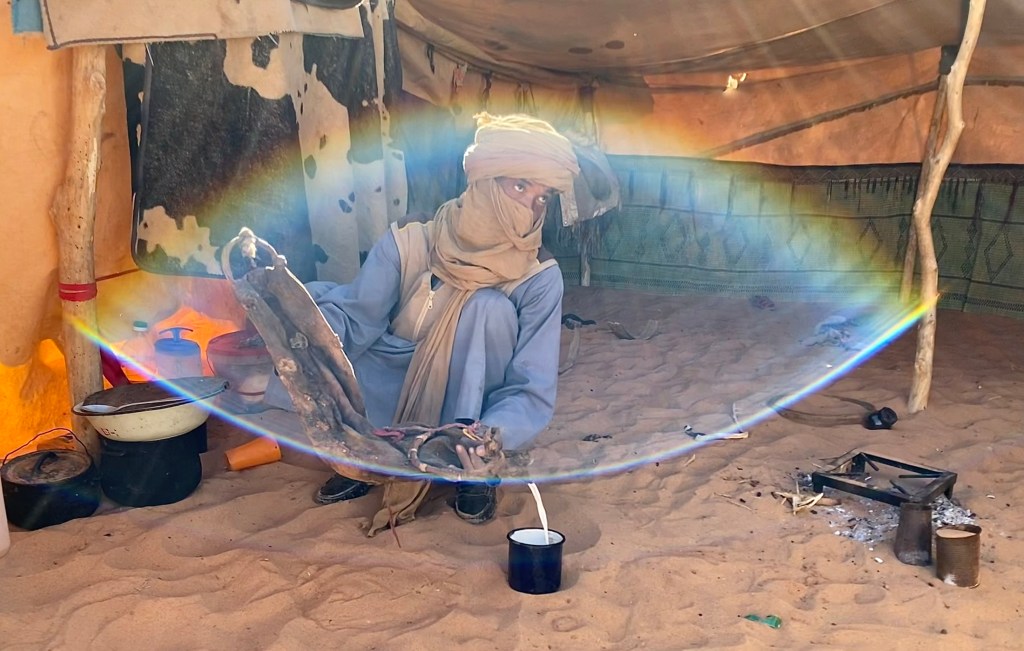
We were treated to an enthusiastic explanation and demonstration of different natural implements.

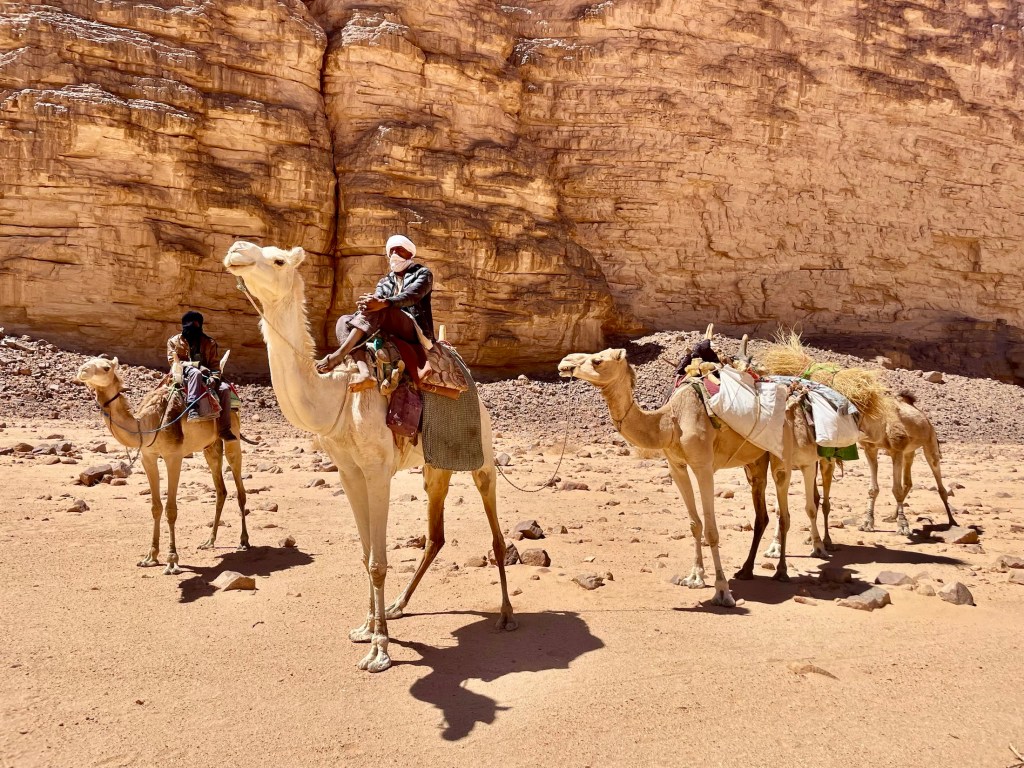
Knowing that most Tuaregs have long given up their nomadic ways this chance encounter with a few camelteers was very special.

Greeting the camel train

Of course, Youssef knew them and had a little chat. They were bringing fodder back home for the animals.

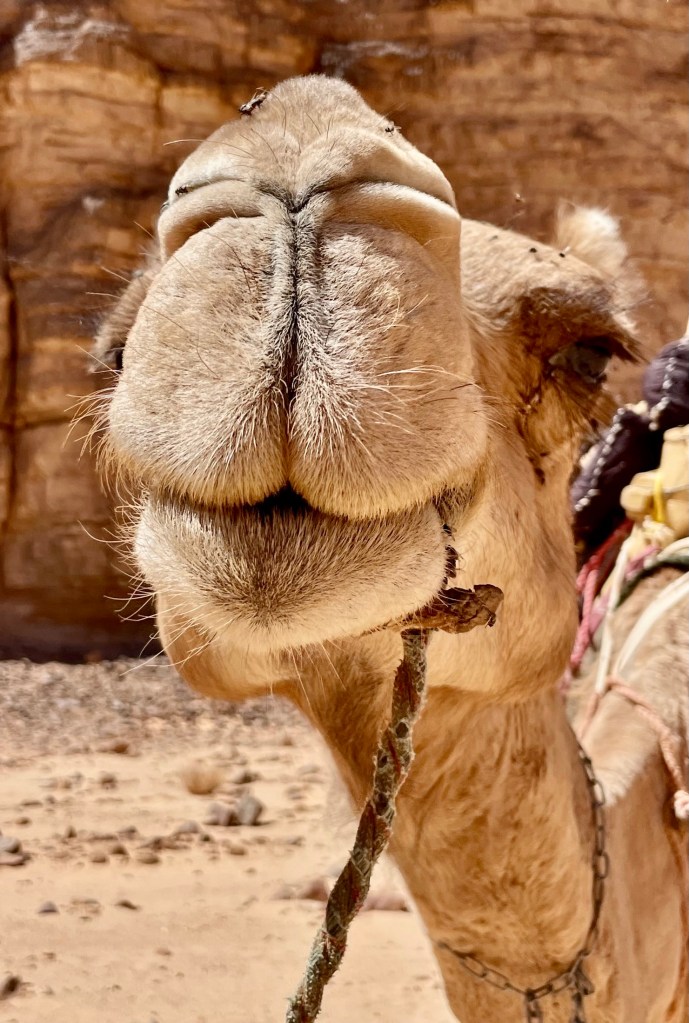
Happy meeting

Soon after we were engulfed in a sea of goats. If not for the sunglasses we would be apt to believe we were teleported back a few thousand years.

Turned out the goats were being taken to market to Lybia for a good price was rumored to be had there.

But they lost their way.

Straight from the Bible. Except for his oil field overalls.

After giving him directions

We pressed upon him some supplies and wished him luck.

We would be remiss to not mention music as a big part of Tuareg culture. The original ancient tradition of music, poetry and dance continues and is celebrated in a ten day festival of Sebeiba in the little town of Djanet where we were based. The festival is held in the month of July, so we will have to return.

There is an everyday tradition of music being played after dinner and around the campfire. Many a young man picks up a guitar and learns to riff the Sahara blues or desert rock (also called tishoumaren or assouf) that first became popular in the 1970s. Every evening on our camping trip our cook Bubba would pick up his guitar and the rest of the crew would sing and clap along.

One evening at a goat barbeque in town we were even treated to a performance of a local Tuareg rock group.
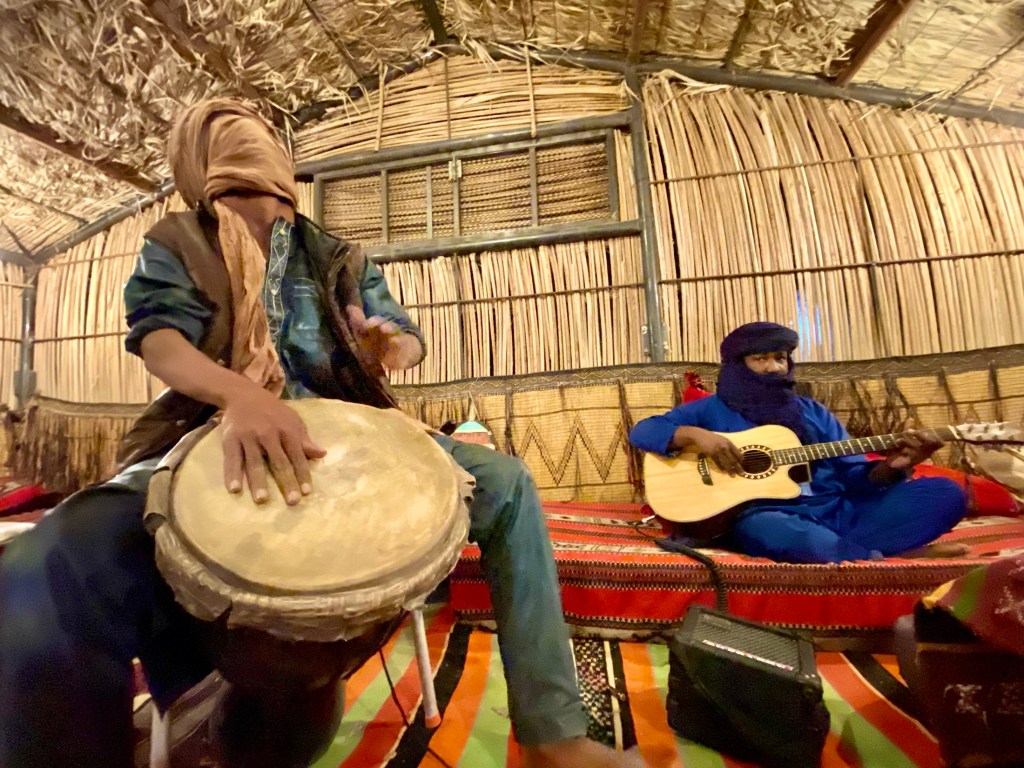
Traditional drum and acoustic guitar
A perfect night on the edge of the Sahara

Until we meet again!

Algerian Sahara II

Part II D(r)iving into Sand Seas

Since the time we first met some forty years ago on the edge of the desert of Ancient Mesopotamia, we traveled and even lived in diverse deserts around the world. In a car without AC, we crisscrossed the desert in Iraq searching for the ancient cities of Ur, Uruk, Ninive, Babylon.

My first camel ride in Iraq, 1983. Yeah, I haven’t changed a bit. 😉

We started our family in the Arizona desert studded with white saguaro cacti blooms. We drank tea in the desert of Jordan on the way to Petra, got sore riding camels in Morroco, climbed the dunes of Namib, and drove in arid Australia. More driving in the Atacama and Patagonia deserts. We stepped on land in Antarctica; did you know it is considered desert, in fact the largest in the world?

To tell the truth I am not and never was particularly fond of deserts. (Now desserts, those I am very much fond of! That’s how I remember how to spell them correctly, with double “s” as I always want seconds.)

Algerian desserts

So, really, I was not expecting that much from our Algerian Sahara desert encounter. We were here for the prehistoric rock art after all. And then right at the start to paraphrase Nat King Cole’s famous song:

🎶…

We were driving along, minding our business, (drinking in sunshine)
When out of an orange, (well blue), colored sky
FLASH, BAM, ALAKAZAM
Wonderful desert flew by,

… 🎶

And Sahara love hit us in the eye and like any person madly in love we are now shouting it from the rooftops and writing it on walls (of social media).

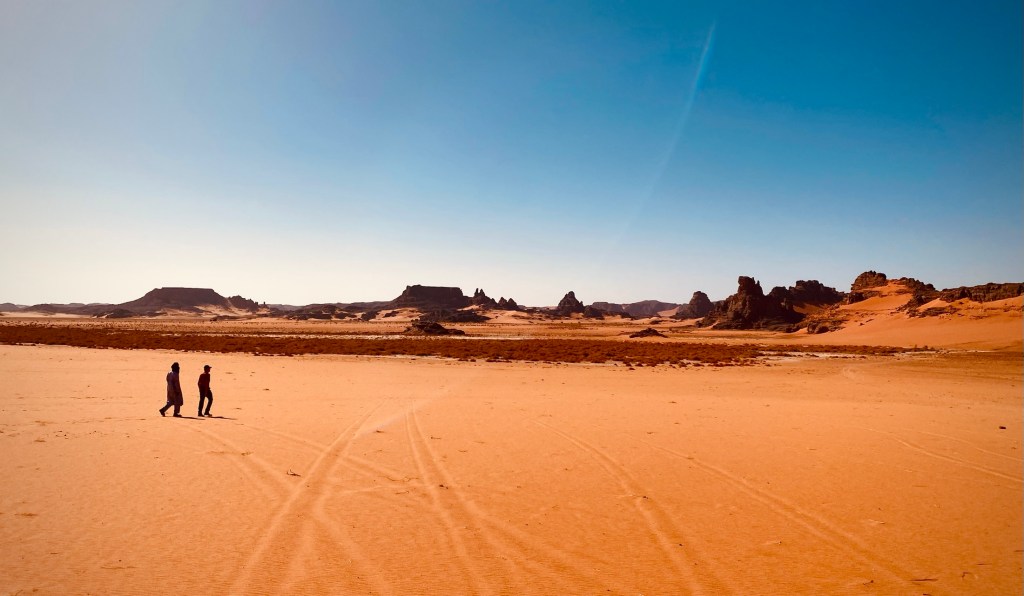
The Algerian Sahara is the most beautiful desert in the world! It is incredible, otherworldly, ever-changing, multi-faceted, dramatic yet tranquil, fascinating, colorful, and overseen by a deep black velvet sky studded with a myriad of stars. There is nothing like stumbling out of your tent in the middle of the night to pee and looking up straight into the vortex of Milky Way.

Ladies to the right, gents to the left…don’t forget the toilet paper roll!

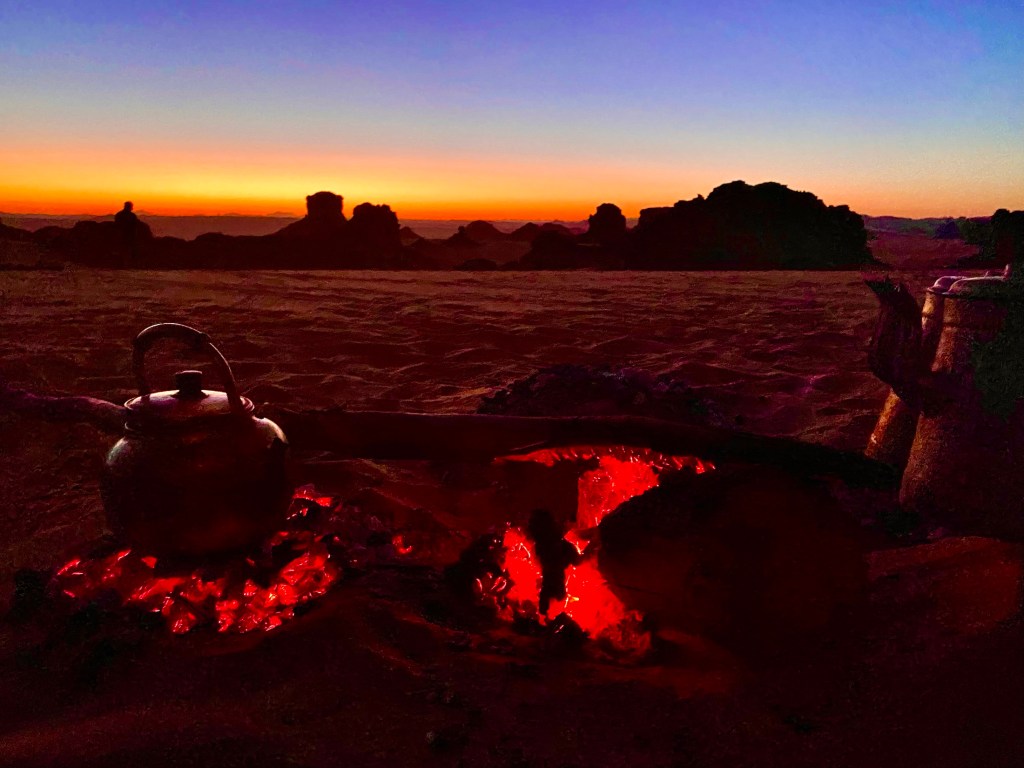
You can’t see the stars in the camp in the evening because there is always a fire burning long into the night

with your Tuareg companions drinking countless tiny cups of strong sweet tea strumming a guitar or chatting. And chatting. Man, those guys can talk. I would love, love to know what about.

What is so extraordinary about the Algerian Sahara is the constant surprises, new vistas, color hues, and changing rock formations. Do not nod off even for a moment in the car or you will miss something magnificent.

The rocks delineate the place of worship with direction to Mecca where our guys enter to pray

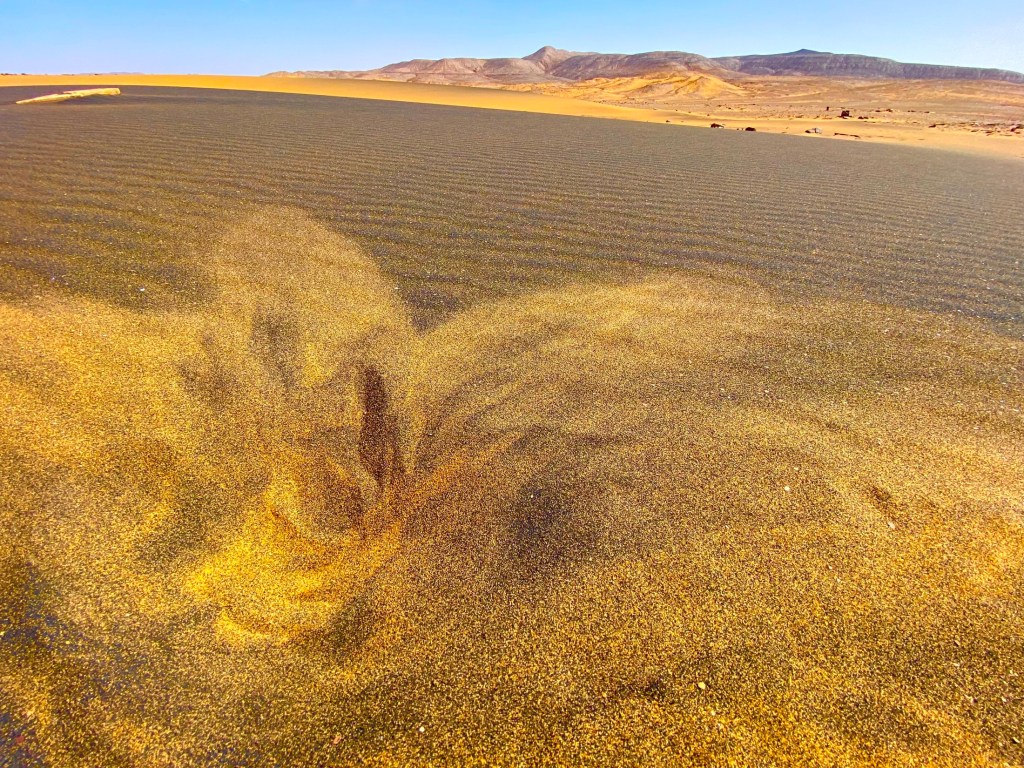
Alas, my poor little iPhone is not capable of capturing the vibrant true colors of this desert. And my editing skills don’t suffice. If anything, they make it look worse. Especially this unique yellow and black desert area called Adjalati just past the entrance to the renowned Tardart Rouge=Red Mountain.

A thin layer of fine black volcanic sand creates a fantastic effect and brings out the yellow.

Digging in. Can you glimpse the tiny conical shapes of old 🌋 on the horizon?

For the first and certainly not the last time we are numbstruck by the immensity of this place, the grandeur, and the extraordinary privilege of having it all to ourselves. Somehow, far from making us feel small and insignificant, or scared and alone, it makes us feel welcome. Like these vistas were waiting just for us to be admired and extolled, like we are a perfectly fitting piece of Nature’s puzzle.

Can you detect a tiny figure of Mirek?

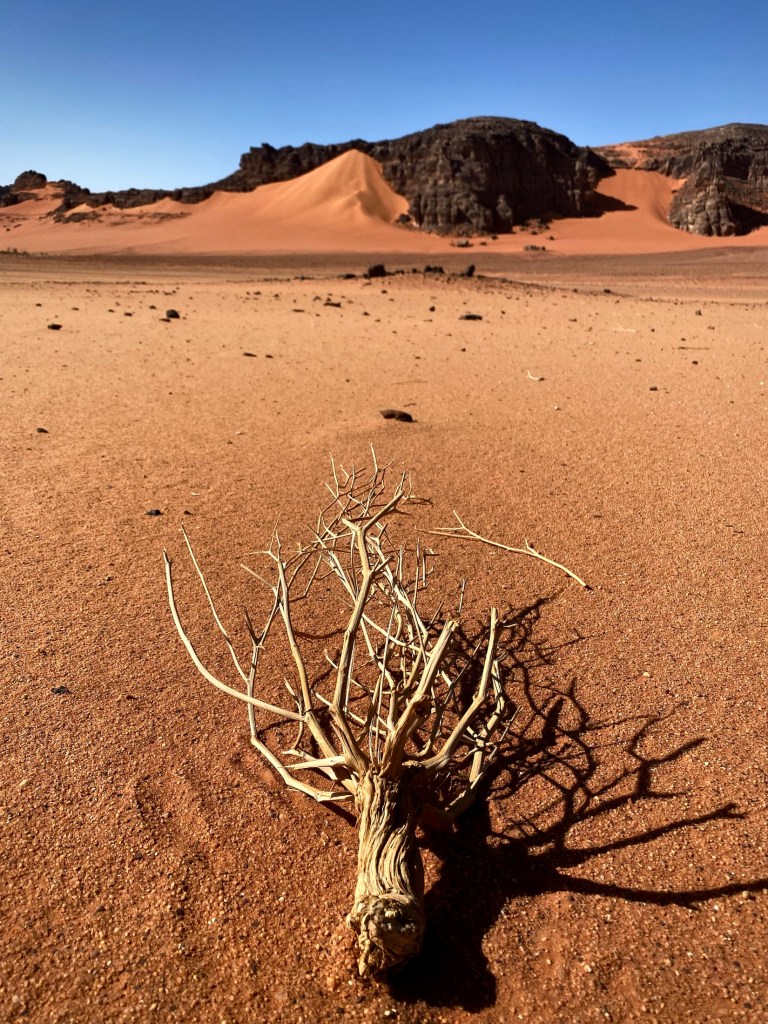
Not to be outdone the red desert warmly embraces us, too.

And when I say warmly I also mean with perfect temperatures. Sahara might be mighty hot in the summer months but right now the temperatures are perfect. In a place known for extremes on both ends, we rarely break a sweat during the day, and only a few middle of the nights could be considered nippy.

Morning walk
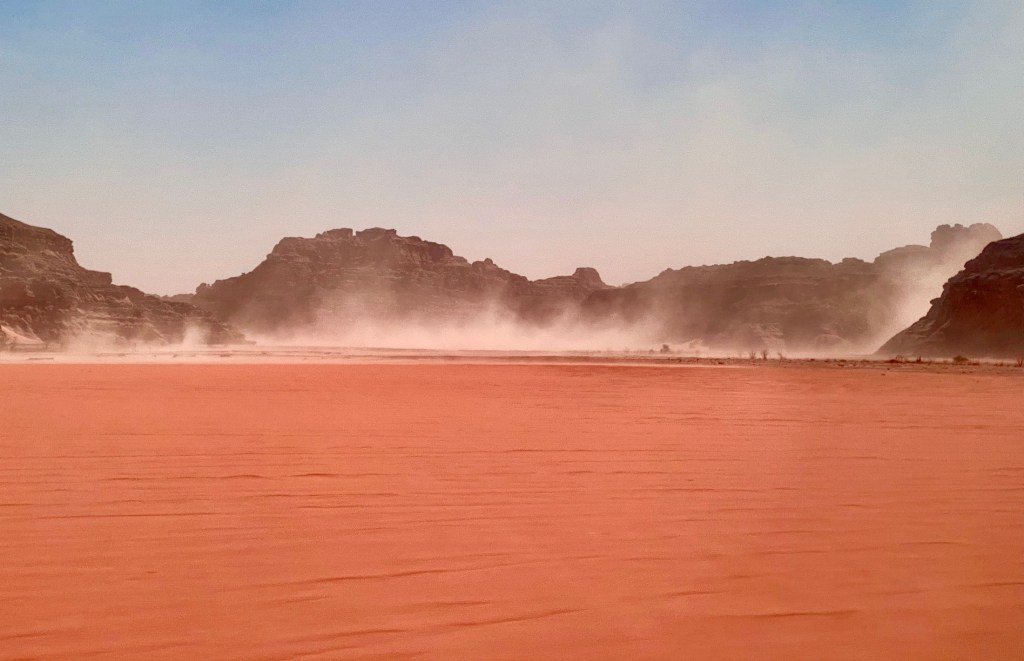
1st sandstorm of the season

We only have one day when the weather is not optimal as Sahara wind brings the first inkling of the sand storms.

Makes it a bit more difficult to lunch and a new understanding of the desert men’s very practical head and face coverings

The details are worthy of attention, too. The patterns on the sand are poetry written with a calligraphic brush of the wind.

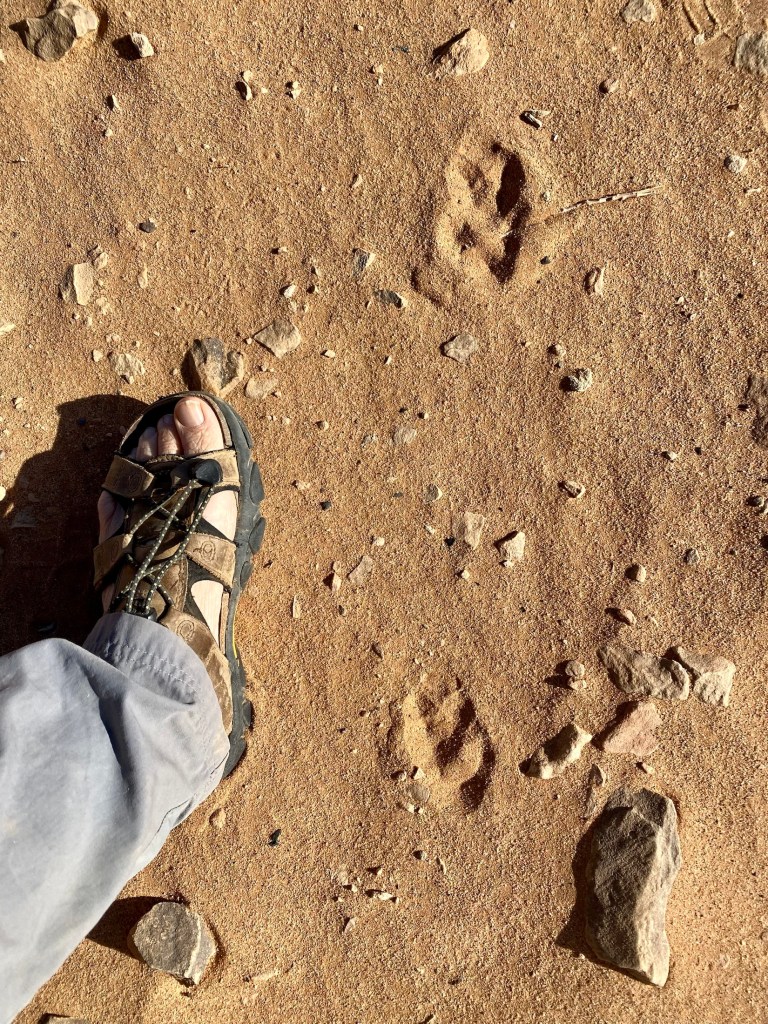
Another task for you: can you trace the bird tracks?

There is plenty of life in the desert still. While the megafauna has long ago moved out with desertification, the last lions were only shot in the 1920s. We still encountered half wild camels and one totally wild ass loudly protesting our presence. Coyotes are hanging around hoping for some tasty scraps. One night there was a commotion: our valiant cook Bubba sleeping out in the open single handedly managed to defend his supplies (especially dried goat) from two stealthy thiefs. We find plenty of fresh tracks in between our tents in the morning.

Birds are luckier, the baguettes that are getting staler by the minute and the day are generously shared.

Small acacia trees,

donkey melons, and tiny flowers of all kinds, many medicinal, somehow flourish, too.

Flower of the torha tree that goats enjoy

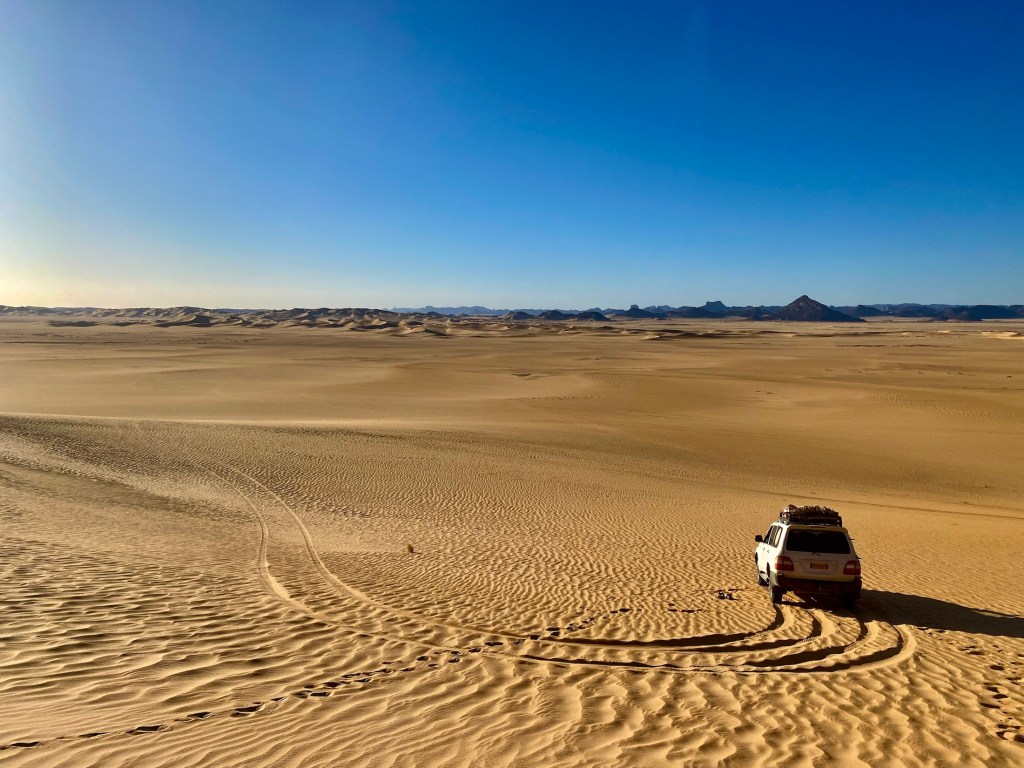
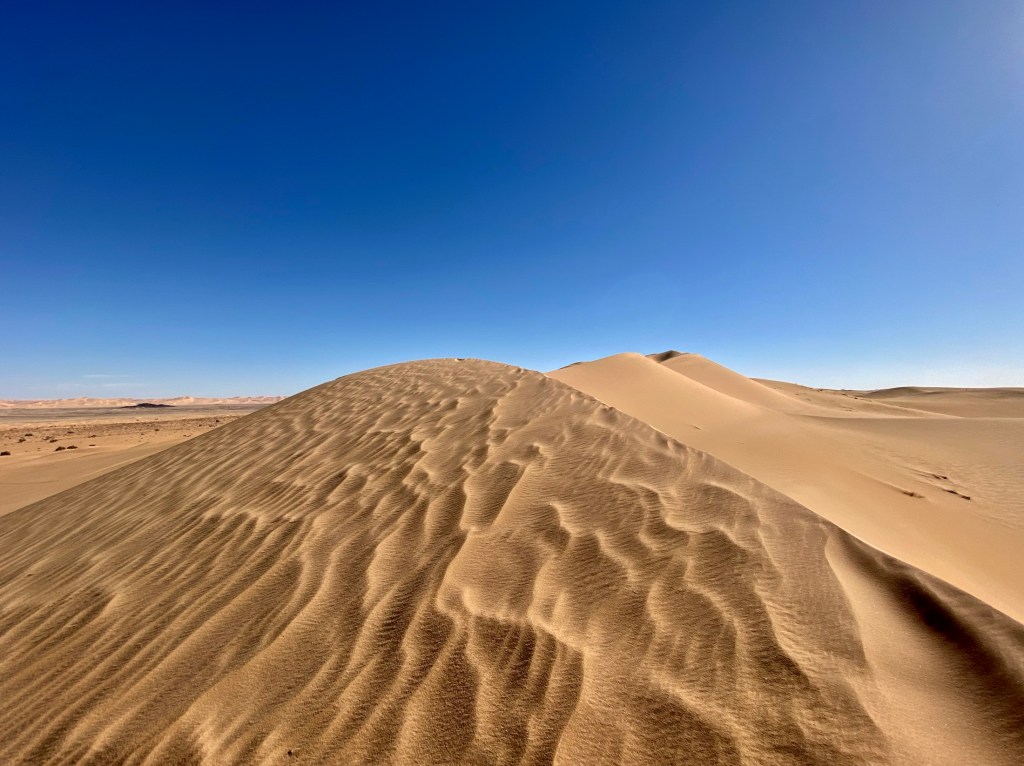
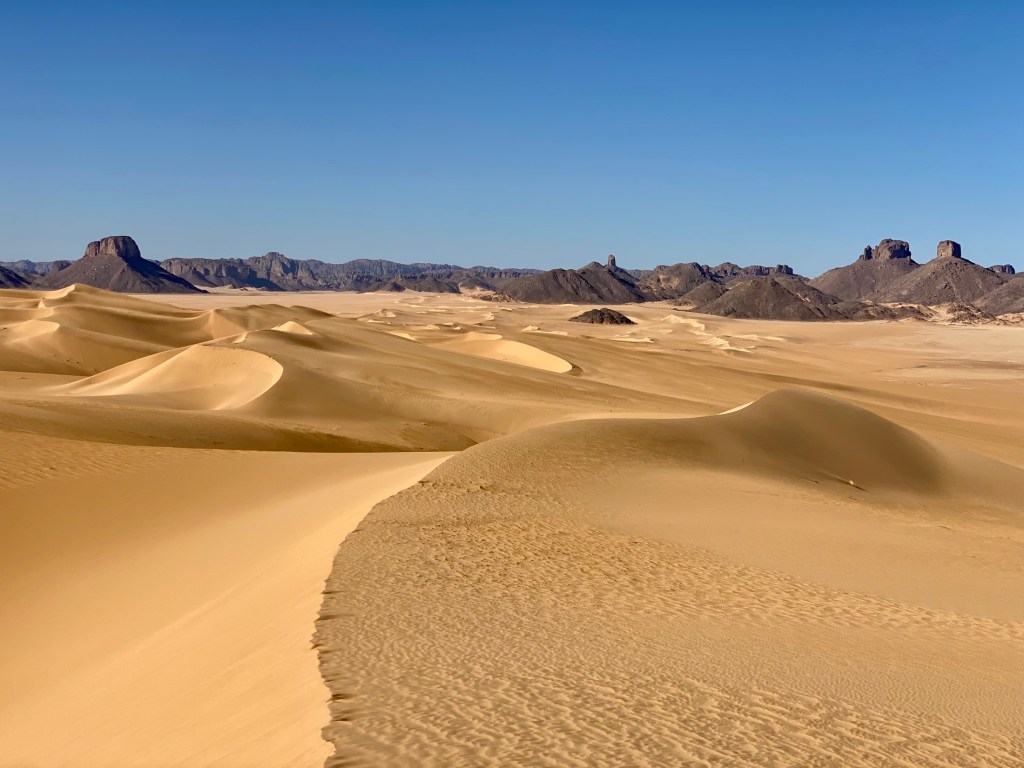
The “regular” dunes, too, simply spectacular.

They go on forever and ever. And when I say forever I mean it. All the way to the horizon and over the border to Lybia and Niger.

So far only car tracks, how long before the annoying quad bike excursions show up?

The view from the top would take your breath away if you were not already all out of breath making your way up the steep slippery slope.

Before taking the grave risk of going down the slippery slope some people take a little rest

And some take a little fly

and others opt for a little hug

The power of wind is evident in the sand dunes driven high up the sturdy rocks.

The yin and yang of such sand and rock interactions is the unique attraction of the Algerian Sahara.

But more on that in the next installment on The Stone Forrests of Sahara.

Algerian Sahara

Part I Rocking the Prehistoric Rock Art

Before “Bucket List” was a thing I put Algerian Tassili on my travel bucket list. I remember it well. I was still a teen when I cracked open my first thick Art History Book and immediately felt a visceral connection to prehistoric art. The effortless calligraphic arc of a wild animal’s back carved or painted on a cave wall was drawing me in with a strange force.

Some years later I fell in love with a man who also loved art and prehistoric art, to boot. And travel. How extraordinarily coincidental and auspicious for our future of sharing life and exploring the globe for forty years and counting.

We have chased prehistoric art in many places from well known caves in France and Spain to obscure places in Norway,

Reindeer etchings in Alta, Norway 2022

Namibia, and Indonesia.

The oldest rock paintings in the world: over 38.000 years old on Sulawesi, Indonesia 2015

But one site remained elusive: Tassili n’Ajjer National park in Algeria.

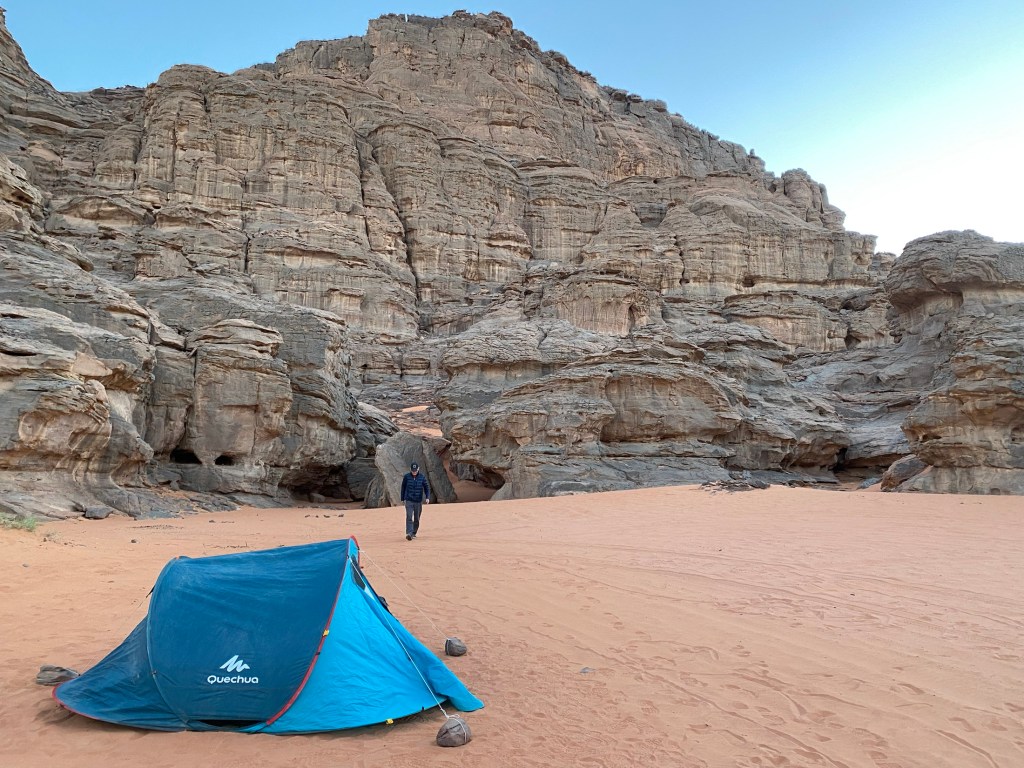
Desert dunes and rocks hiding prehistoric art treasures

Algerian Civil war and threat of terrorism kept the doors firmly closed. Until it suddenly opened a crack in the spring of 2024 and we slipped in. With some trepidation and much gleeful anticipation… After such a long wait it was better and more than we had ever dreamed and hoped for.

It was also quite effortless for the extremely lucky introduction to the tourist guide and organizer extraordinaire Youssef, a Touareg man of exceptional charm, education, and ability.

Youssef is a young mechanical engineering professor with a PhD who speaks five languages fluently. Every question, every email and WhatsApp was answered with immediate precision and welcoming grace and soon a detailed plan was in place for a 15-day visit. The majority was spent in his beloved Sahara surrounding his hometown of Djanet, the rest up North on the antiquity-studded coast.

Taking into account the weather, his teaching schedule, and our family obligations we had to settle on March, not the perfect timing due to the start of Ramadan and the arrival of the first desert storms. We were determined to make it work worried that the door might slam shut again at a moment’s notice.

At the very last moment, we were faced with a Lufthansa worker’s strike and scrambled to rearrange overnight flights so we could make an early morning connection from the capital of Algiers to Djanet. Only when we spied the towering figure of Youssef in his striking blue traditional Tuareg clothes we truly believed it was happening, breathing a huge sigh of relief. From that moment on everything was smooth sailing and what a fantastic ride, indeed!

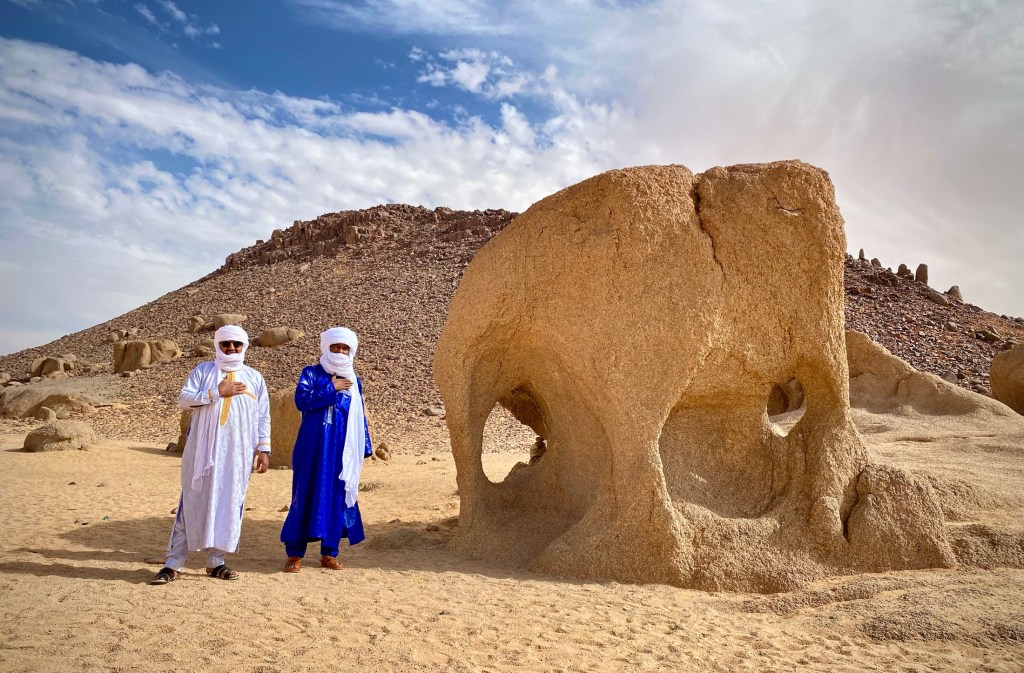
Muhammad and Youssef in front of the sand elephant carved by the desert winds

And how could it not be with a fabulous team making it happen.

Little Abbas, Muhammed, pick up driver, Bubba, the cook, Abbas, SUV driver, Youssef and us two

It was pretty much a family affair with our driver Abbas, Youssef’s older brother, and Muhamad, his cousin. Their regular cook was spending holidays with his family so Bubba stepped in. In his regular life he was a rock guitarist and every evening he brought out his guitar and jammed around the campfire.

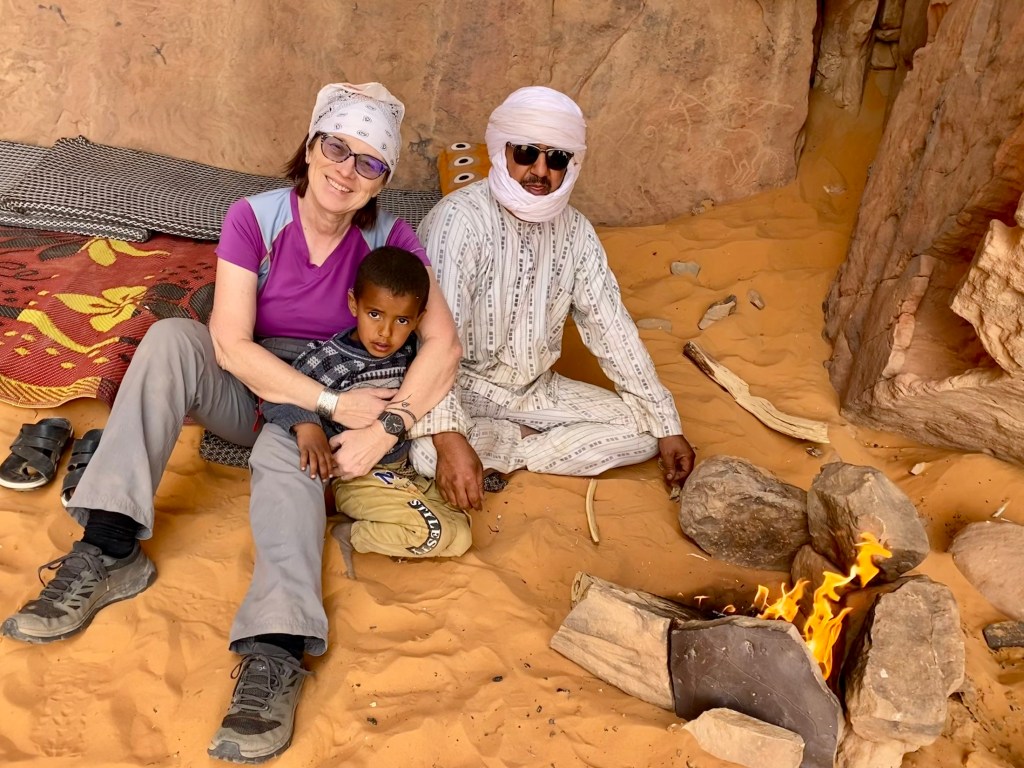
Our first of two desert camping trips was livened up by Muhhamad’s 4-year-old son Abbas.

If I had any misgivings about such a little boy coming along they quickly turned into a unique opportunity to observe intriguing cultural aspects of Tuareg parenting. The little boy had not a single toy with him yet he played and explored on his own all day long. He never whined or cried once.

We made it clear that our main interest was seeing as many prehistoric art sites as possible and Yousef delivered. Right from the start he made our jaws drop

Our first encounter: La Vache Qui Pleure – Crying Cows engravings

and to our credit we never tired of scrambling over rocks or squeezing into canyons to see the treasures he led us to.

Can you see the tiny painted cows and even tinier people?

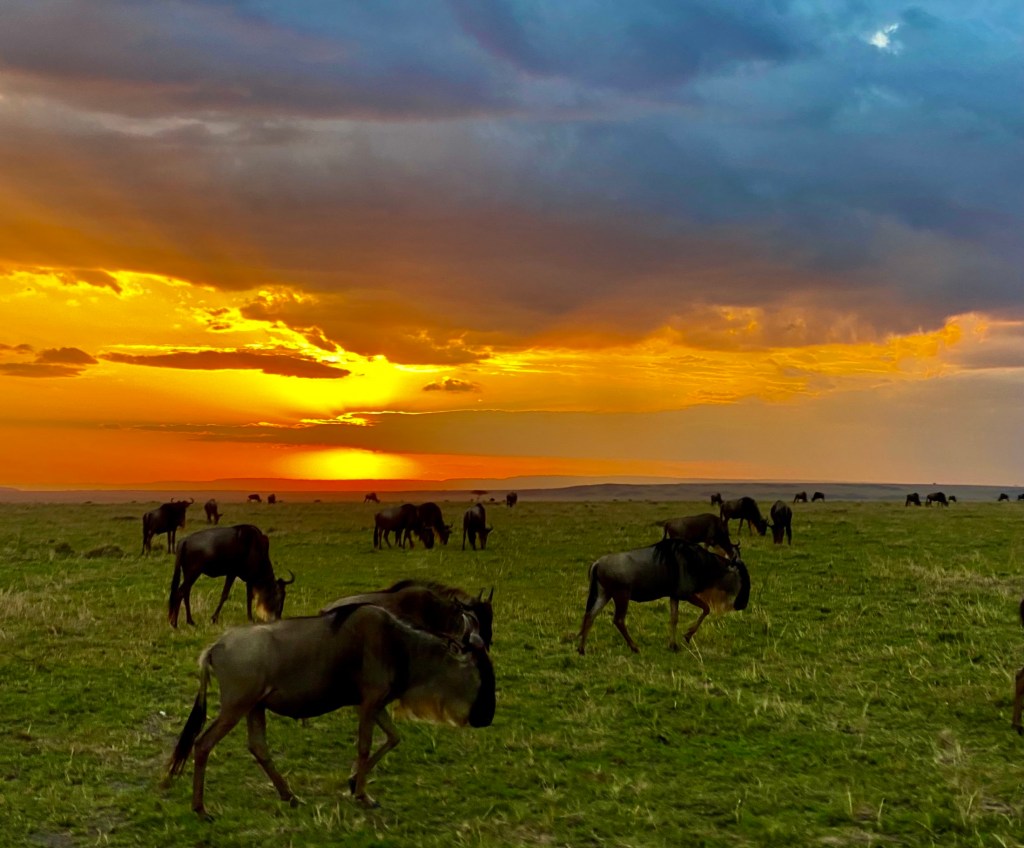
You see in prehistoric times Sahara used to be a lovely savanna with many animals cavorting in green fields. It is officially named the “greening” of the Sahara. It is thought to have been driven by changes in Earth’s orbital conditions, specifically Earth’s orbital precession. (yeah, I have no clue what does it mean, I just copied it from Google.)

Probably looked just like Masai Mara in Kenya on our trip in 2021

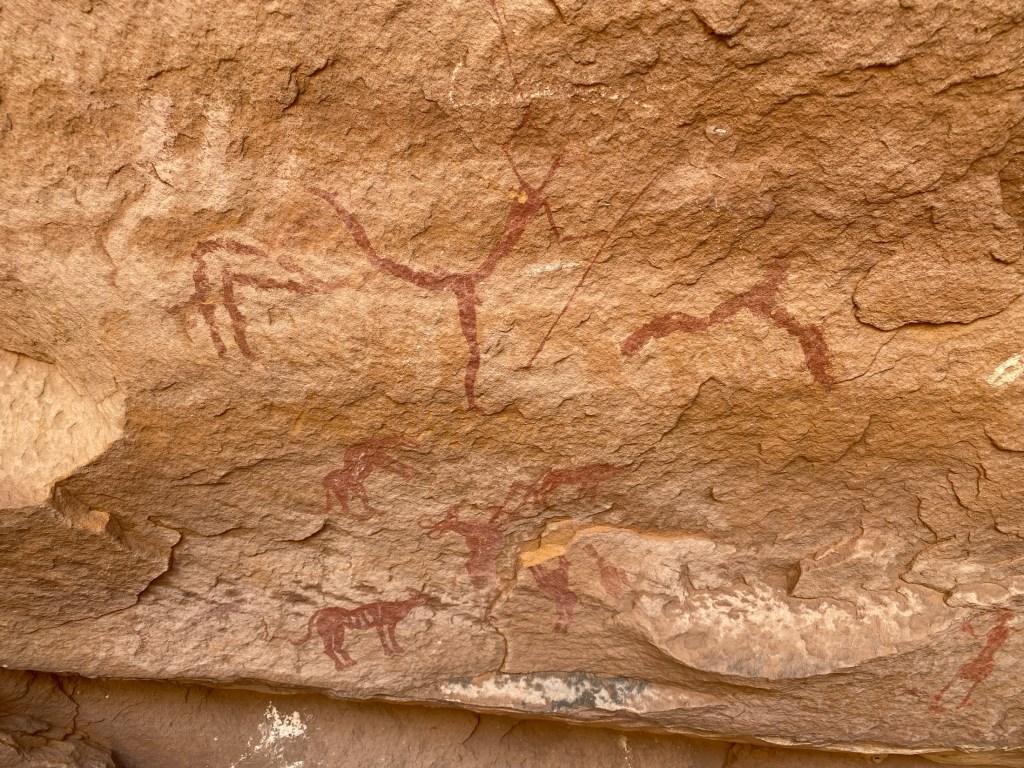
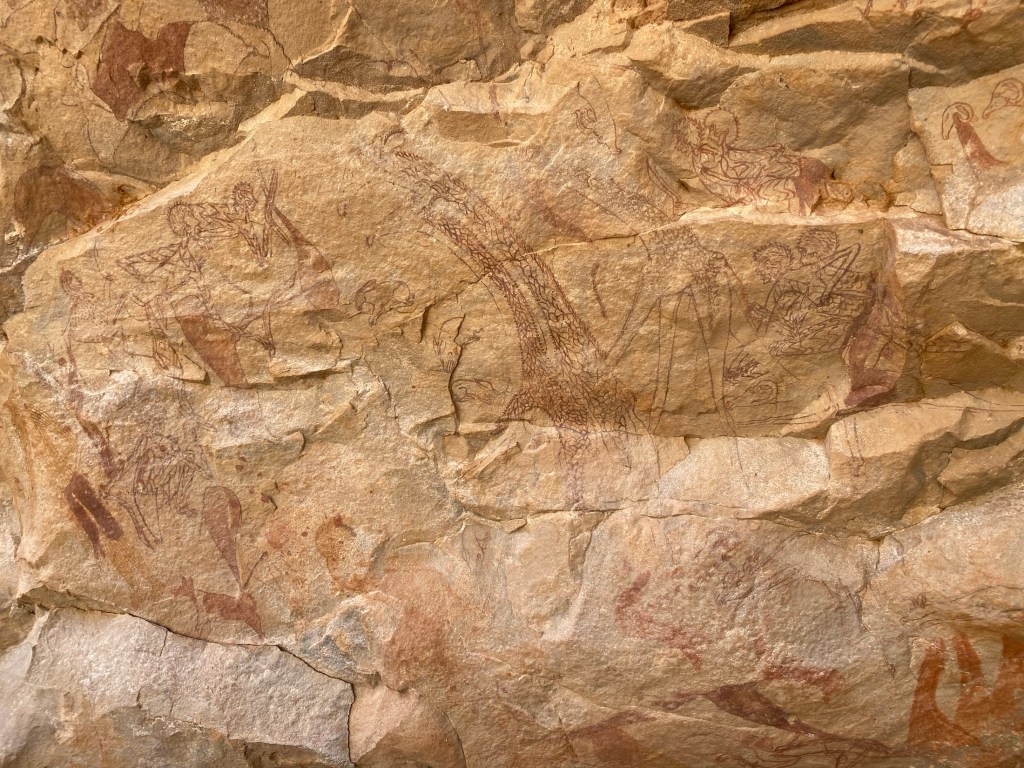
Some paintings are very well preserved, but others can be faded or layered over older paintings and images all jumbled up. The longer one looks the more details one discovers. Though at some point every red smudge on a rock’s face starts to look like a possible animal depiction.

Smiling giraffe painting
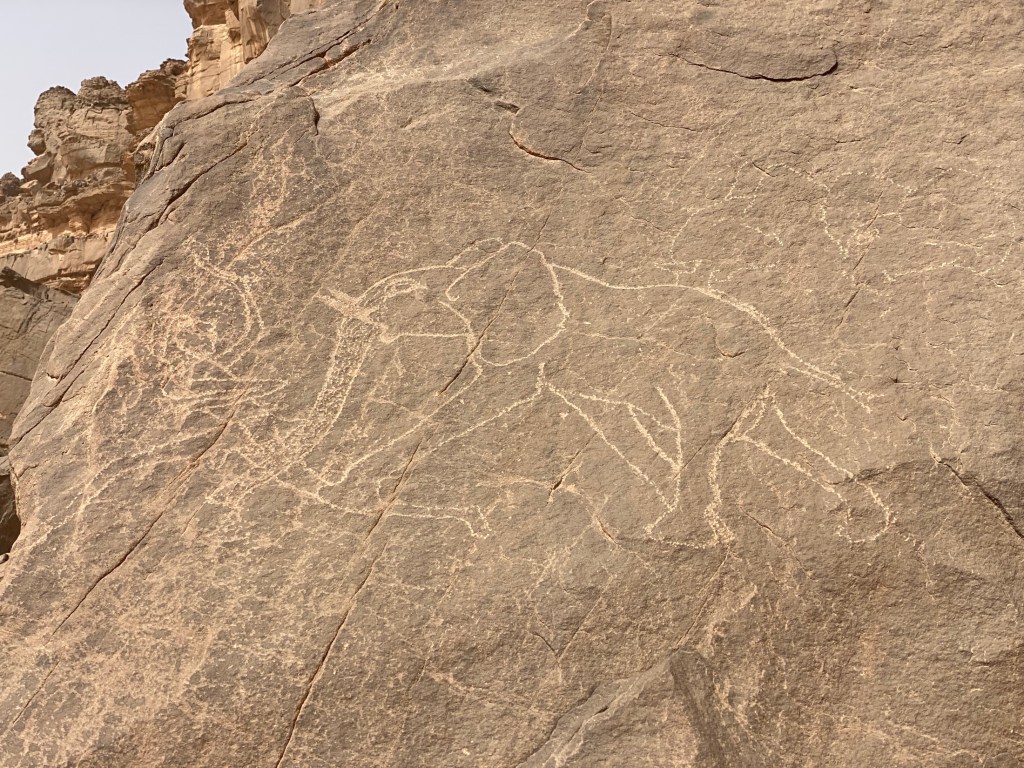
Rhino etching
Carving of lion’s footprint. Do you think there is a skinny elephant bellow?

Bands of men hunted wild animals through the ages and depicted themselves in tricolor of reds, whites, and ochers on the walls of their natural surroundings. Some pictures were very schematic but graceful nonetheless

and some incredibly realistic and detailed

Hunters clad in animal skins stalk giraffes. Can you see the boomerangs they are holding? Can you spot a little dog and three hares?

And some even humoristic.

Elephant stepping on a leg of a hunter with a club in his hand.

Knowing our interest in all things historic we were taken to any local (often very dusty) museum. Despite Ramadan, they magically opened their door just for us. We were treated as VIP guests and to our shock and delight invited to handle 10,000+ years old stone implements.

Couldn’t hide the thrill when the director passed the stone spear tip onto me

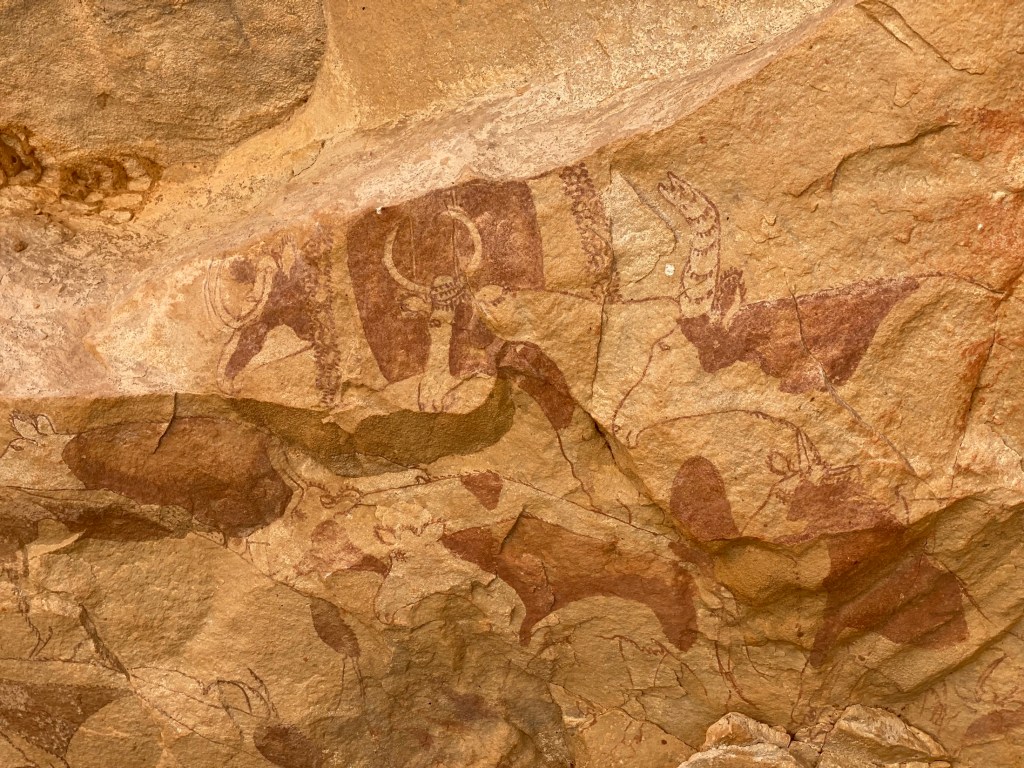
That is also the probable age of domestication of cattle in Africa, again beautifully depicted on the stone walls.

Delicate, very artistic painting of a herd of whimsically decorated cows

People turn from hunter gatherers to nomadic pastoralists with movable camps.

A simple, but sweet depiction of a woman reclining in front of her hut. The rich red color is called carmine, paint is made from crushed stone mixed with cow’s blood.
This intricately carved bovine is part of a large stone platform in Dider Valley with numerous etchings of animals and people. Possibly a site of Neolithic worship for the many magical spirals?

The long horn piebald (= multicolor) cattle are reminiscent of the cattle in Kenya or South Sudan with typical big curved horns. Some were possibly shaped by their owners like the remote Dinka tribes do till today in South Sudan.

Two herders with long sticks and water gourds. One is painted white and decorated with red dots.

Looking at the painting of these two herders I can’t help but think of the Mbororo or Wodaabe nomads gathering at the Gerowol courtship festival in Chad. They have the same white feathers on top of their heads and highly decorated faces and bodies.

We were lucky to visit Omo River tribes in South Ethiopia

Dasanech tribe, Omo Valley, Ethiopia 2013

and they still live the three dimensional colorful reality of the prehistoric life depicted in Algerian Sahara art sites.

Animals skins and beads clad Karo tribe people in Omo Valley Ethiopia 2013

It is interesting to see the appearance of goats, sheep, as well as domesticated dogs.

Herd of white goats. Can you see the little white dog on the left and a red person holding an arrow?

Goats are still a staple diet of the contemporary Tuareg people, the descendants of the original population of Sahara. And our main diet on this trip, too.

Carving of the large crispy goat

Later on, horses emerge and even later with the trans-Saharan trade camels make an introduction though theirs are far cruder renderings.

All in all, there have been 15,000 engravings and paintings identified to date (and more are still being discovered). Despite our best efforts, we were able to see only a teeny-tiny fraction. French archeologist Henri Lhote is credited with describing and popularizing the sites with the help of artists who copied the art onto large canvases in-situ. The exhibitions made quite a stir in France in late 1950s.

While famous European prehistoric paintings at Lascaux and Altamira caves are now closed to the public and one can only see some reproductions nearby, here you have the unique privilege of standing face to face with small and large masterpieces alike.

A short scramble up into a cave
full of small and oversized human figures. Love the lady with the bun!

No lines, no timed ticket sales no nothing but Saharan sand, sun, and wind for company. Of course none of that would be at all possible without the local people’s intimate knowledge of each site and ways to get to them without a map, GPS, or road.

While “hunting” for art was an important and fun activity we often forgot all about it whilst ever-changing phantasmagoric landscapes appeared out of nowhere.

Rocks or all shapes and colors amongst the vast desert sands were the big unexpected surprise

More on that in the next installment.