Algerian Sahara III

Stone Forrests and Rock Sculptures

It must be the privilege and ailment of old age to keep dredging up memories from times long gone and here I go again:

When I was just a slip of a girl at 16 I stepped off the cross country bus for a quick break and stood at the edge of a precipice. I could not fathom it was portending my future but I was acutely aware I was forever spellbound to live my life seeking moments of awe such as that: gazing upon the Grand Canyon, the Mother of all canyons, the grandest chasm of the world. In my wildest dreams, I couldn’t imagine that one day for a time I would live in Arizona with my young family and forevermore travel the world in search of natural and man-made treasures.

Nowhere else has the interplay of nature and human creation formed a more perfect union than in the Algerian Sahara.

I have painted a rich and adoring picture of the impressive prehistoric art in a previous blog and sang praises to stupendous sand dunes, too. Now permit me to chisel out an image of rock and stone forming sensational geological formations.

Woefully lacking any working knowledge of geology I can but playfully share some impressions of ergs, regs, and wadis.

And what can be more playful than naming rock formations.

Some are well-known and easily recognizable such as

The Elephant
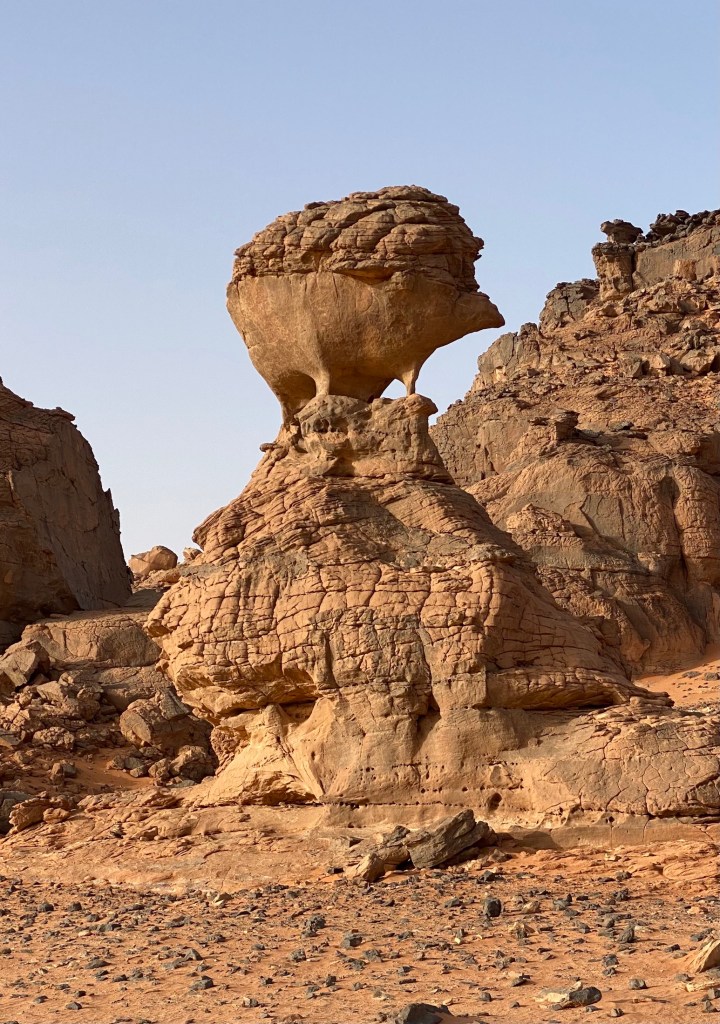
The Hedgehog

and for soccer fans

The World Cup Throphy

Soon, to the amusement of our Tuareg companions, we were seeing (and naming), rock shapes everywhere.

A number of E.T.s, unknown extraterrestrials to our Algerian friends, greeted us throughout our journey.

Peek-A-Boo
Dental work?

More animals popped up their shapely heads.

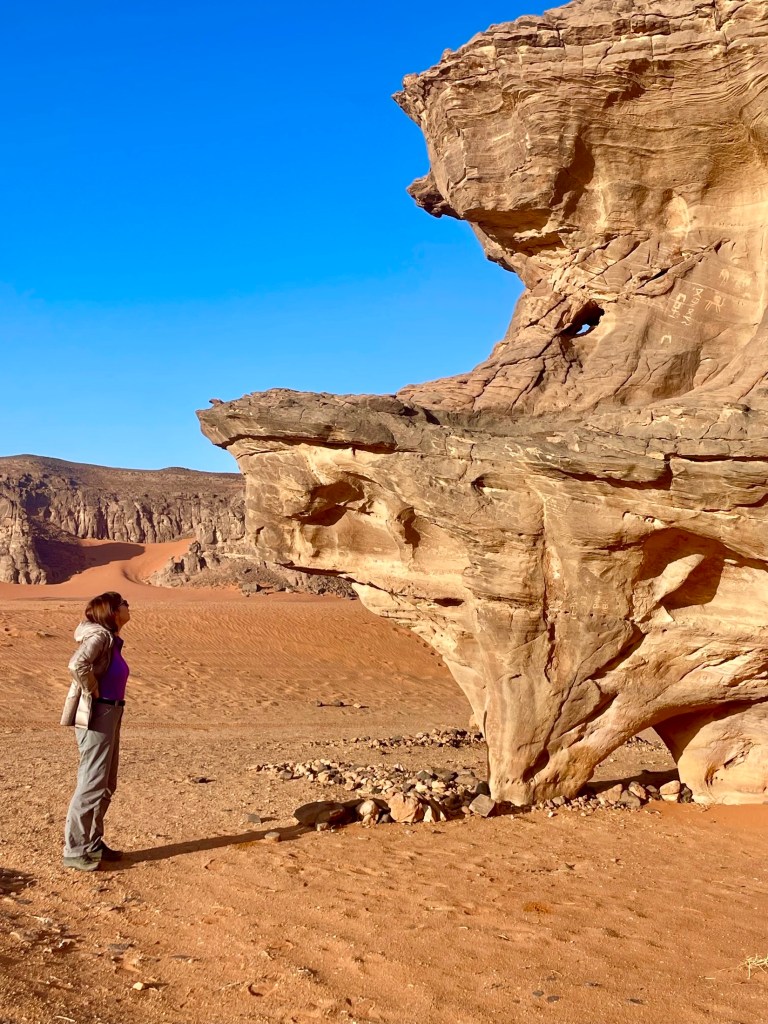
Camel head
Princess and the Dragon

When I see a pyramid I of course can’t help but think of Egyptian pyramids.

The Pyramid with Elephant Etchings

So just for a little numbers fun the Egyptian pyramids were built between about roughly 2700 B.C. and 1500 B.C. This makes the earliest pyramids about the same age as Stonehenge, which was initially built between 4,000 to 5,000 years ago. But the large animal engravings on this nature-made pyramid block of rock are much older than that. These may date back to 12,000 years or more.

The little people that created the big art. Some look like dancing and some worshiping.

But how old is the rock and Sahara itself? New research looking into dust (paleosols made of very fine-grained minerals rich in quartz and mica) that the Sahara blew over to the Canary Islands is providing the first direct evidence that the age of the desert matches that found in deep-sea sediments: at least 4.6 million years old.

Scientists are amazing! They also study fosilized flora by taking samples of plants from the rocks to better understand the Greening of Sahara. Around 8,000 years ago, the Sahara wasn’t desert, but instead was a vibrant ecosystem that supported hunter-gatherers and fisherfolk. The ‘Green Sahara’ – the colloquial term for the African Humid Period – was the period in which North Africa became much wetter so animals (and even fish) and people thrived.

Fosilized flora in a desert rock

Alas, it didn’t last forever. Around 5,500 years ago, the ecosystem in the Sahara went into a terminal decline towards the desert we have today.

Erosion is a mighty power and has formed a large number of impressive tall arches.

The Cathedral
Mirek under the Big Arch
Ksenija under a Little Arch
Youssef on top of a Bridge Arch

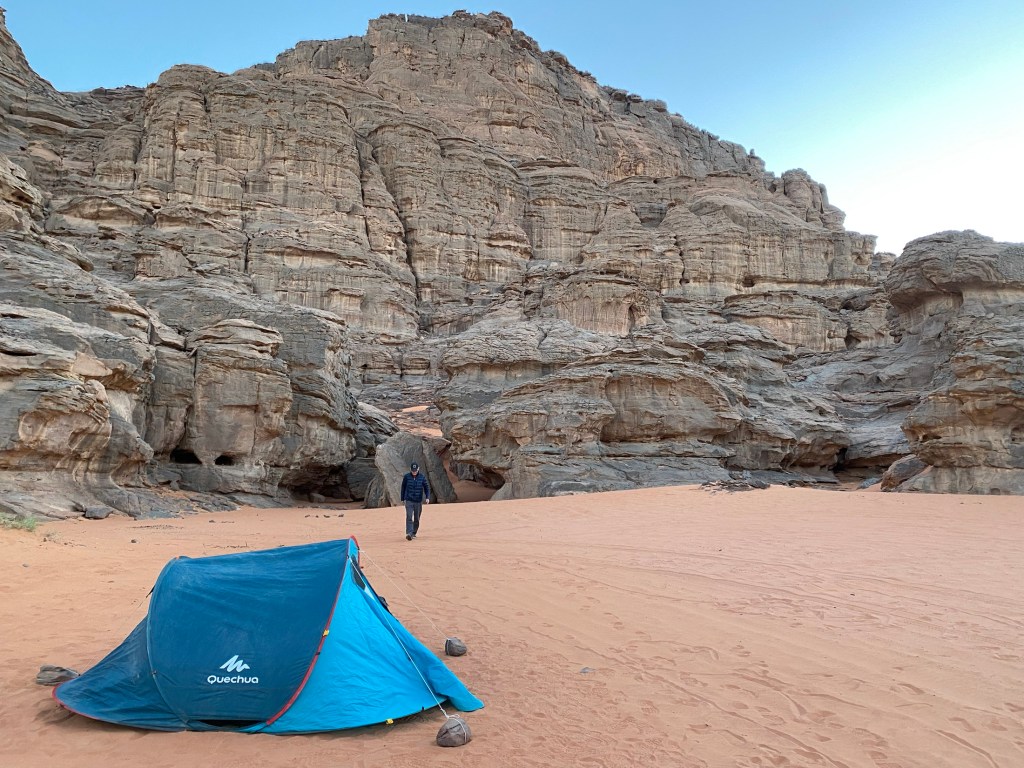
Throughout our camping trip various arches provided marvelous shelter for us. Undoubtedly they must be a an integral lifesaver in the hotter months of the year. Our lunch breaks and overnight camps were always set up in the protective proximity of rocks.
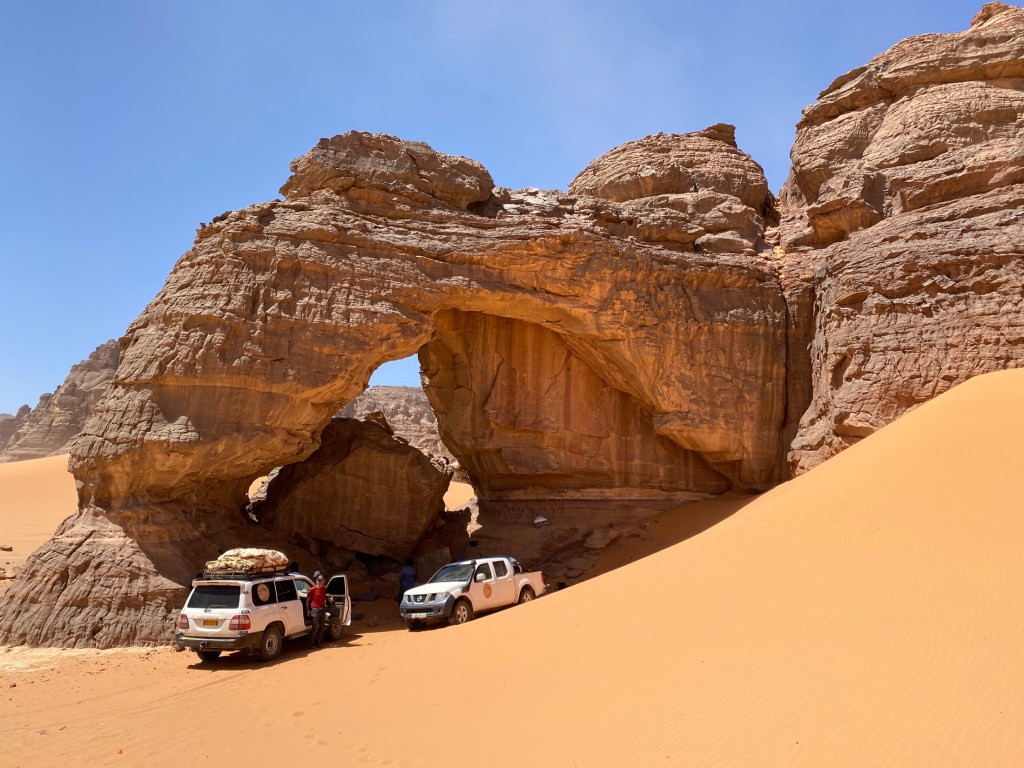
Cosy fit under the arch

The most attractive and exciting was the rock formation that surprisingly had no name. So we named it The Eye of Bouhadienne for the geographic area.

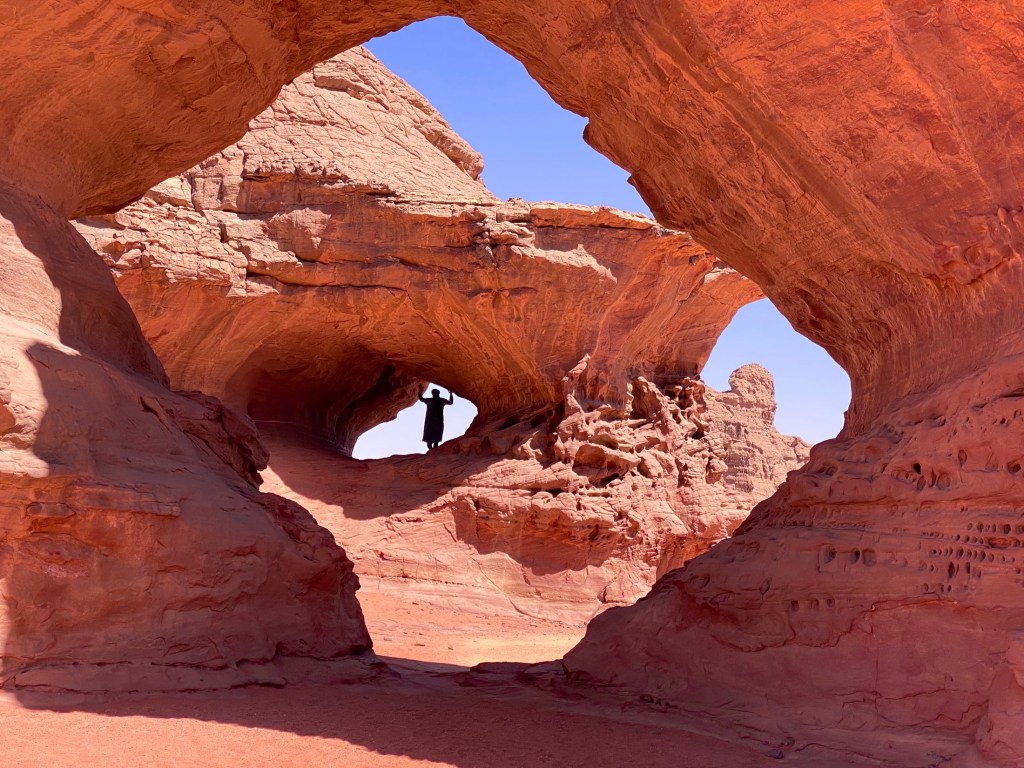
We only peeked into a few canyons, but gaping at tall walls and walking on the dry beds of long-gone rivers was pretty darn cool.
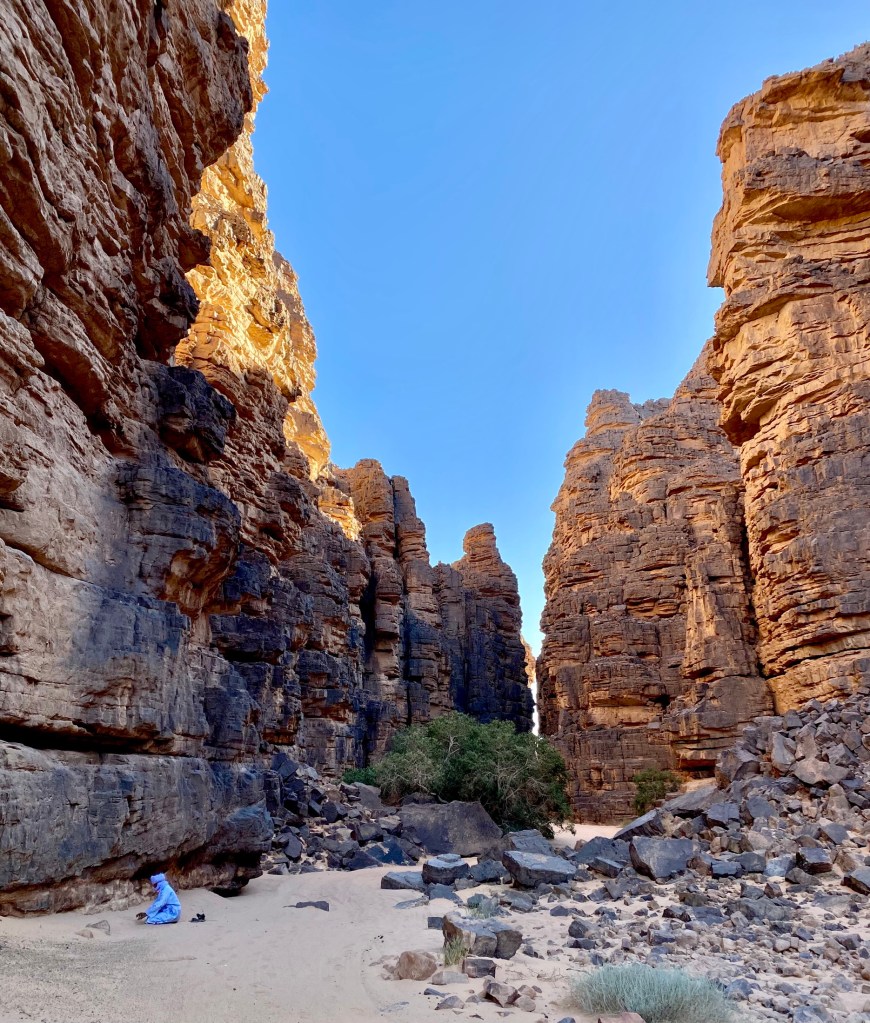
Prayer

We were surprised to find out that there is quite a lot of water in the desert. Researchers from the British Geological Survey and University College London have been able to carry out a continent-wide analysis of the plentiful ancient water reserves hidden under the surface in aquifers.

“Our” trusty “researchers” led us to water above ground, too. Like a mirage water appeared in a narrow canyon. One can clearly see the long process of powerful water patiently carving down down through the rocks.

Gultae of Agzel (=Kidney Lake)

This was but a small guelta, a pocket of water that forms in drainage canals or wadis (river valleys) of Sahara.

A much bigger supply of water was found around the little tumble down town of Iherir in a wadi named Oued Iherir near the center of the Tassili n’Ajjer mountain range. Big date plantations grew along the river. We could replenish our dwindling date supplies, an important staple as our guys broke the Ramadan fast every night with a handful of dried dates and milk.

Me and my shadow

We followed the river into the rocky hills of the plateau just for a little while. It gave us a taste of the week-long hike that is achieved with the help of donkeys up to another area rich with prehistoric art. I am already planning the next trip!

Dear Youssef played an extra role, besides a well-informed guide, he was also a willing photo model.

The Prince of Dunes gazing upon his Martian kingdom

In the ever-changing landscape, so many of the places indeed gave off a totally otherworldly vibe.
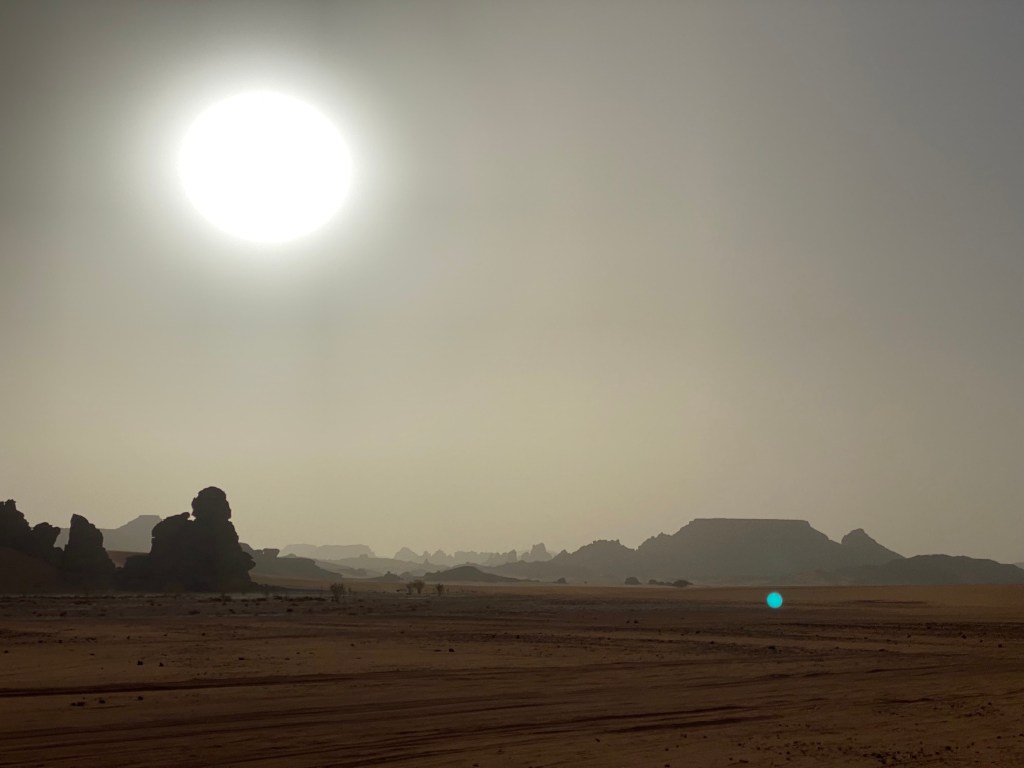
We drove into the areas of stone forests as far as the eye could see,

and then on to stone cities where curious toppled temples dreamt of old, long-forgotten (imaginary) civilizations.
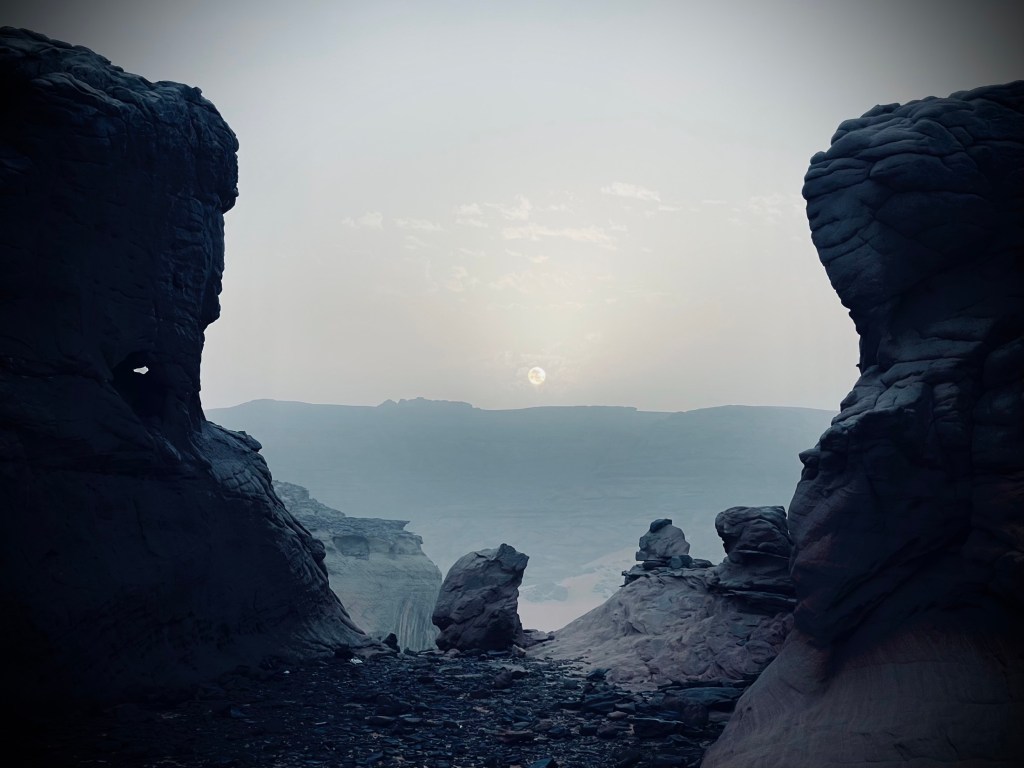
When we emerged again into the warm sunny desert
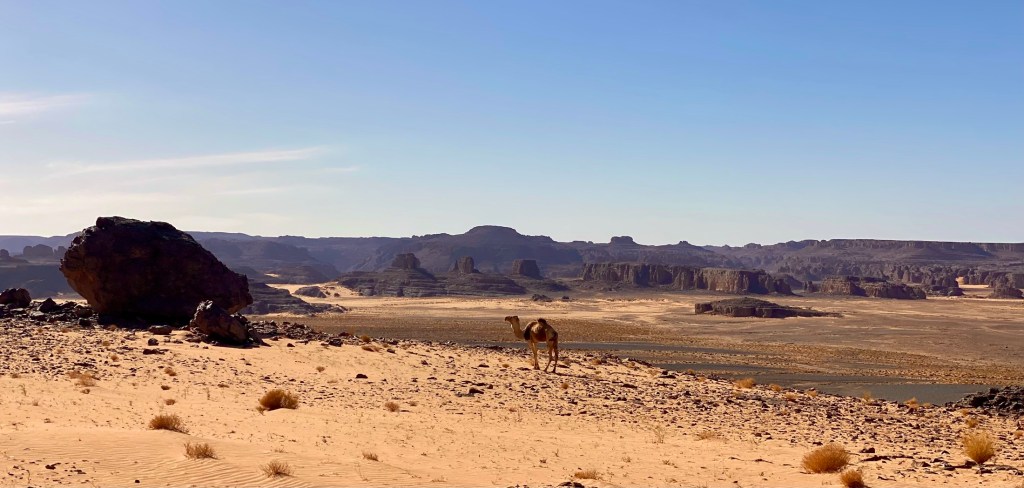
A lone camel looking for nourishment

we reveled in the interplay of rocks and sand dunes and long shadows.
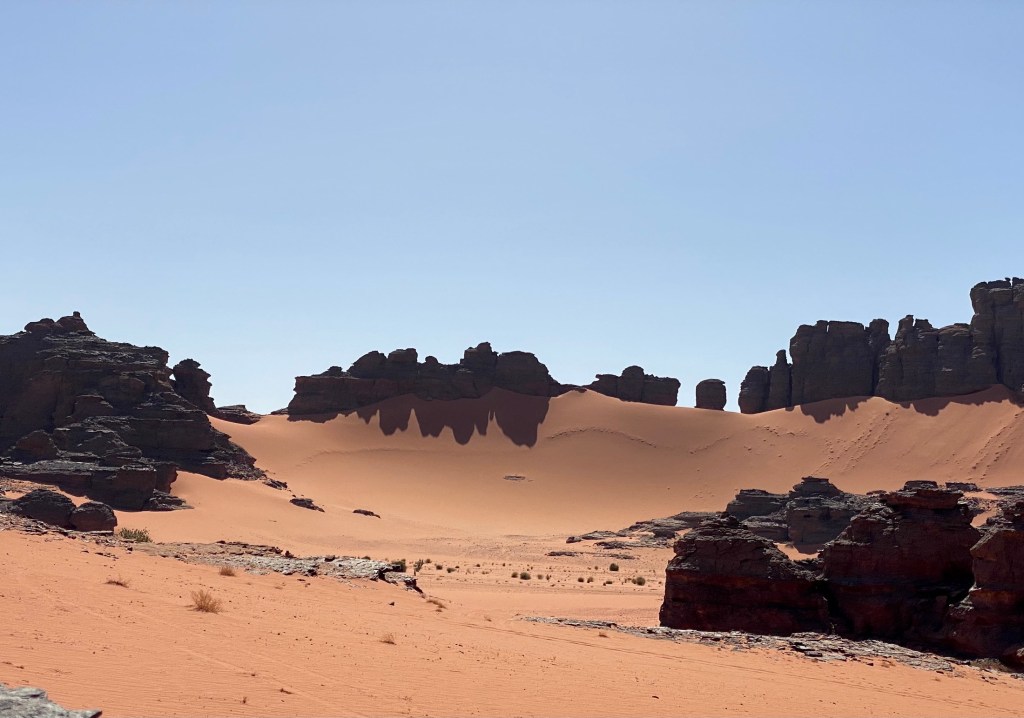
As we pressed, on like Fata Morgana, a caravan appeared before our eyes.

More on that in the next installment: The Tuareg: The Sons and Daughters of Sahara.

Algerian Sahara II

Part II D(r)iving into Sand Seas

Since the time we first met some forty years ago on the edge of the desert of Ancient Mesopotamia, we traveled and even lived in diverse deserts around the world. In a car without AC, we crisscrossed the desert in Iraq searching for the ancient cities of Ur, Uruk, Ninive, Babylon.

My first camel ride in Iraq, 1983. Yeah, I haven’t changed a bit. 😉

We started our family in the Arizona desert studded with white saguaro cacti blooms. We drank tea in the desert of Jordan on the way to Petra, got sore riding camels in Morroco, climbed the dunes of Namib, and drove in arid Australia. More driving in the Atacama and Patagonia deserts. We stepped on land in Antarctica; did you know it is considered desert, in fact the largest in the world?

To tell the truth I am not and never was particularly fond of deserts. (Now desserts, those I am very much fond of! That’s how I remember how to spell them correctly, with double “s” as I always want seconds.)

Algerian desserts

So, really, I was not expecting that much from our Algerian Sahara desert encounter. We were here for the prehistoric rock art after all. And then right at the start to paraphrase Nat King Cole’s famous song:

🎶…

We were driving along, minding our business, (drinking in sunshine)
When out of an orange, (well blue), colored sky
FLASH, BAM, ALAKAZAM
Wonderful desert flew by,

… 🎶

And Sahara love hit us in the eye and like any person madly in love we are now shouting it from the rooftops and writing it on walls (of social media).

The Algerian Sahara is the most beautiful desert in the world! It is incredible, otherworldly, ever-changing, multi-faceted, dramatic yet tranquil, fascinating, colorful, and overseen by a deep black velvet sky studded with a myriad of stars. There is nothing like stumbling out of your tent in the middle of the night to pee and looking up straight into the vortex of Milky Way.

Ladies to the right, gents to the left…don’t forget the toilet paper roll!

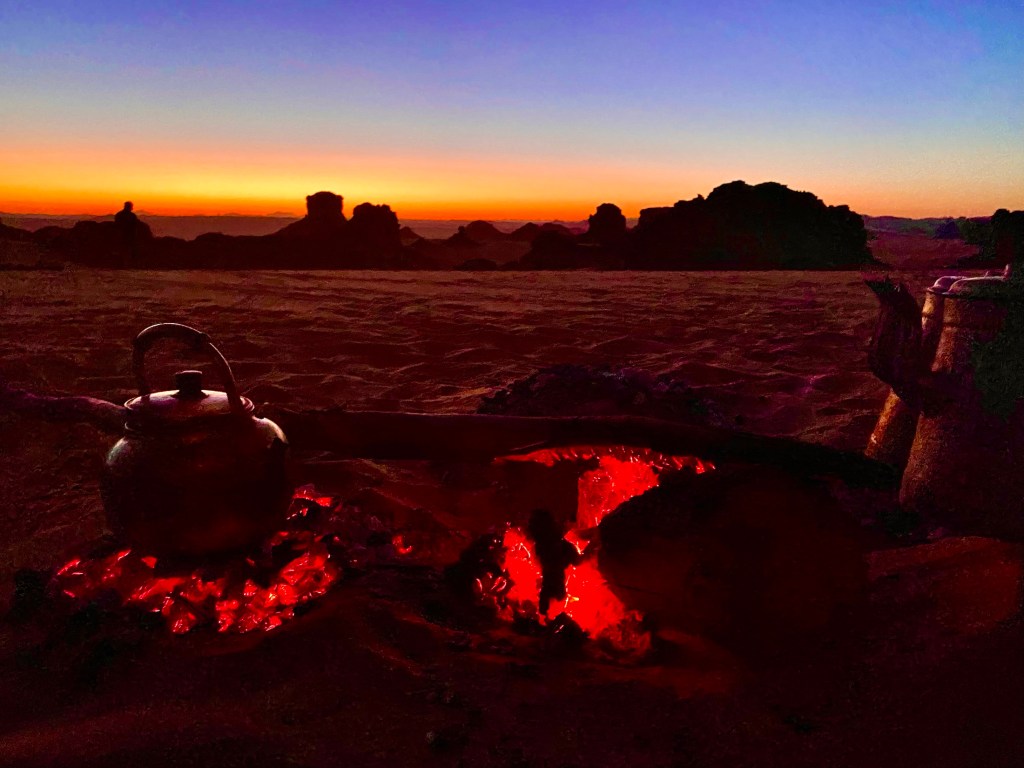
You can’t see the stars in the camp in the evening because there is always a fire burning long into the night

with your Tuareg companions drinking countless tiny cups of strong sweet tea strumming a guitar or chatting. And chatting. Man, those guys can talk. I would love, love to know what about.

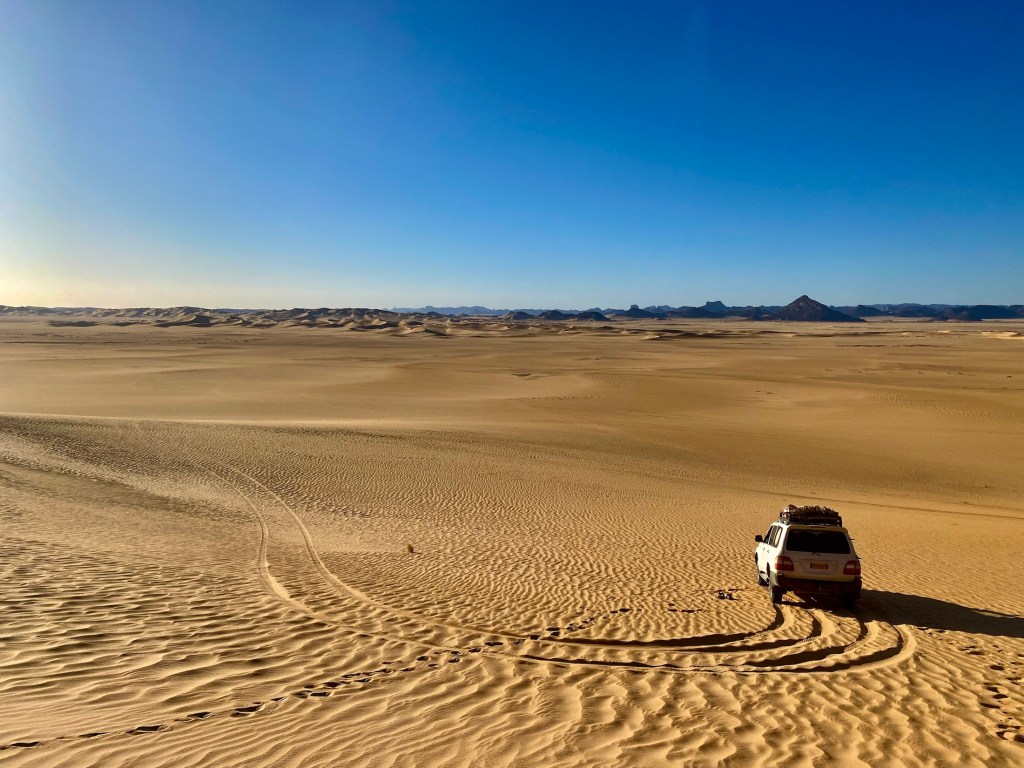
What is so extraordinary about the Algerian Sahara is the constant surprises, new vistas, color hues, and changing rock formations. Do not nod off even for a moment in the car or you will miss something magnificent.

The rocks delineate the place of worship with direction to Mecca where our guys enter to pray

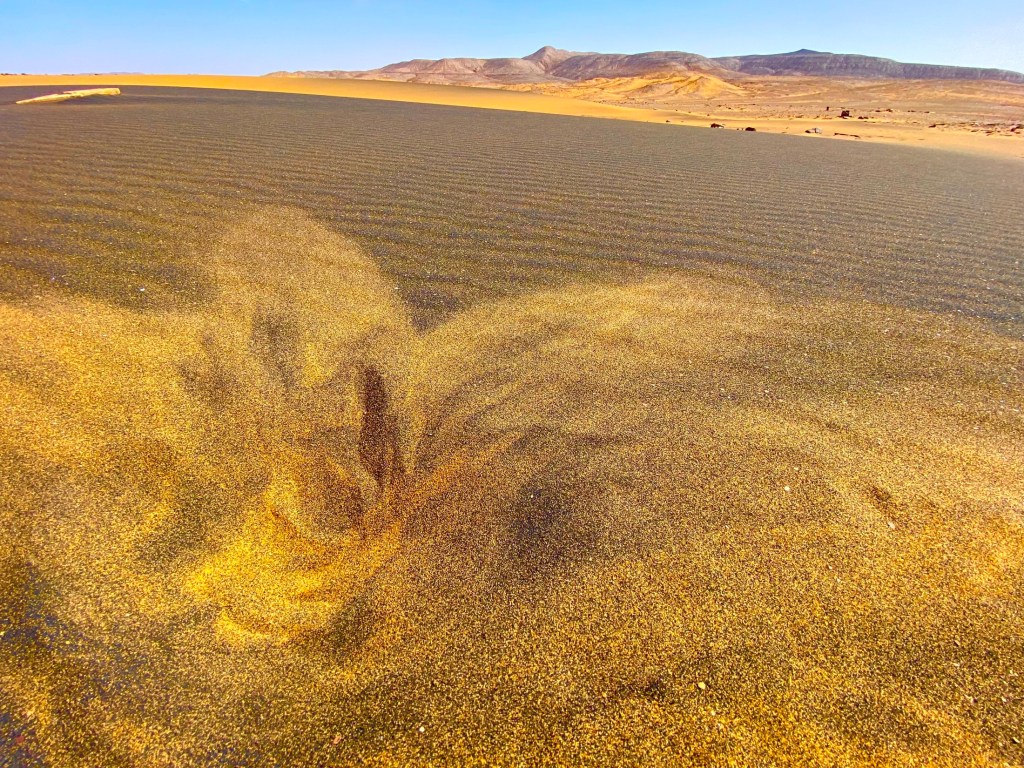
Alas, my poor little iPhone is not capable of capturing the vibrant true colors of this desert. And my editing skills don’t suffice. If anything, they make it look worse. Especially this unique yellow and black desert area called Adjalati just past the entrance to the renowned Tardart Rouge=Red Mountain.

A thin layer of fine black volcanic sand creates a fantastic effect and brings out the yellow.

Digging in. Can you glimpse the tiny conical shapes of old 🌋 on the horizon?

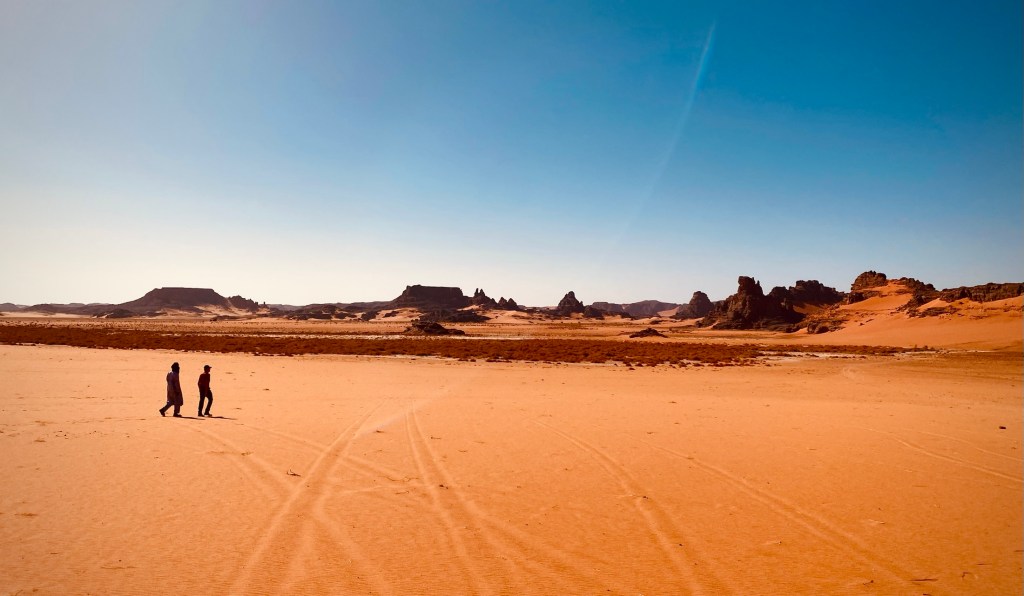
For the first and certainly not the last time we are numbstruck by the immensity of this place, the grandeur, and the extraordinary privilege of having it all to ourselves. Somehow, far from making us feel small and insignificant, or scared and alone, it makes us feel welcome. Like these vistas were waiting just for us to be admired and extolled, like we are a perfectly fitting piece of Nature’s puzzle.

Can you detect a tiny figure of Mirek?

Not to be outdone the red desert warmly embraces us, too.

And when I say warmly I also mean with perfect temperatures. Sahara might be mighty hot in the summer months but right now the temperatures are perfect. In a place known for extremes on both ends, we rarely break a sweat during the day, and only a few middle of the nights could be considered nippy.

Morning walk
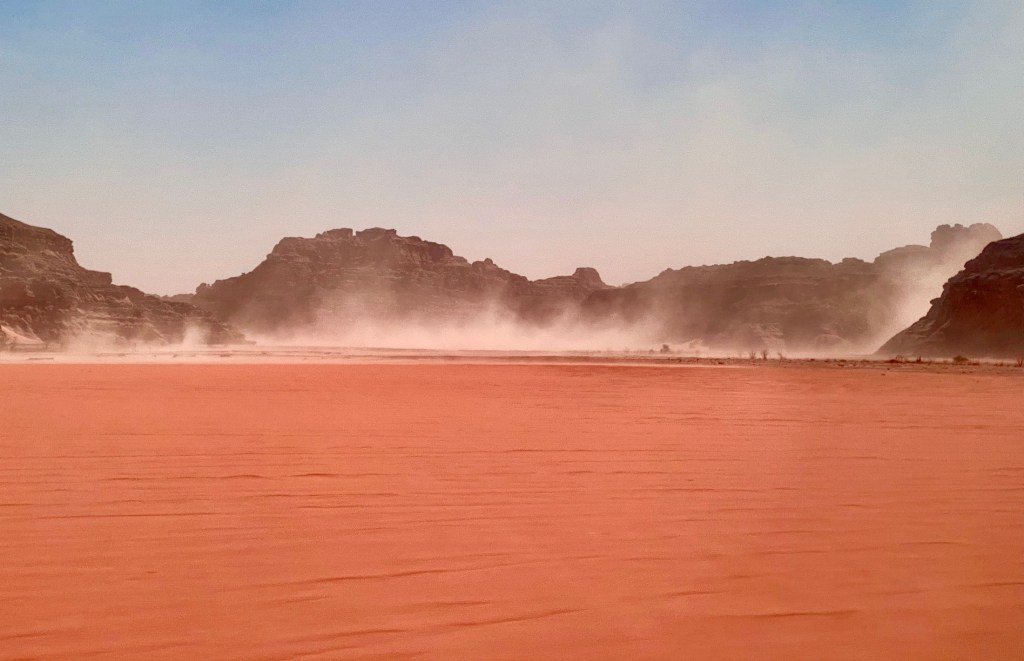
1st sandstorm of the season

We only have one day when the weather is not optimal as Sahara wind brings the first inkling of the sand storms.

Makes it a bit more difficult to lunch and a new understanding of the desert men’s very practical head and face coverings

The details are worthy of attention, too. The patterns on the sand are poetry written with a calligraphic brush of the wind.

Another task for you: can you trace the bird tracks?

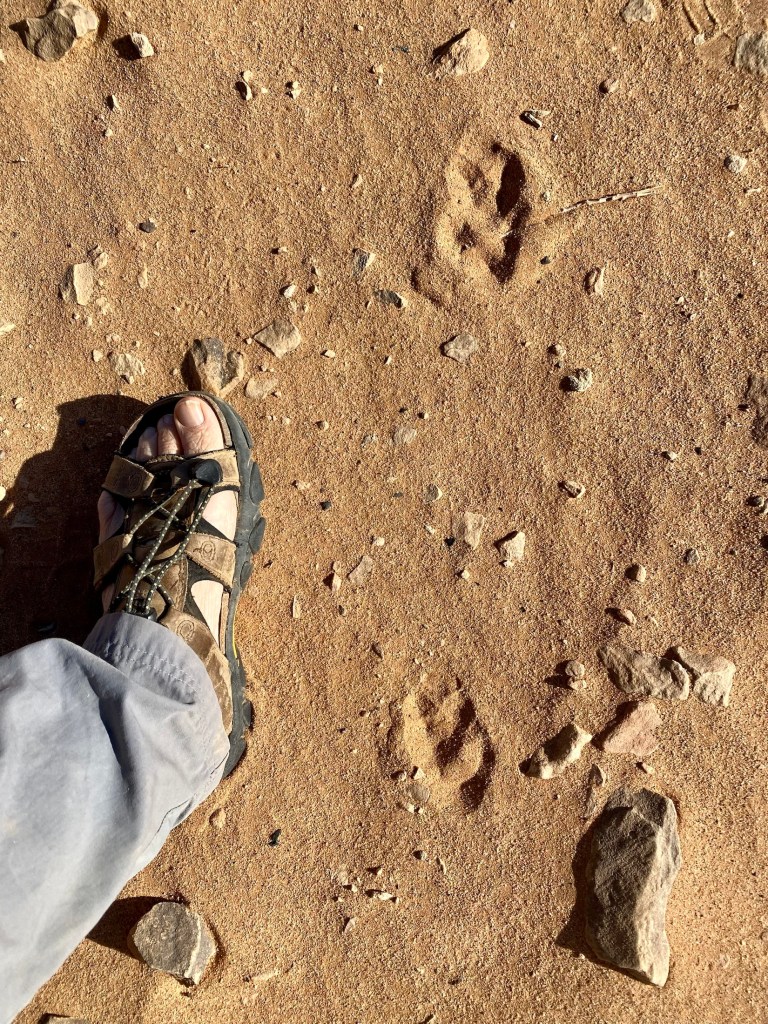
There is plenty of life in the desert still. While the megafauna has long ago moved out with desertification, the last lions were only shot in the 1920s. We still encountered half wild camels and one totally wild ass loudly protesting our presence. Coyotes are hanging around hoping for some tasty scraps. One night there was a commotion: our valiant cook Bubba sleeping out in the open single handedly managed to defend his supplies (especially dried goat) from two stealthy thiefs. We find plenty of fresh tracks in between our tents in the morning.

Birds are luckier, the baguettes that are getting staler by the minute and the day are generously shared.

Small acacia trees,

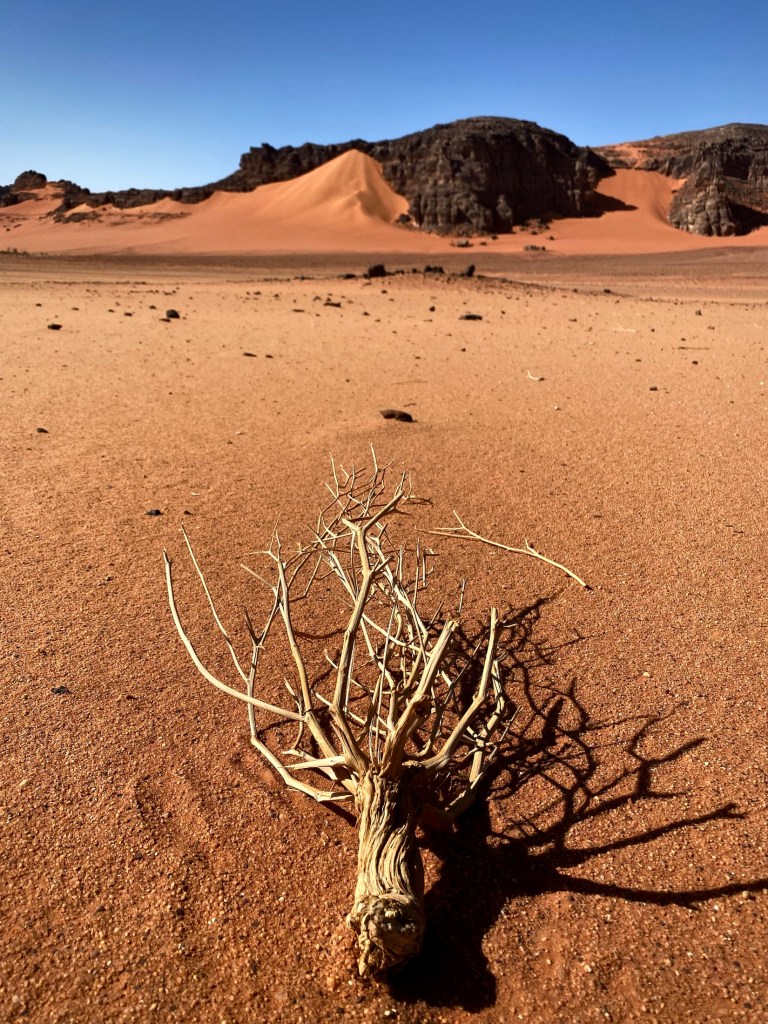
donkey melons, and tiny flowers of all kinds, many medicinal, somehow flourish, too.

Flower of the torha tree that goats enjoy

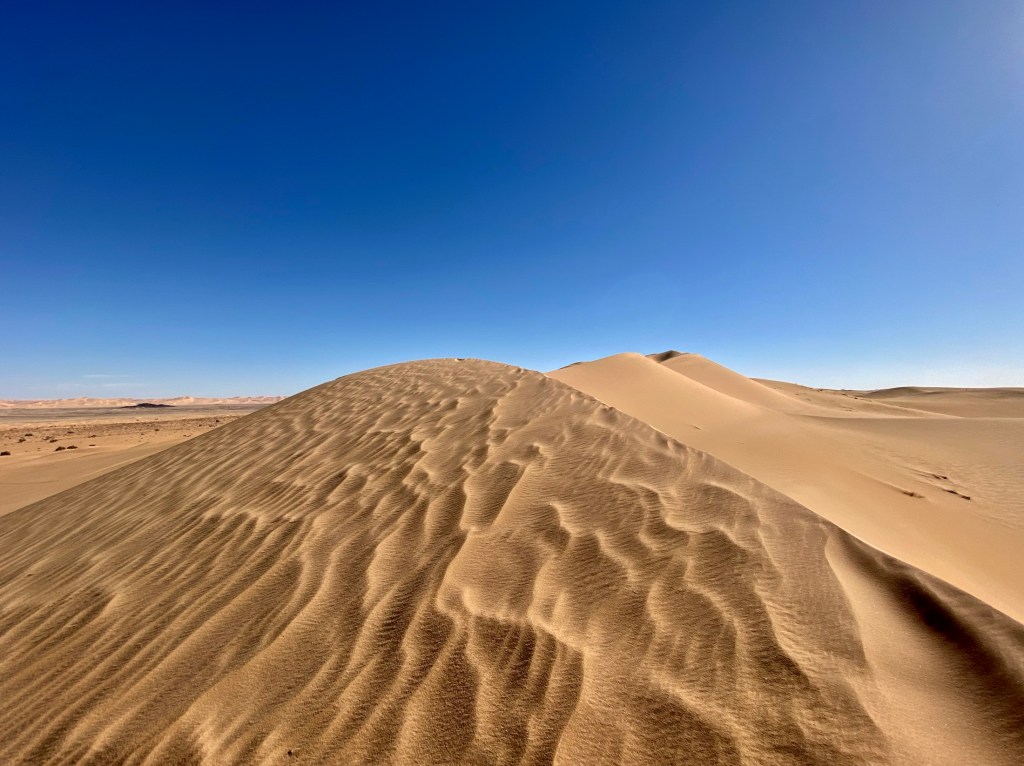
The “regular” dunes, too, simply spectacular.

They go on forever and ever. And when I say forever I mean it. All the way to the horizon and over the border to Lybia and Niger.

So far only car tracks, how long before the annoying quad bike excursions show up?

The view from the top would take your breath away if you were not already all out of breath making your way up the steep slippery slope.

Before taking the grave risk of going down the slippery slope some people take a little rest

And some take a little fly

and others opt for a little hug

The power of wind is evident in the sand dunes driven high up the sturdy rocks.

The yin and yang of such sand and rock interactions is the unique attraction of the Algerian Sahara.

But more on that in the next installment on The Stone Forrests of Sahara.