
Stone Forrests and Rock Sculptures

It must be the privilege and ailment of old age to keep dredging up memories from times long gone and here I go again:
When I was just a slip of a girl at 16 I stepped off the cross country bus for a quick break and stood at the edge of a precipice. I could not fathom it was portending my future but I was acutely aware I was forever spellbound to live my life seeking moments of awe such as that: gazing upon the Grand Canyon, the Mother of all canyons, the grandest chasm of the world. In my wildest dreams, I couldn’t imagine that one day for a time I would live in Arizona with my young family and forevermore travel the world in search of natural and man-made treasures.
Nowhere else has the interplay of nature and human creation formed a more perfect union than in the Algerian Sahara.

I have painted a rich and adoring picture of the impressive prehistoric art in a previous blog and sang praises to stupendous sand dunes, too. Now permit me to chisel out an image of rock and stone forming sensational geological formations.

Woefully lacking any working knowledge of geology I can but playfully share some impressions of ergs, regs, and wadis.
And what can be more playful than naming rock formations.
Some are well-known and easily recognizable such as

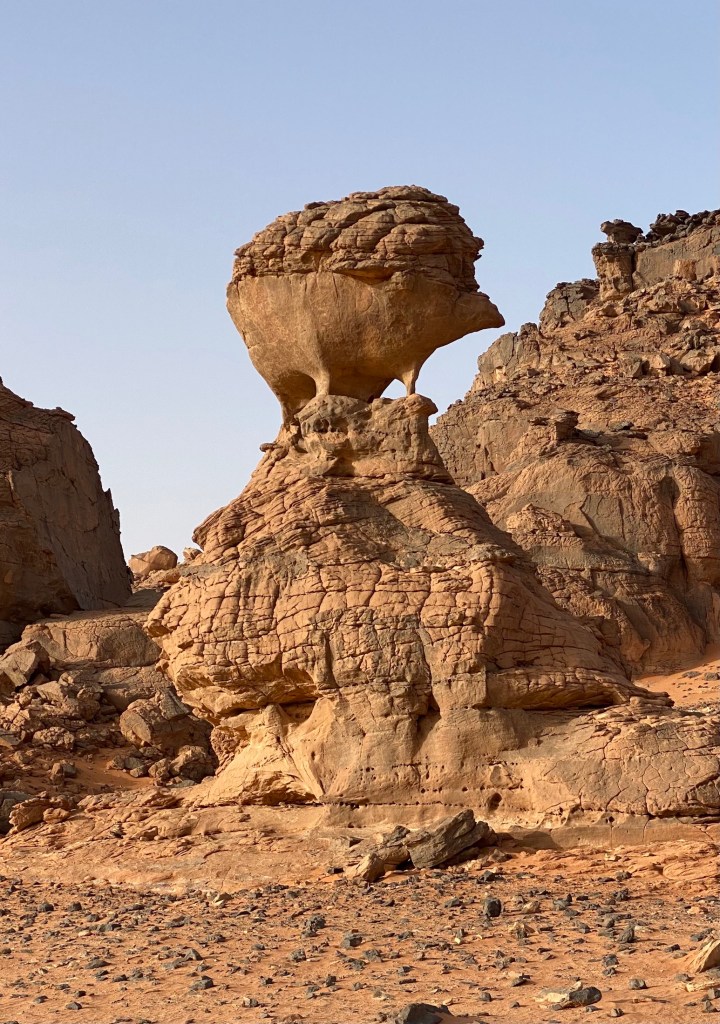
and for soccer fans

Soon, to the amusement of our Tuareg companions, we were seeing (and naming), rock shapes everywhere.
A number of E.T.s, unknown extraterrestrials to our Algerian friends, greeted us throughout our journey.


More animals popped up their shapely heads.

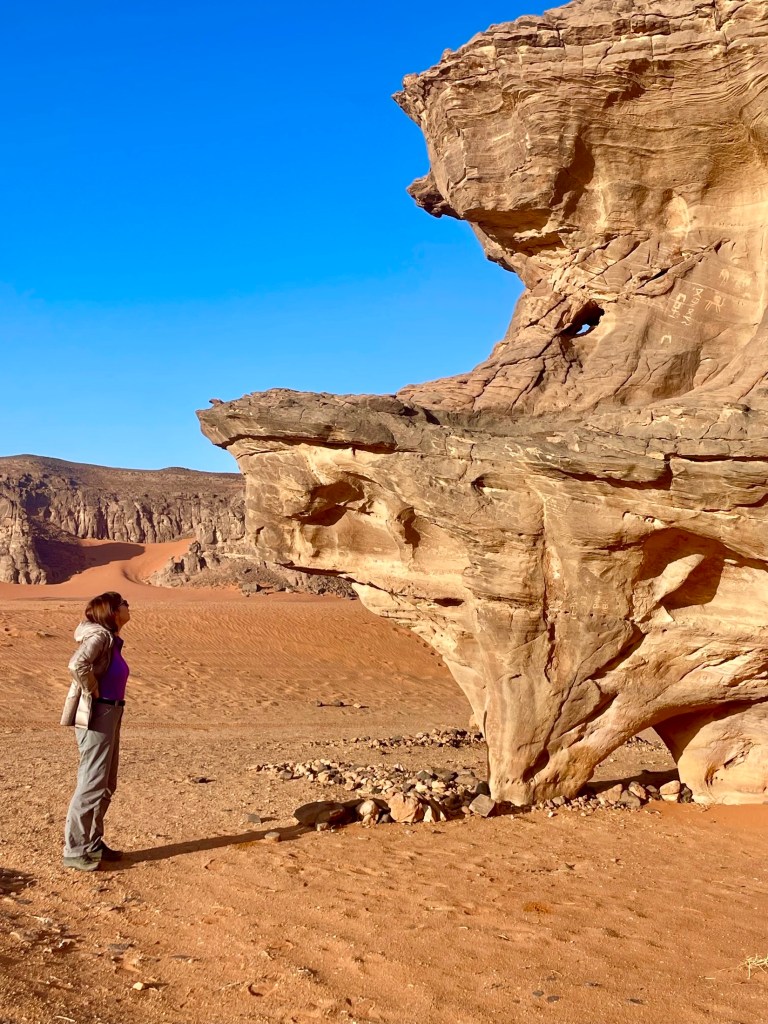
When I see a pyramid I of course can’t help but think of Egyptian pyramids.

So just for a little numbers fun the Egyptian pyramids were built between about roughly 2700 B.C. and 1500 B.C. This makes the earliest pyramids about the same age as Stonehenge, which was initially built between 4,000 to 5,000 years ago. But the large animal engravings on this nature-made pyramid block of rock are much older than that. These may date back to 12,000 years or more.

But how old is the rock and Sahara itself? New research looking into dust (paleosols made of very fine-grained minerals rich in quartz and mica) that the Sahara blew over to the Canary Islands is providing the first direct evidence that the age of the desert matches that found in deep-sea sediments: at least 4.6 million years old.
Scientists are amazing! They also study fosilized flora by taking samples of plants from the rocks to better understand the Greening of Sahara. Around 8,000 years ago, the Sahara wasn’t desert, but instead was a vibrant ecosystem that supported hunter-gatherers and fisherfolk. The ‘Green Sahara’ – the colloquial term for the African Humid Period – was the period in which North Africa became much wetter so animals (and even fish) and people thrived.

Alas, it didn’t last forever. Around 5,500 years ago, the ecosystem in the Sahara went into a terminal decline towards the desert we have today.
Erosion is a mighty power and has formed a large number of impressive tall arches.


Throughout our camping trip various arches provided marvelous shelter for us. Undoubtedly they must be a an integral lifesaver in the hotter months of the year. Our lunch breaks and overnight camps were always set up in the protective proximity of rocks.
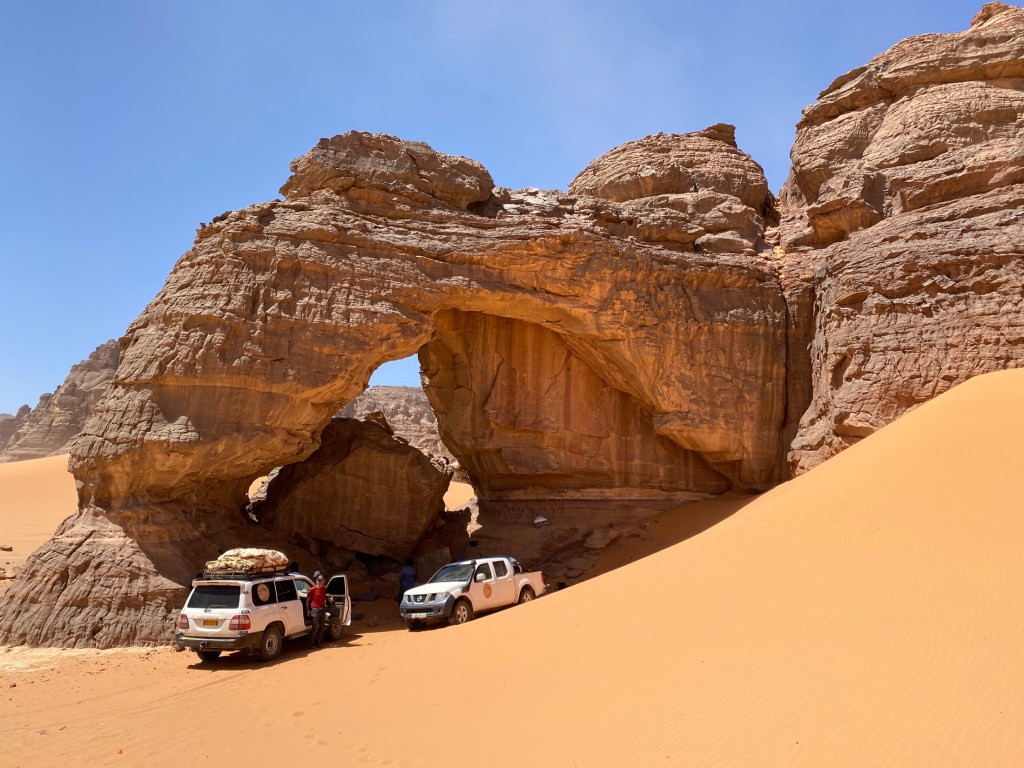
The most attractive and exciting was the rock formation that surprisingly had no name. So we named it The Eye of Bouhadienne for the geographic area.

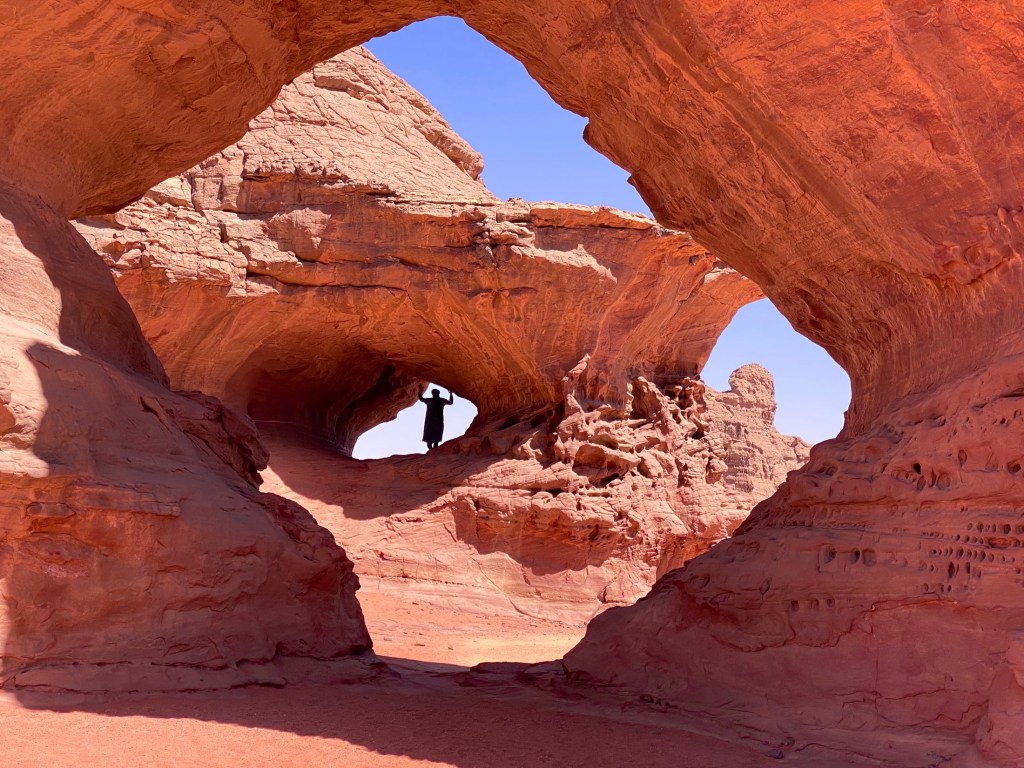
We only peeked into a few canyons, but gaping at tall walls and walking on the dry beds of long-gone rivers was pretty darn cool.
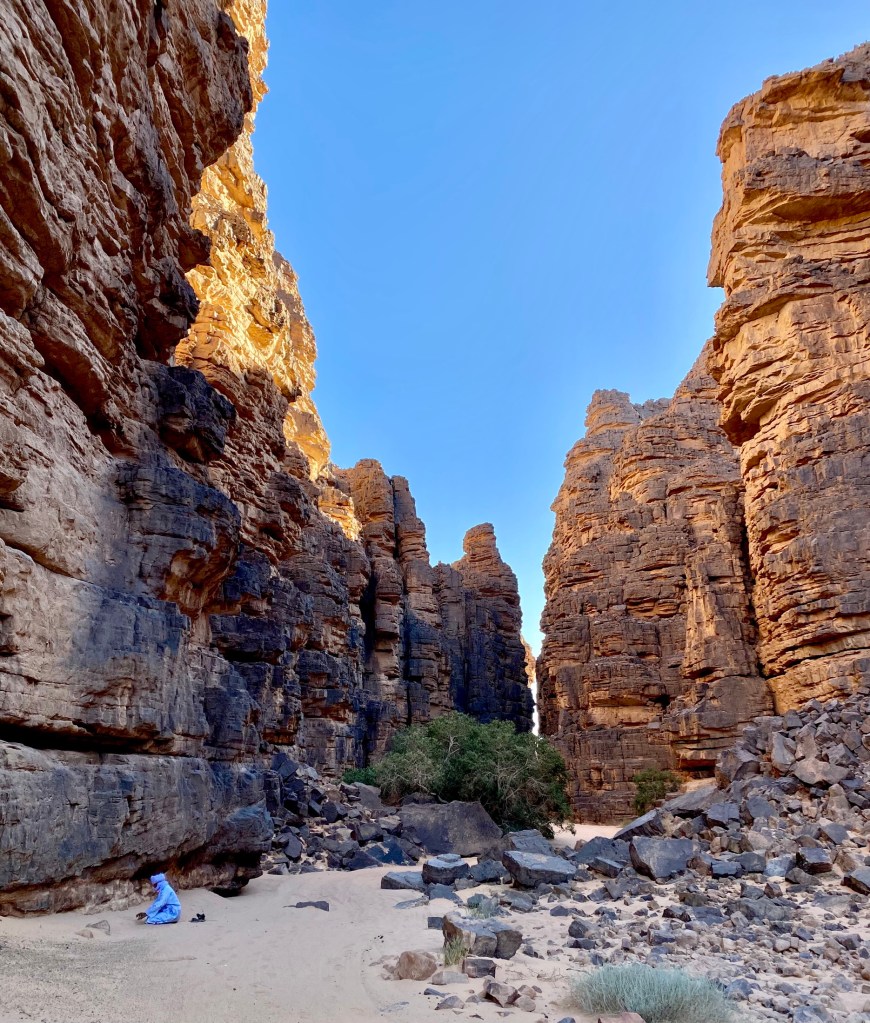
We were surprised to find out that there is quite a lot of water in the desert. Researchers from the British Geological Survey and University College London have been able to carry out a continent-wide analysis of the plentiful ancient water reserves hidden under the surface in aquifers.
“Our” trusty “researchers” led us to water above ground, too. Like a mirage water appeared in a narrow canyon. One can clearly see the long process of powerful water patiently carving down down through the rocks.


This was but a small guelta, a pocket of water that forms in drainage canals or wadis (river valleys) of Sahara.
A much bigger supply of water was found around the little tumble down town of Iherir in a wadi named Oued Iherir near the center of the Tassili n’Ajjer mountain range. Big date plantations grew along the river. We could replenish our dwindling date supplies, an important staple as our guys broke the Ramadan fast every night with a handful of dried dates and milk.

We followed the river into the rocky hills of the plateau just for a little while. It gave us a taste of the week-long hike that is achieved with the help of donkeys up to another area rich with prehistoric art. I am already planning the next trip!

Dear Youssef played an extra role, besides a well-informed guide, he was also a willing photo model.

In the ever-changing landscape, so many of the places indeed gave off a totally otherworldly vibe.
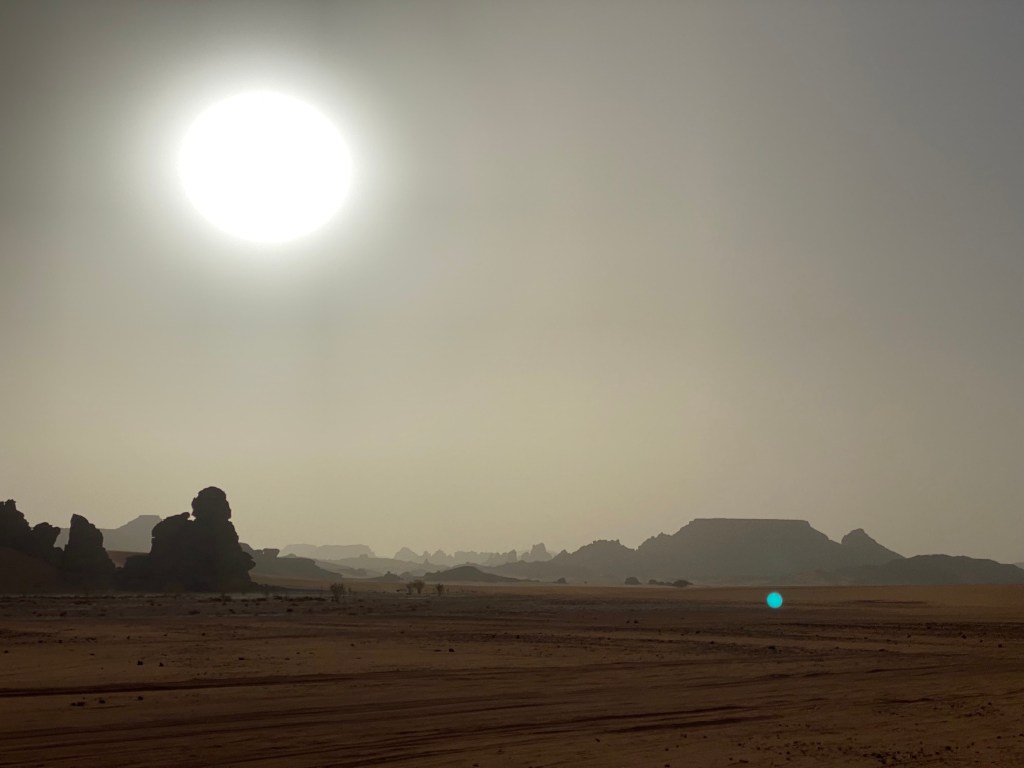
We drove into the areas of stone forests as far as the eye could see,

and then on to stone cities where curious toppled temples dreamt of old, long-forgotten (imaginary) civilizations.
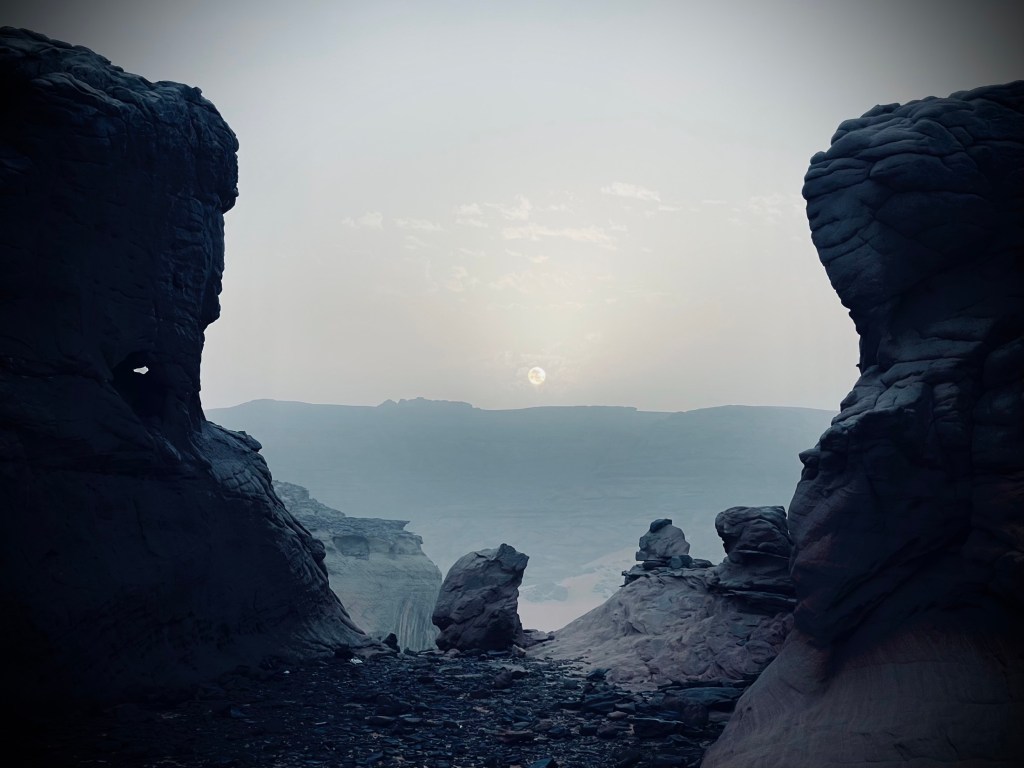
When we emerged again into the warm sunny desert
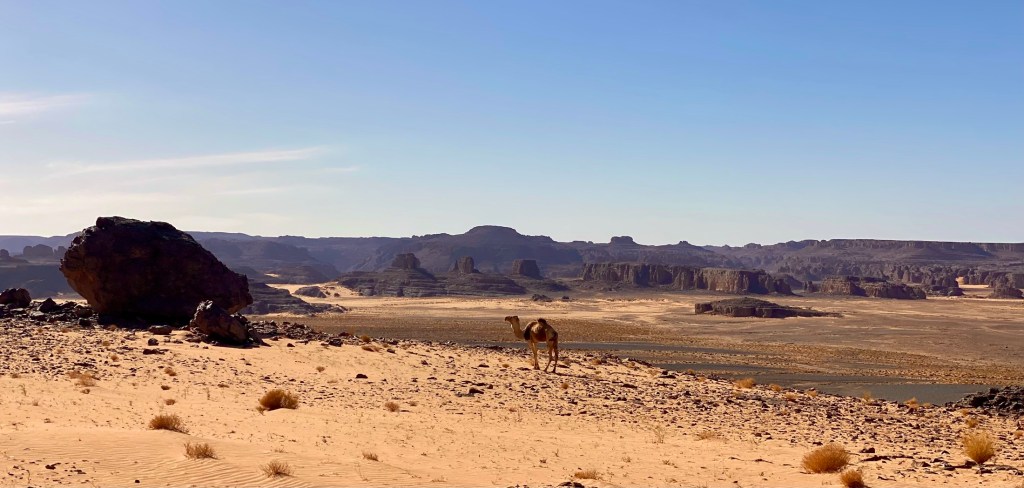
we reveled in the interplay of rocks and sand dunes and long shadows.
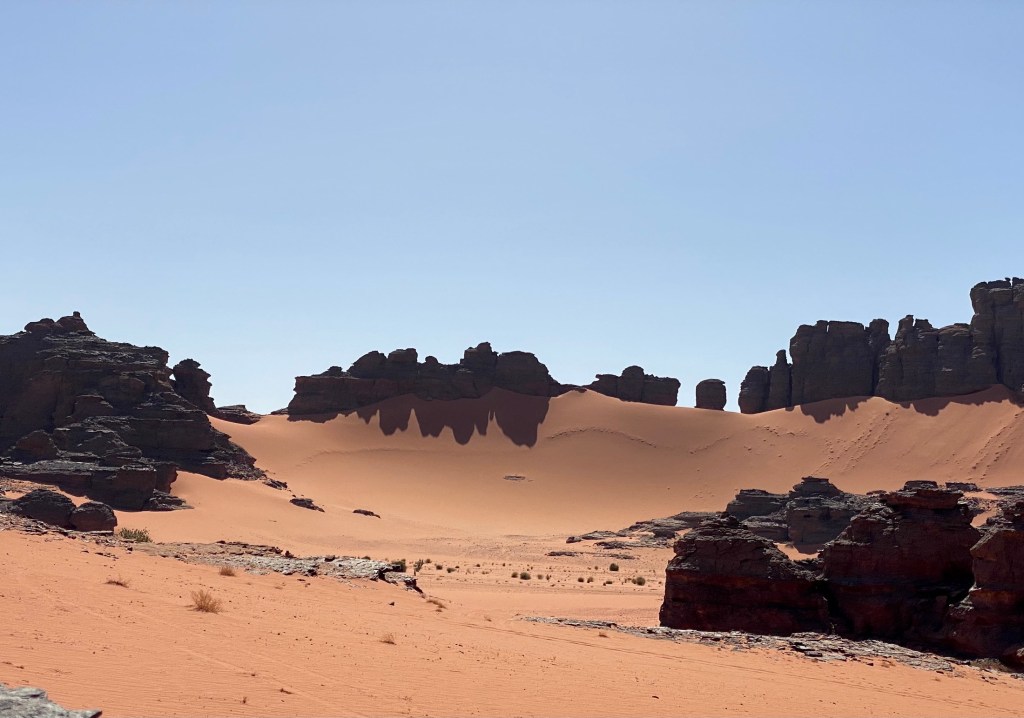
As we pressed, on like Fata Morgana, a caravan appeared before our eyes.
More on that in the next installment: The Tuareg: The Sons and Daughters of Sahara.
 Crazy Parents Travel
Most amazing and amusing photos. Love taking the “computer” travel with you.
Margaret
LikeLike
i am glad you found humor. It really was amusing and awe inspiring.
LikeLike
amazing report with superb photos. You should be the voice for Algerian tourism.
LikeLike
that would be fun!
LikeLike
Absolutely breathtaking scenes! I love it!
LikeLike
thank you. It was fun going back and reliving it through photos.
LikeLiked by 1 person
Great pictures of an amazing landscape! Thanks for sharing.
LikeLike
The scenery seems so timeless, and yet it was changed so much over the centuries… Gorgeous views!
LikeLike
thank you for always taking the time to comment. It means a lot.
LikeLike
I’m just catching up a year late – but amazing! Thank you so much for the effort you put into a fabulous travelogue.
Eva
LikeLike