Stopping on your travels for a longer period of time than, let us say a week, you expect yourself to adjust your pace and style to…
Well, to what is a question on Bali in general and Ubud in particular. The first tourists coming to Ubud under the auspices of Dutch colonial powers enjoyed the peacefulness of the rural setting of endless rice fields, the intricate arts and crafts and the natural beauty of tropical paradise amply enhanced by the natural beauty and shape of the local beauties.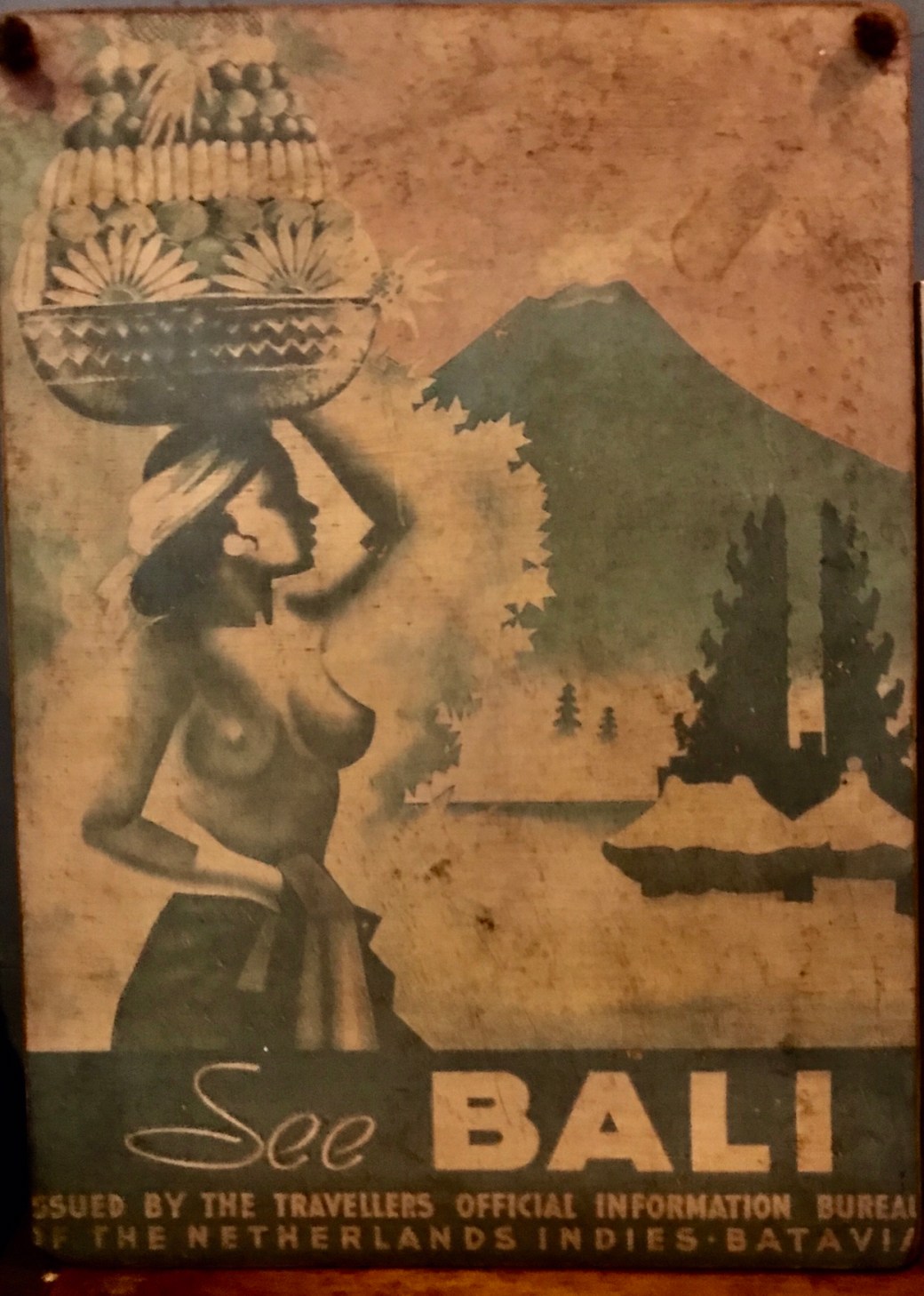
Talking to the people that were lucky to visit after the war or independence and before the waves of mass tourism, like our friend K. De Groot, you can get a sense of wonder and enchantment:
“Ubud was a lovely little village with ONE Main Street lined with delightful “local” shops & artists studios…with all the “locals” bringing their offerings to their shrines….we were in heaven … then with a car we explored the island for another 10 days…NO traffic! Only gamelan music rising from the rice paddies and charming villages and temples galore!”
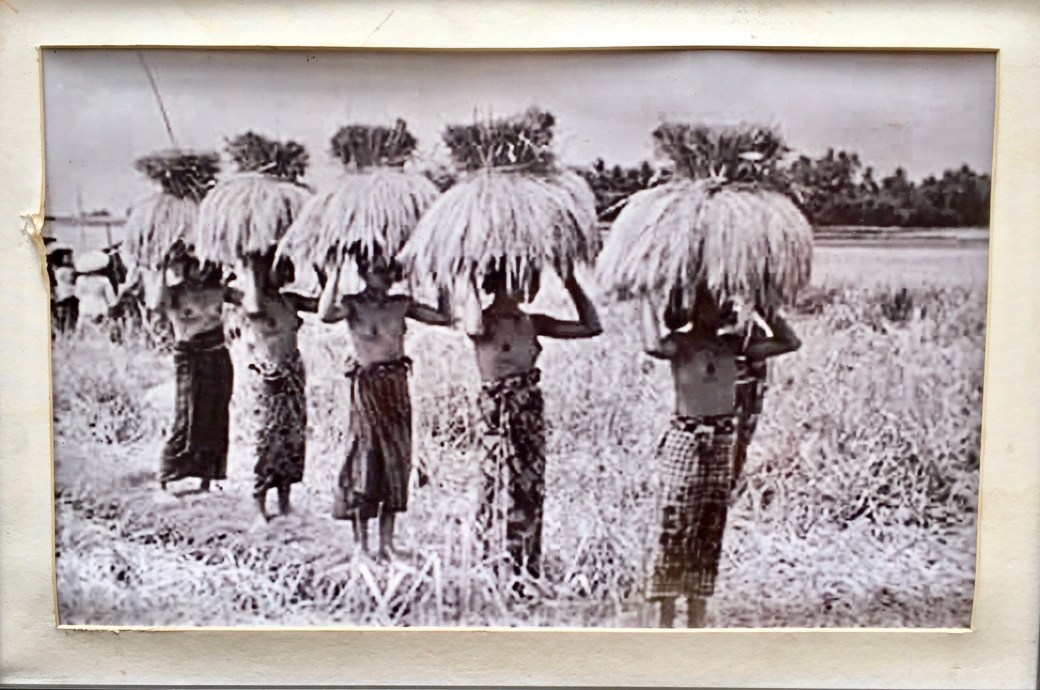 For us, who came here for the first time fifteen years ago with our girls, we could still find the green expanse of rice paddies, but on the outskirts of a place that had grown from a village into a substantial town. We were lucky that we had it largely to ourselves as we came here shortly after a nightclub terrorist bombing that scarred away all but the hardiest of travelers. This time, again, we are visiting on the heels of another disaster, a near eruption of the local volcano. While the Balinese complain about the tourists being scarred away, we complain about the lack of the emerald green.
Most rice paddies have been sold to developers of hotels, resorts, bars, and boutiques. Every second house is offering a home stay or rooms in the back of the family compound. A few small patches of rice can still be found squeezed between large houses and the larger swathes of paddy fields on the outskirts warrant organized tours with busloads of selfie sticks yielding tourists. Then they go back to their fancy resorts and enjoy a n afternoon cocktail reception with a performance of the local dance troop representing a stylized Day in the Life of the Balinese Village. 
Meanwhile around the corner the local farmer works the rice field unnoticed and uncelebrated. 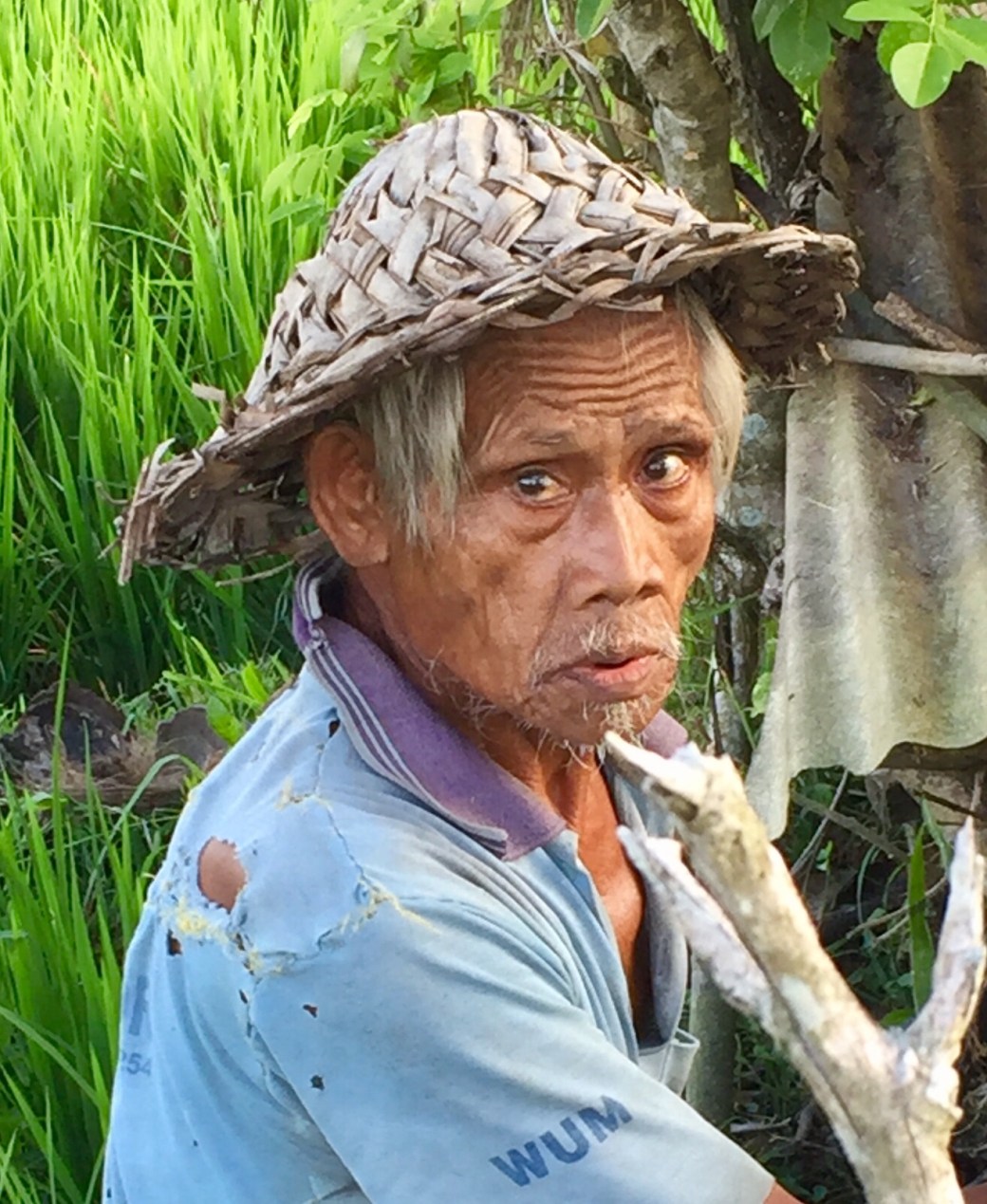
It is an adjustment for the locals, some dreaming in vain to ever have a piece of land and a home, while some enjoying what a new life style can offer with the monies from the sales of the expensive lots.
If the early tourists had no choice but to accept what locals could offer, this has changed dramatically and nowhere more than in the Ubud center. The visitors from rich countries got what they wanted. Coffee shops (the Starbucks building now competes in size with the former Royal Palace), mini/maxi/super markets, galleries, boutiques, WiFi, air-conditioning, massage and nail saloons on every corner, swimming pools, yoga classes, cooking classes and ATV adventures. With western amenities at very affordable prices visitors are tempted to stay longer, creating an expat community, living its own, separate life altogether.
Here we are settling in Bali for just two months, not exactly long term like many expats we meet, but not as typical tourists jumping from destination to destination, following the fixed itinerary of “If It’s Tuesday, It Must Be Belgium”. We like to see ourselves as somewhere in between, trying to catch what is left of the old Balinese peaceful way of life, even as we gratefully accept the western comforts of air-conditioning. (And who wouldn’t, for God sake?) We enjoy a break in Mie/Nasi Goreng (Fried noodles/rice) line of dinners with an occasional decent Italian pasta or French onion soup, topped with great panna cotta and cappuccino. Or, and I can’t believe I am saying that, a decently sized BEEF hamburger with French fries.
While we have wholeheartedly embraced the local culture, we were also delighted to find cinemas here in Ubud. Twice a day they show many European movies in Paradiso. 
Here you buy the tickets for 50,000 rupees each in the lobby, leave your sandals in a cubby and are ushered barefoot upstairs to the theater. The set up is inviting with comfortable sofas and armchairs complemented by coffee tables. What you appreciate the most– the hall is well air-conditioned. You may wonder if the price of 50,000 rupees is not too high, but it is not even four bucks. It is a great deal indeed, because you can use your ticket as a voucher to pay for any item on the (alas, vegetarian) menu offered by waitresses before and during the film presentation. I am quite Ok with vegetarian ice cream. If you are used to lying down at home, stuffing yourself in front of your home entertainment system, then you know what I am talking about. Of course, here you cannot surf remotely through the channels and you are not allowed to terrorize your own live-in partner to bring you another beer or ice cream from the fridge.
The movies are not the only attraction shown in Paradiso. Once in a while there are even live music performances. For a few extra bucks we can enjoy the piano music of an Iranian new age composer, complemented by a video presentation on the large theater screen. More vegetarian food and drinks offered. All those goodies described above enhanced by intimate lighting and enjoyed in a reclining position would lullaby almost everybody in the hall, if it were not for the young pianist banging the keyboard with such fervor making sleep quite impossible!
Our youngest daughter and our friend K.’s (see above) son, who has just recently returned from spending some months in Ubud, BOTH tried to convince us we should absolutely try yoga, but not any yoga, yoga at YOGA BARN. Yoga Barn (YB) located just a few meters from the split of Jalan Hanuman and Monkey Forest Road has, just like Ubud some time back, recently exploded and grown into an institution among visitors and expats. Unless you count the staff in the reception and coffee shop as avid followers of yoga, please do not expect to find any locals within YB’s legal boundaries. To be fair, we were told that all locals have been offered free yoga classes, but I guess they are too busy serving the Western customers and taking care of their families to participate. So I would say it is more western/expat institution than anything else in the whole of Ubud.
I never fell for yoga, and neither for massage, nor chiropractor, nor any other non medically prescribed activities seeking improvement of human body and/or mind. But you never know and as the co-leader of this expedition, who is always right, says, “Be open to new ideas!” My wife also advised me to stop dredging up bad memories from the one and only yoga class I took in my twenties (and not in the female company of my wife).
So here I am, dutifully walking down Jalan Hanuman in the high noon heat, disproving the old saying that only mad dogs and Englishmen go out in the midday sun (for those too young to know the very funny song and the unbeatable Noel Coward kindly click here: https://m.youtube.com/watch?v=vMlyT_Sb7sg). For now in the midday sun us two and all the yogis walk outside. Or I should say yoginis, as I am fairly wading through a constant stream of lean, young and middle aged females in tight leggings and lose T-shirts with a foam mat in a matching pattern casually slung over their shoulders. Not exactly the cover girl type of beauties. Those can be found on the lounge chairs at the pool of an expensive resort, or with a glass of wine or perhaps a mojito in their well manicured hands lingering over a dinner of 3 pieces of green salad (dressing on the side) in a pricey air conditioned restaurant. Those ladies pouring down the street are rather of the thinking, strong will kind, with the inner beauty revealed only if you make a concerted effort to find it.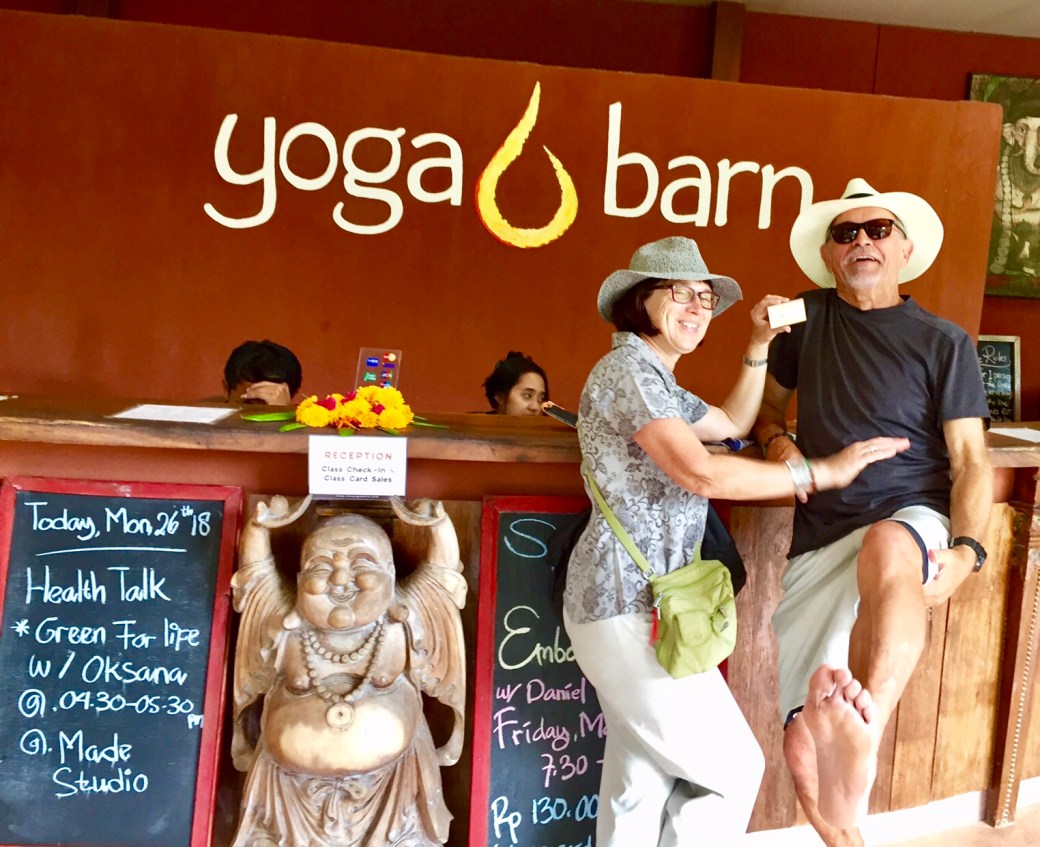
I was kind of unsure of what to expect from it all, as we progressed through the huge YB campus down the stairs passing by the organic café and then the green cleansing juice bar to the plaza in front of the reception looking for all purposes like a huge barn.
Now that I am back in our House in the Hidden Garden and can reflect more, I would like to say it was actually good. If not good, then very interesting. My major concern before coming to Yoga Barn was my total inability to sit on the ground with my legs crossed and twisted. But nobody broke my spine, crushed legitimate joints or torn any ligaments. My wife signed me up for a class called Tibetan Bowl something. This class must be a commercial success and Yoga Barn’s true cash cow. The class is taught by Teacher/Master/Guru who is a male. He must be, to balance out the gender ratio among F/M attendees which is about 95:5. (Those five Ms were dragged there by their freshly minted girlfriends, met at their last youth hostel or home stay). If he is of Italian descent it helps, Italian accent is always good marketing, and, oh, his body mass index should be below 20. Better than being bald, I would recommend Master’s hairdo to be shaped like a Caribbean dreadlock volcano shortly after explosion. If all of the above is incarnated in one person then most of those 95 female attendees are guaranteed to become returning customers.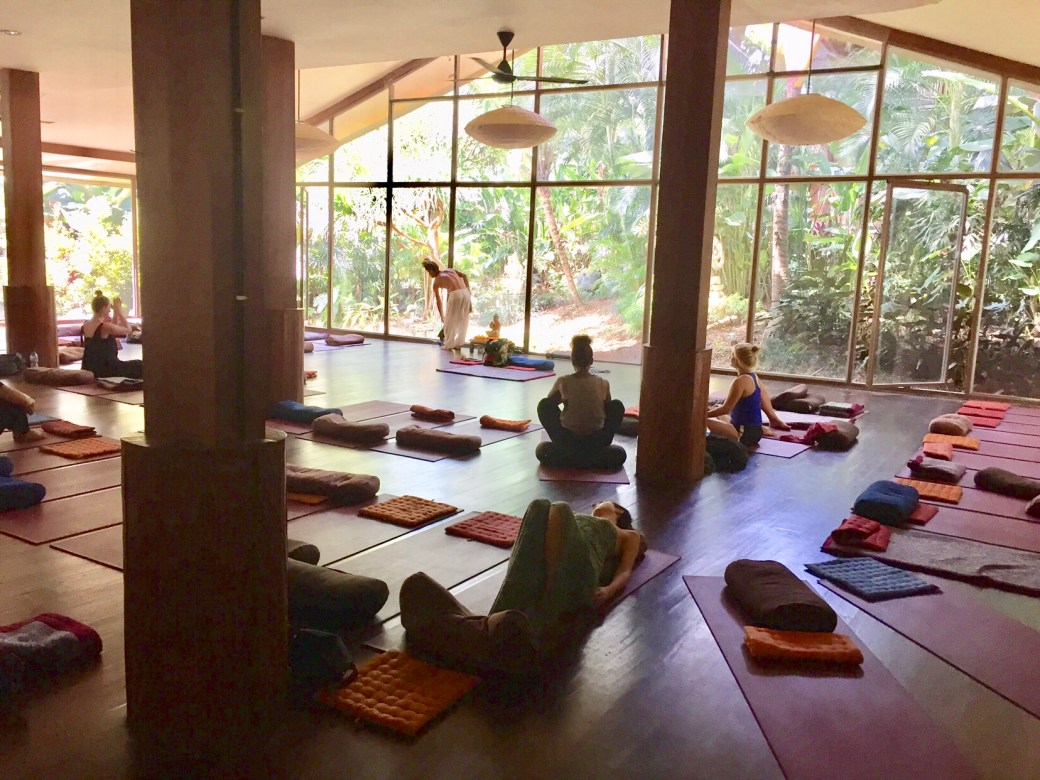
Tibetan Bowl may have been envisioned (wrongfully so) by me to be a yoga class, but my fear of breaking my neck or any other parts of my skeleton during this class was mercifully discarded by the Master himself:
“Do not worry about anything, sit or lay down if you want. Close your eyes if you want, just smell the incense and listen to the music of the bowls, gong and bells!”
And I did follow his instructions exactly to a T.
With mat and pillow provided the Italian guru gently spread perfumed oil on my forehead as I was listening to the first pleasant tones of Tibetan bells. I was lying on my mat with eyes closed thinking of…..many pleasant things. If hard pressed, I could probably recall a few, but I should not tell them in mixed company. My co-participant presumes I have fallen asleep and tries to jab me in the ribs. This is, of course, a huge misunderstanding, only because I knew from the Master’s clear instructions how important the act of deep breathing was for reaching the highest meditation levels! To interpret this effort by some, my wife in the first place, as snoring, is absolutely outrageous! Nevertheless after an hour or so I felt strongly rejuvenated and almost agreed to sign for an Ecstatic Dance class.
When you are on the road for an extended period of time, even as a male, you have to use the help of hairdressers, no matter how laughable your head cover is. After two months on the road, while in a relatively remote place, my wife suggested it was time we both went to get a haircut. She even suggested I may have a good reason for looking presentable, as we shortly planned to leave for Ubud, the center of social and cultural life of the island.
“I don’t think you really want to look like an over-aged hippie, honey?”
After a few seconds as I tried to catch my breath to soften the blow to my confidence, she added:
“Or do you?”
“Of course not!” I bravely barked back. “But where should we go?”
“Oh, the cook’s wife suggested a fancy new hair salon just a few steps down on the Main Street!” You could almost hear this trap door falling loudly and I was on my way to execution.
After seeing the lady hairdresser rummaging for a long time through drawers and brand new boxes to find her comb, scissors and different electric powered instruments, I got a strange feeling something was not quite right. But I was raised to be respectful of all women in my life, especially those making their living in harsh conditions of male chauvinist dominated world. So for the next fifteen to twenty minutes I was wondering how to gently and with all due respect escape out of the hair salon, without having one or possibly both of my ears detached from my skull!  Only after I could not take the tugging and poking any more, I jumped from the chair and unceremoniously left the place, uttering over the shoulder my closing remark:
“I think it is short enough!”
My wife stepped in, paid for the services rendered and concluded our visit with a statement:
“I think my hair is quite all right! I guess I do not need my haircut today.”
Walking back to the safety of our small resort, I was wondering if instead of being a guinea pig in a completely unknown territory, should I not have waited for Ubud’s fancy “Men only” barbershop and hair salon, where I had a very nice haircut last year for my birthday. 
It cost me about seven times more, but I never ever felt any fear of losing even a part of my ear. It turns out it is barely a block from our House in the Hidden Garden and every time I pass I ponder how being served by trained professionals catering to the Western clientele has some advantages, including not hiding for the next few weeks till your head injuries are fully healed, and your hair cover recovers to such an extent that your children stop asking you on FaceTime:
“Dad, what happened to your hair?”
I hope you don’t think that we rely in our eternal efforts for physical and mental development strictly on interactions with expat community. As a matter of fact, thanks to staying in a local residential neighborhood, we are integrating into the community with little effort. We are quickly being pulled into the local’s lives such as following their never ending holiday schedule, preparation of offerings, participation in processions and their temple duties, observing Balinese dance rehearsals, motorcycle blessings, and attending weddings (no funerals as of yet). From our Western perspective we are offering access to our medical kit and brainstorming of strategies to increase sales to western tourist buying local Balinese products in Ubud market or, at the very highest level of submerging into their lives, chit chatting with neighbors about lives and deeds of other neighbors or, God forbid, their or our relatives! Another week or two of this and we be forced to leave Bali for good.
Footnote: Bil-la-bong, noun Australian
A branch of a river forming a backwater or stagnant pool, made by water flowing from the main stream during a flood.

 Make it a rice paddy and it makes my heart melt.
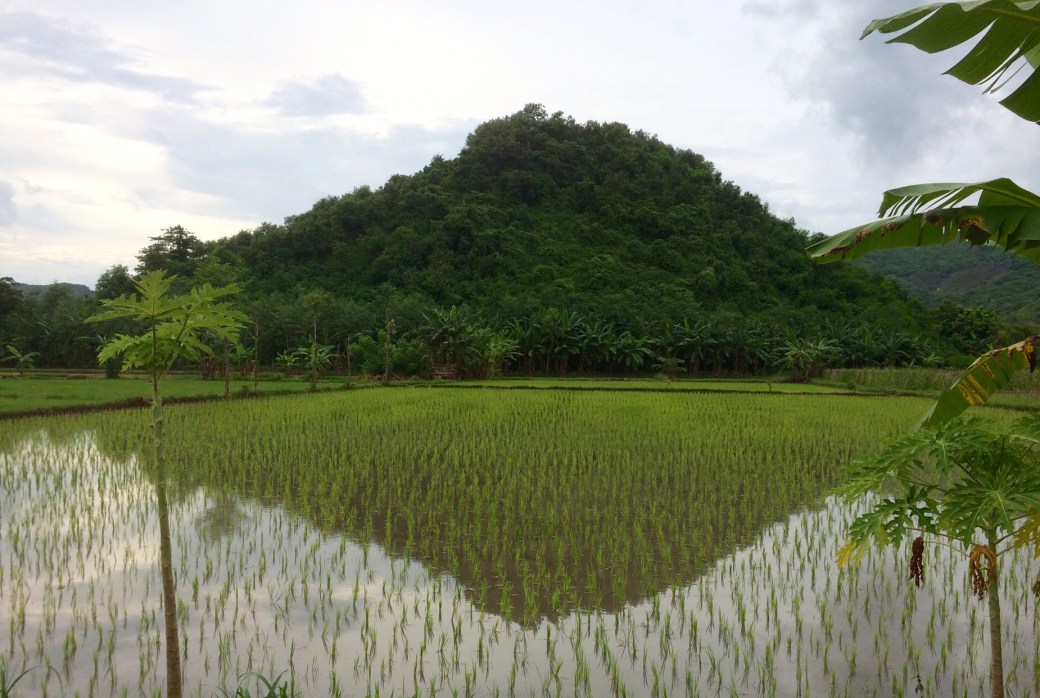 Stand me by a succession of rice terraces and I swoon.
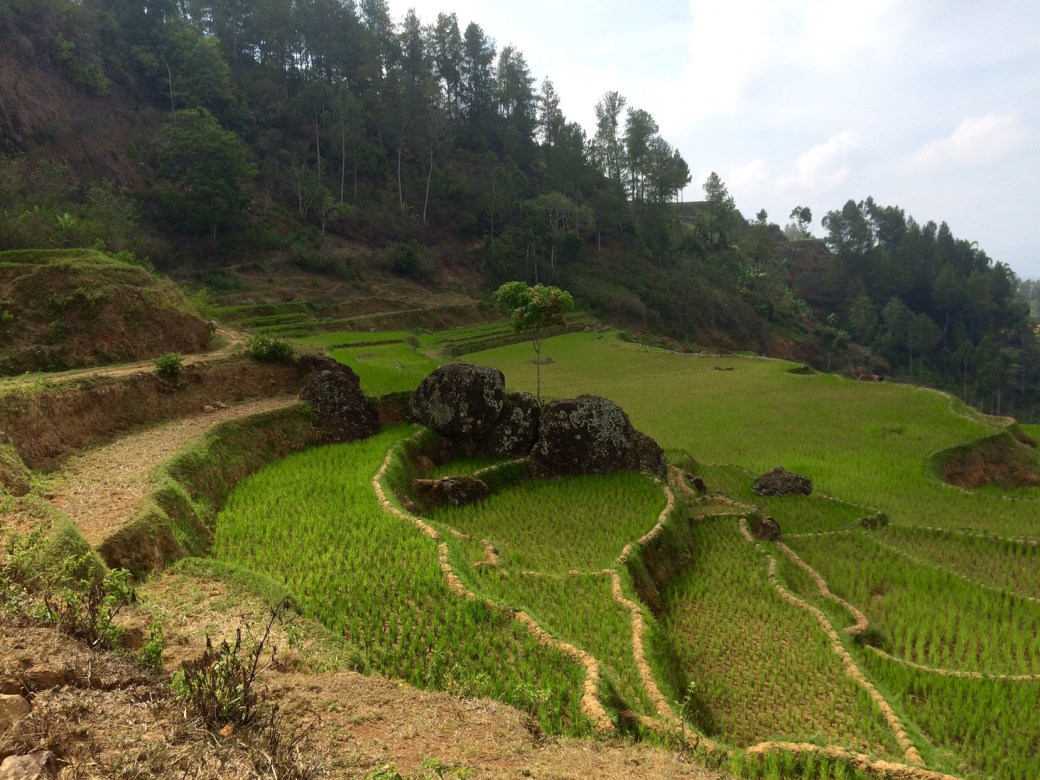 If only, like the countless painters and photographers had, I could capture the beauty of it all- the clouds reflected in the flooded paddies with tender shoots prodding and pushing and reaching through the moist soil towards the sun, the green rainbow of countless hues popping up in every new patch,
  the ripe roundness of the breasts and hats and hills, the graceful arches of bending heads of rice ripening in the afternoon sun, oh, and the arching grace of women in the paddies bending, reaching through life giving water, planting future in the thick fertile mud,

 and then at the other end of the cycle

 bending yet again collecting golden treasure of the harvest.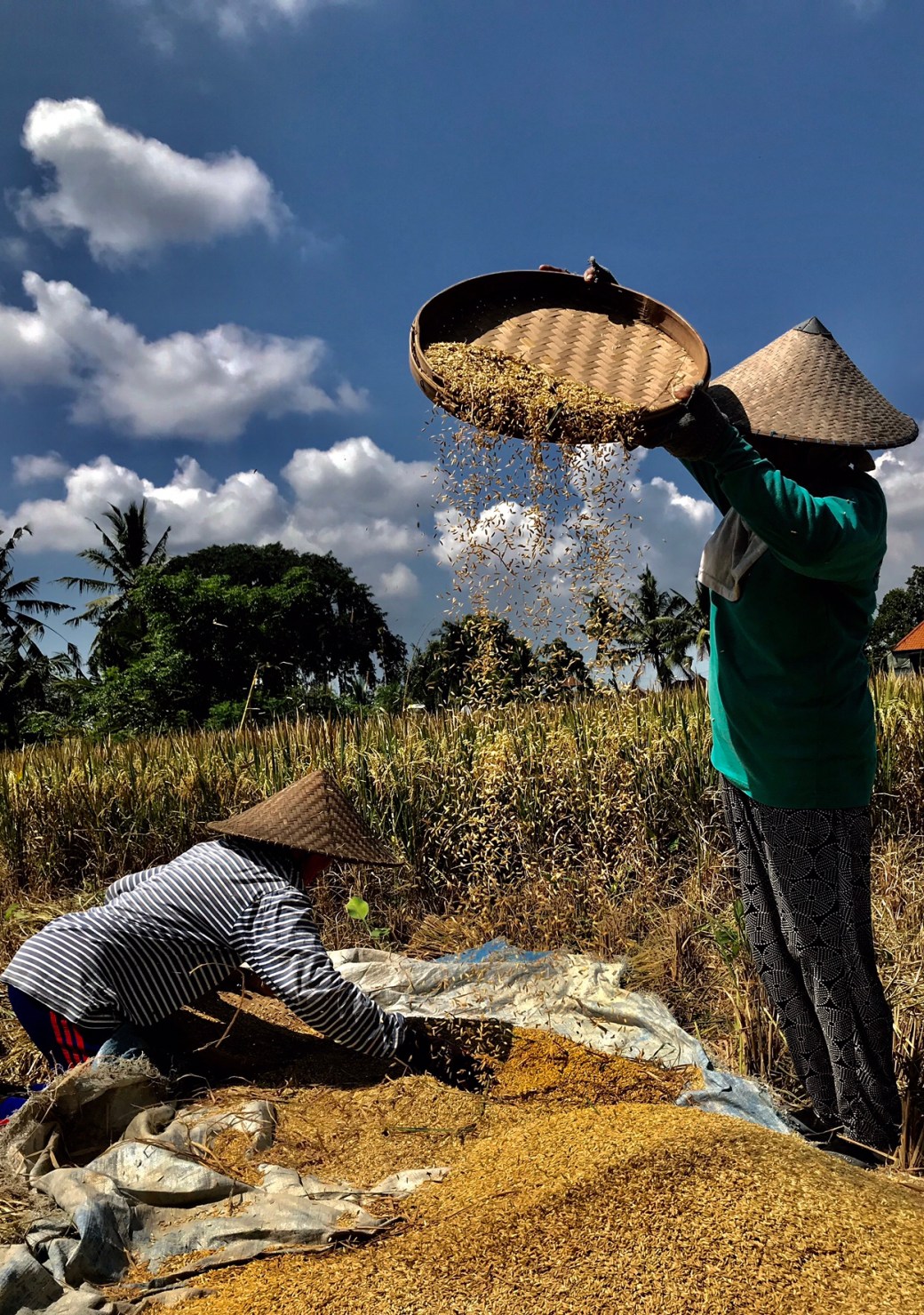


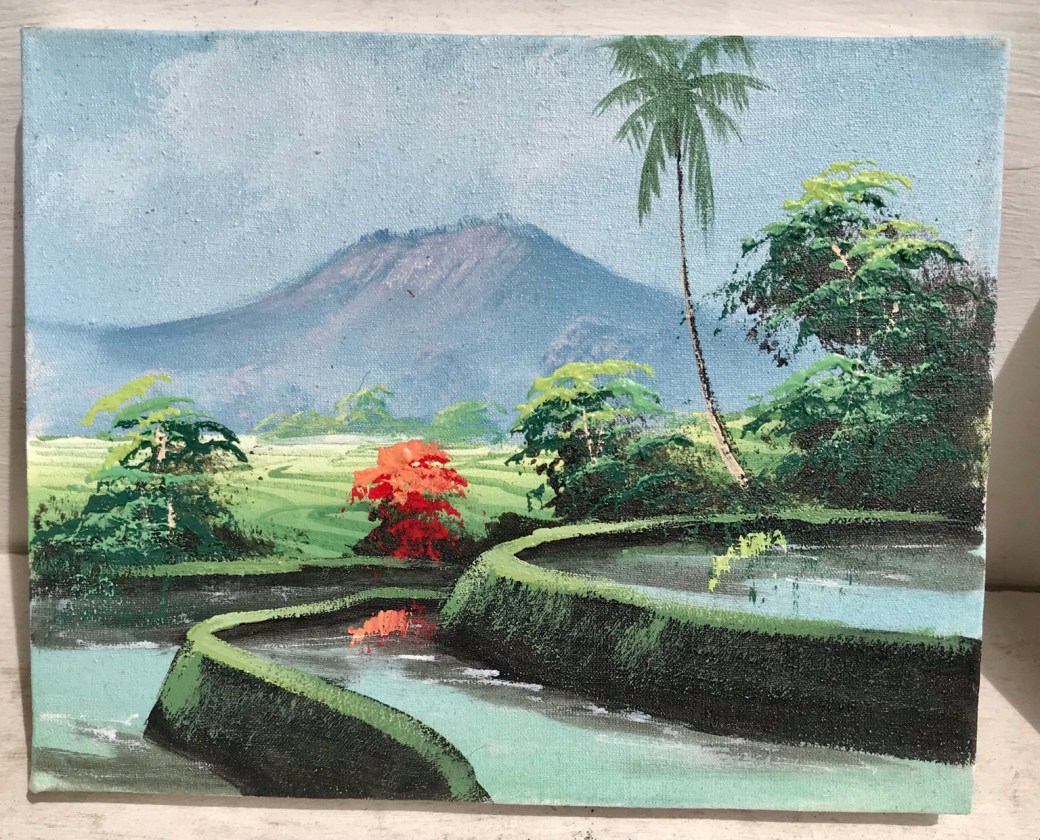
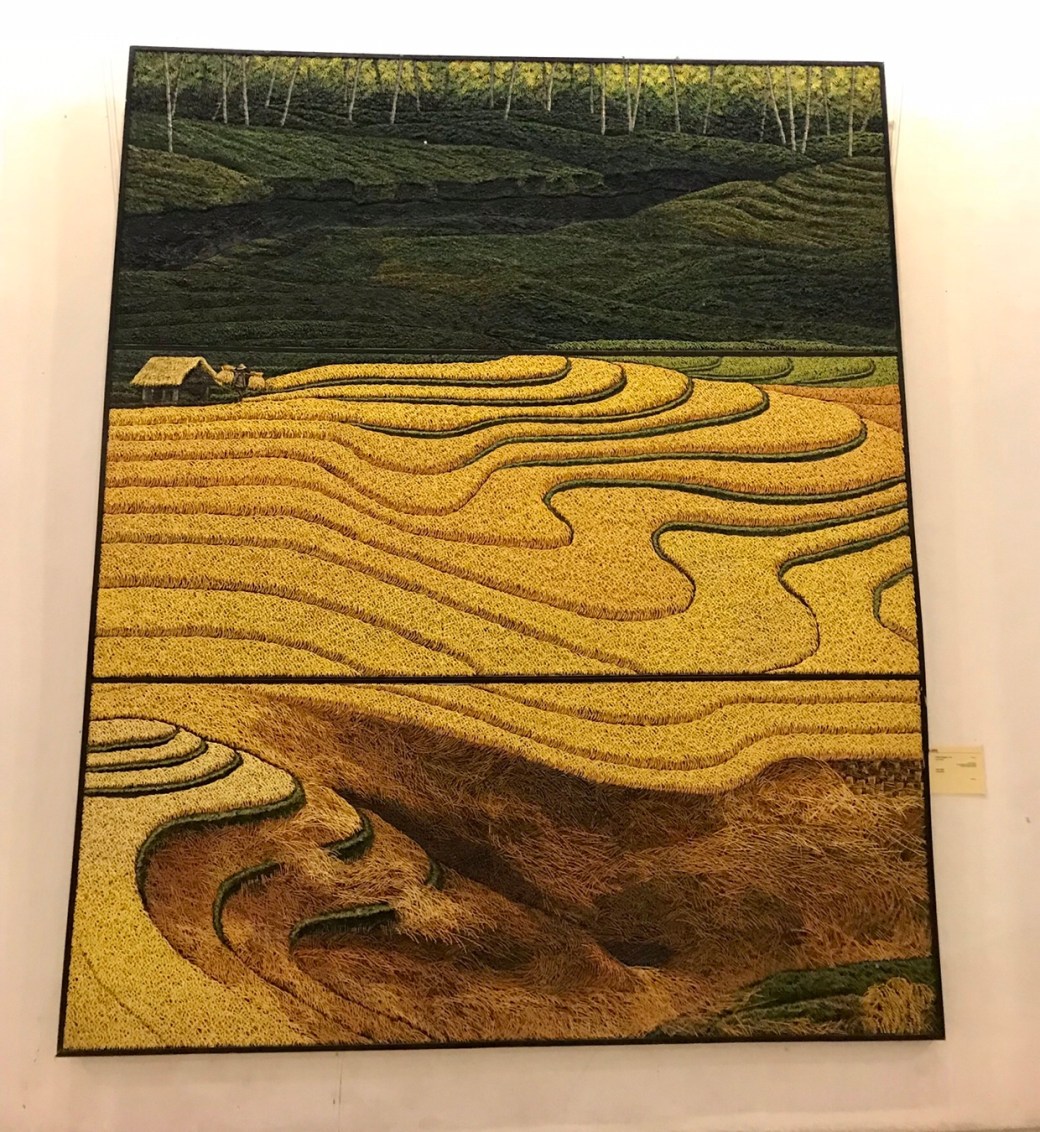
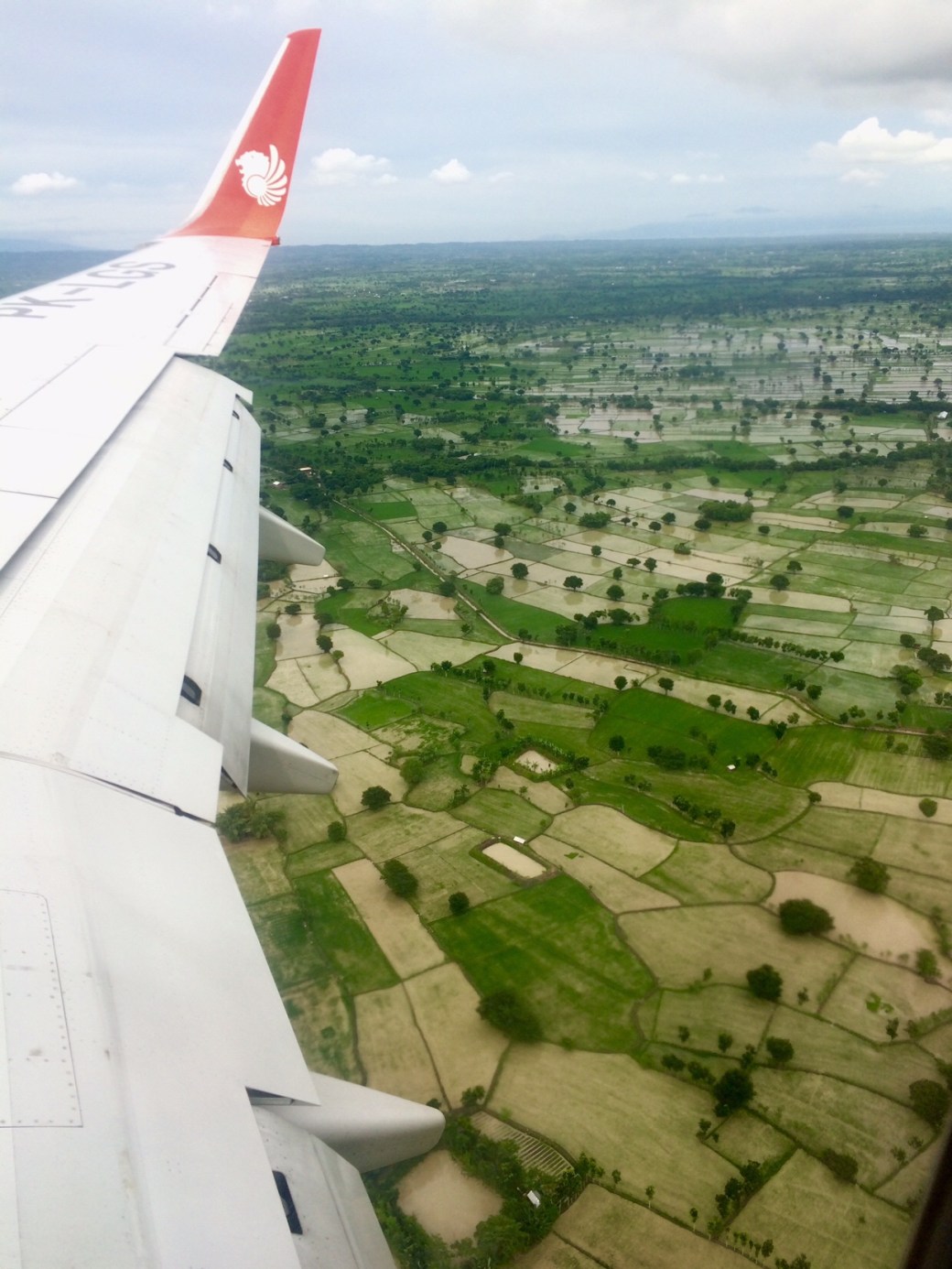 I come across a rice field, my soul is stirred by its beauty.
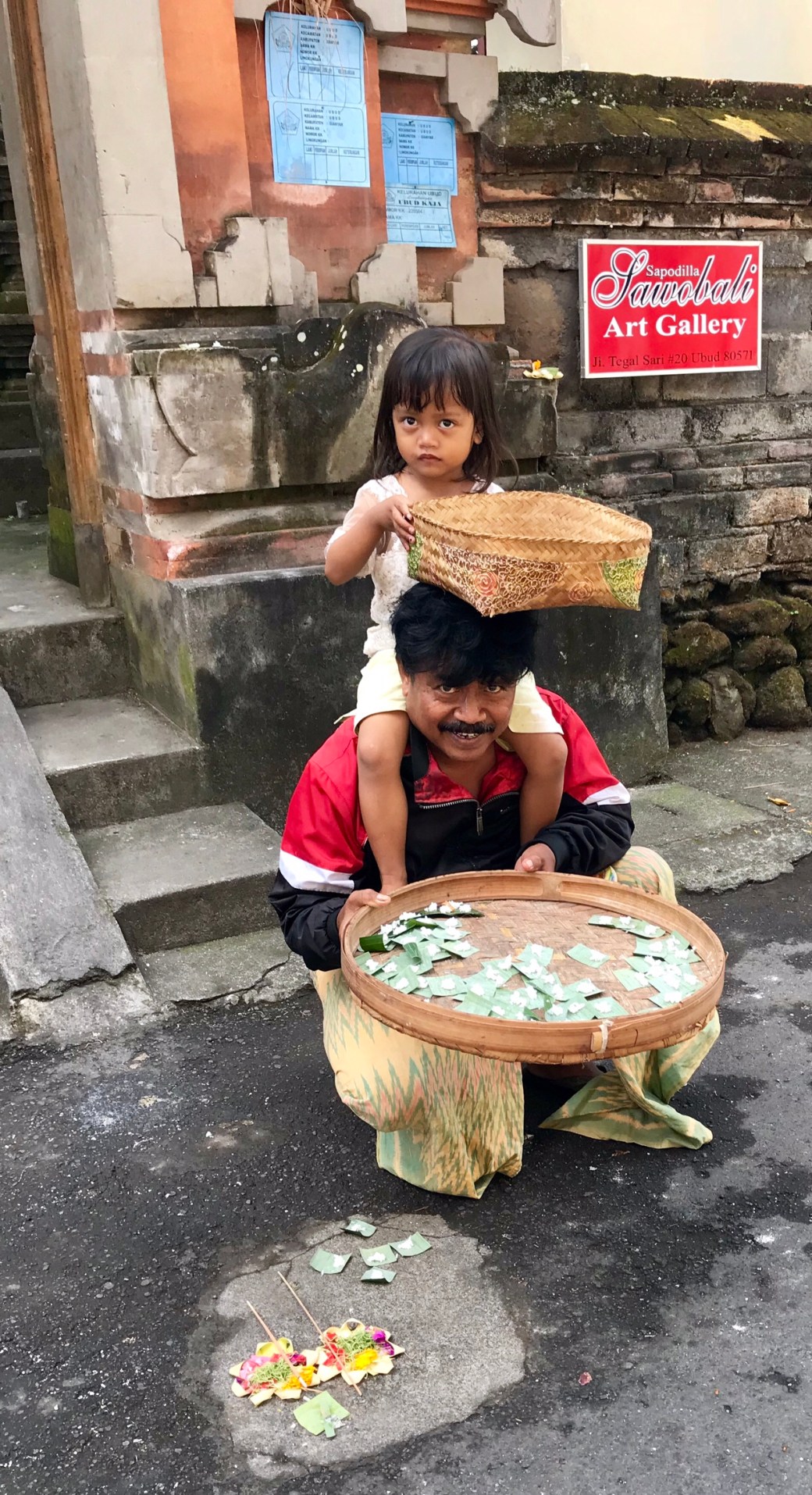 But it goes deeper than that. Because the large majority of rice is grown in water, an intricate system has been developed to distribute water wisely and fairly to all the farmers while protecting natural resources.
 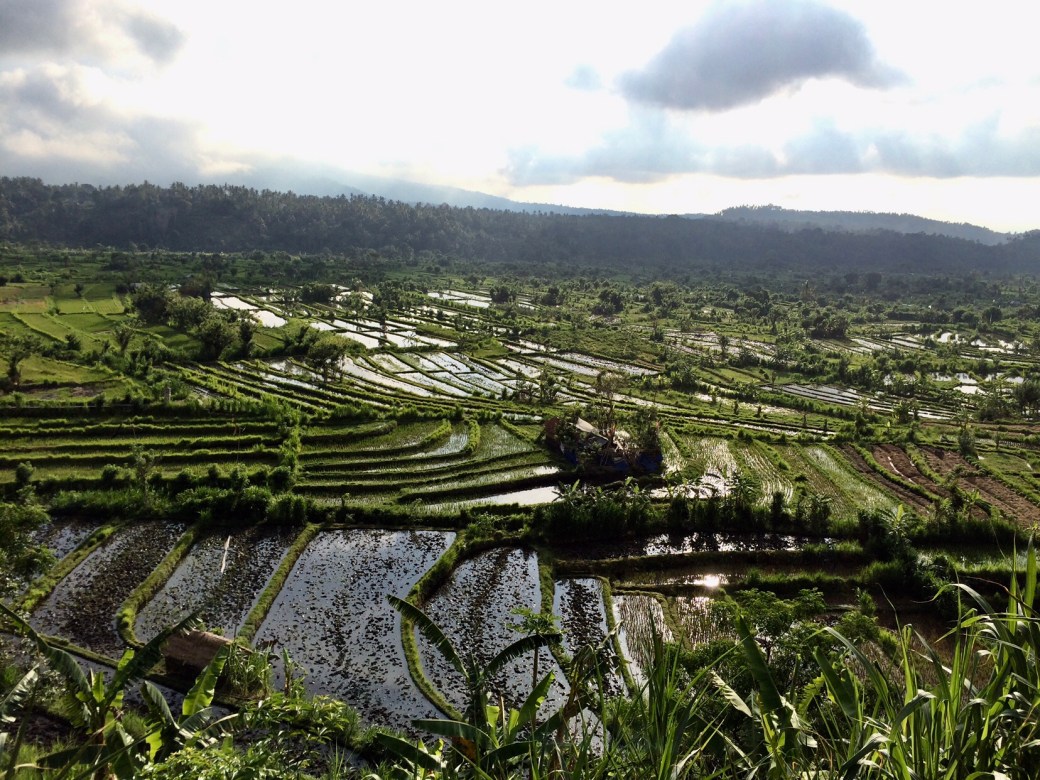 The subak is more than a thousand years old complex system of irrigation flowing from the mountains to the terraces rice fields and down to the flatlands through the water temples and into countless canals. The priests are the gatekeepers and the farmers play their part in the relationship between the humans, the gods and the earth.
 Animals, too, are part and parcel; the buffalo helping to plow and the ducks snacking on the snails.

 There is a bunch of guys, dressed in traditional clothes spread over every available surface armed with knives.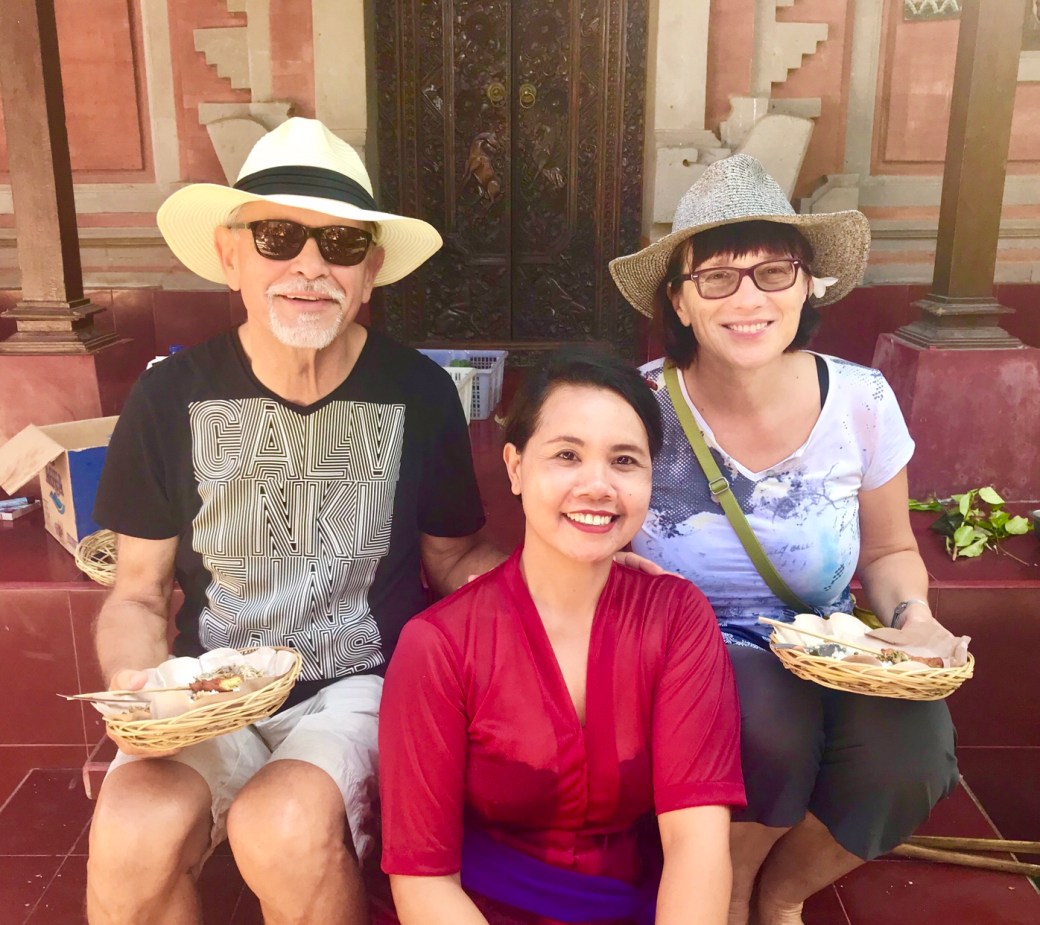
 Open the door to the family compound and scratch the surface just a little and you will find many similarities and dysfunctions to our western life; adultery, sibling rivalry and rifts, neighborly misconduct. Except that here, I am told in all seriousness, there is an additional aspect of black magic involved. The communities and clans are predetermined and the membership is a duty as much as a privilege. The many holidays and ceremonies and rituals are tightly prescribed and everyone is expected to show up and play their part. It is also quite an extravagant expense. But it is not to be helped. Ketut tells me she often has to borrow money so she can fulfill her ceremonial obligations. I try to argue that surely not the same is expected by the gods from a widow as is from a big family where many contribute. But the traditions are ingrained and it is vital that gods and demons are appeased and the forces of good and evil remain in harmony.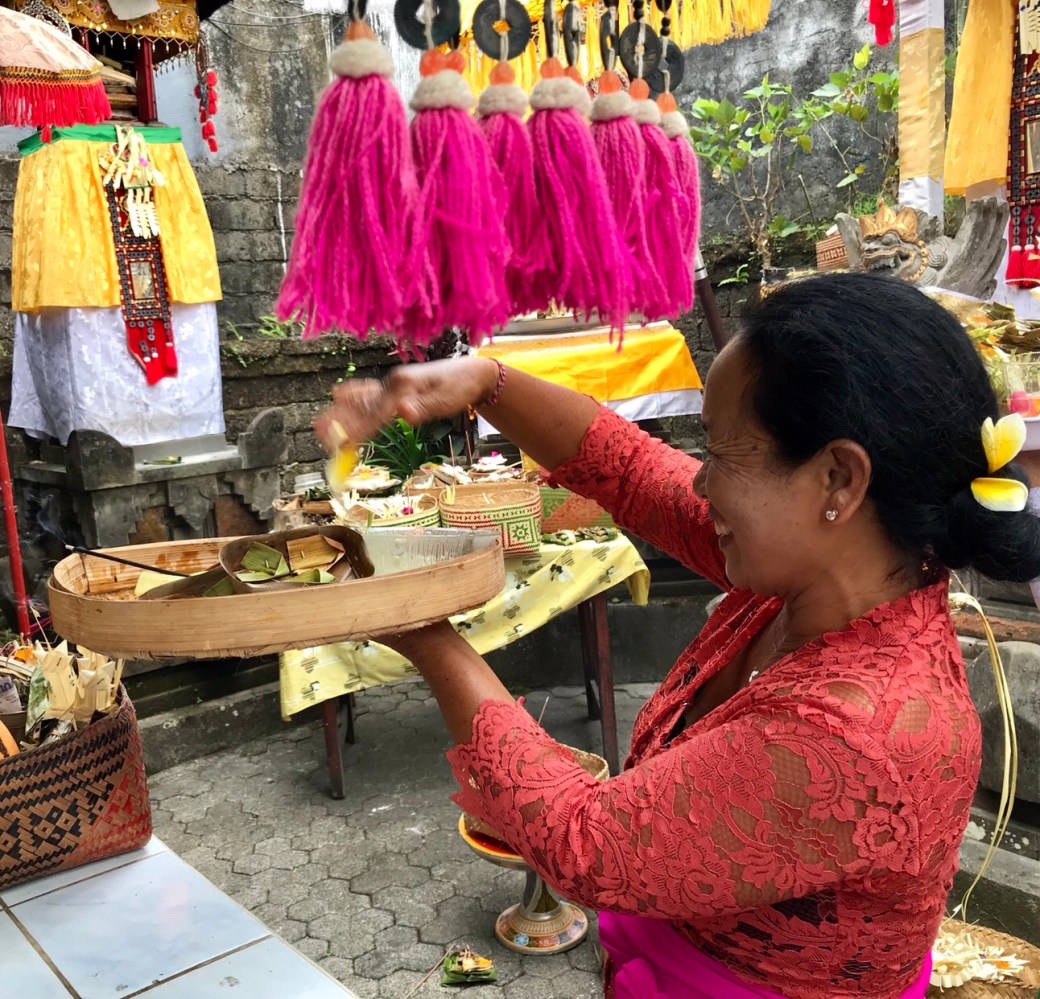
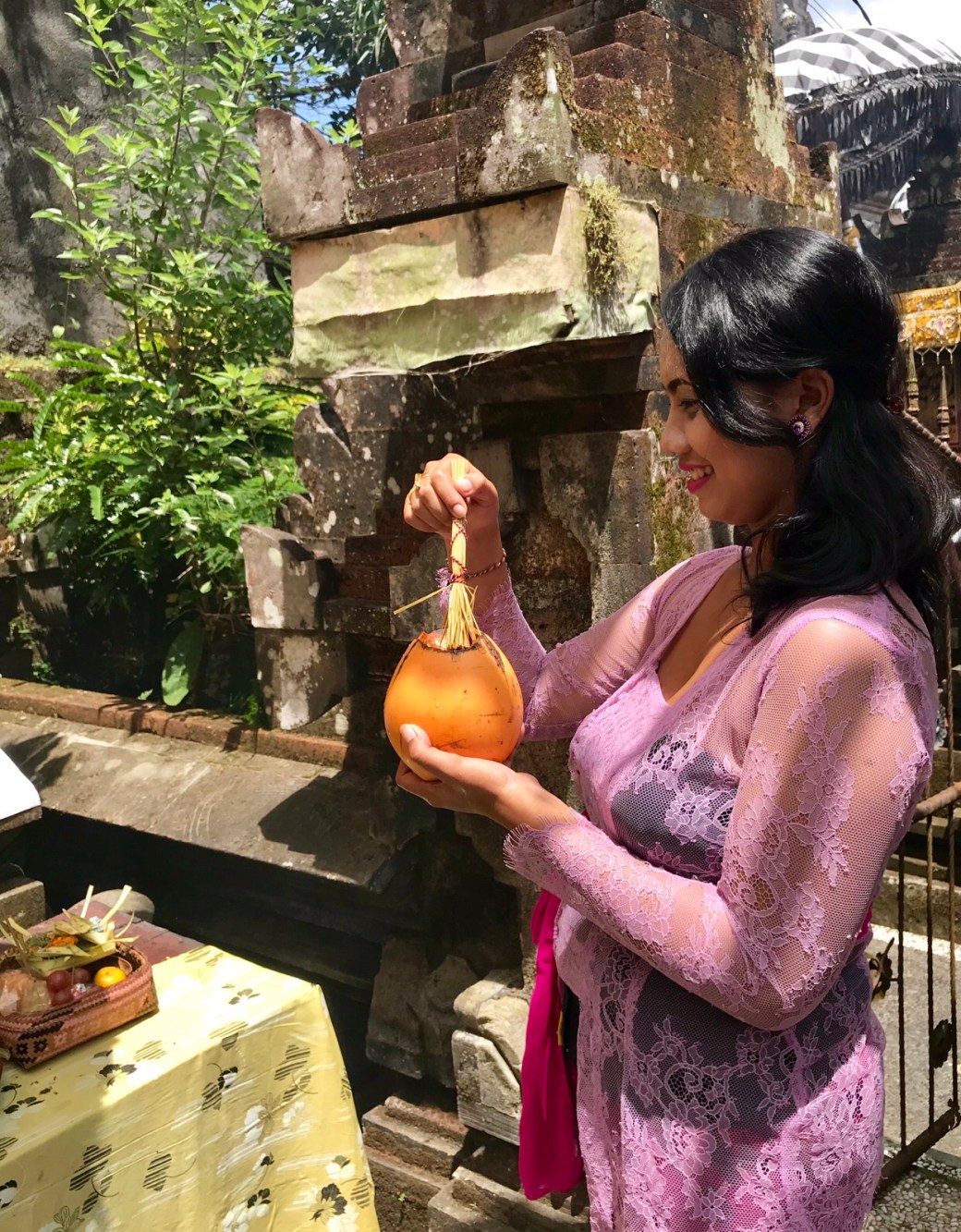
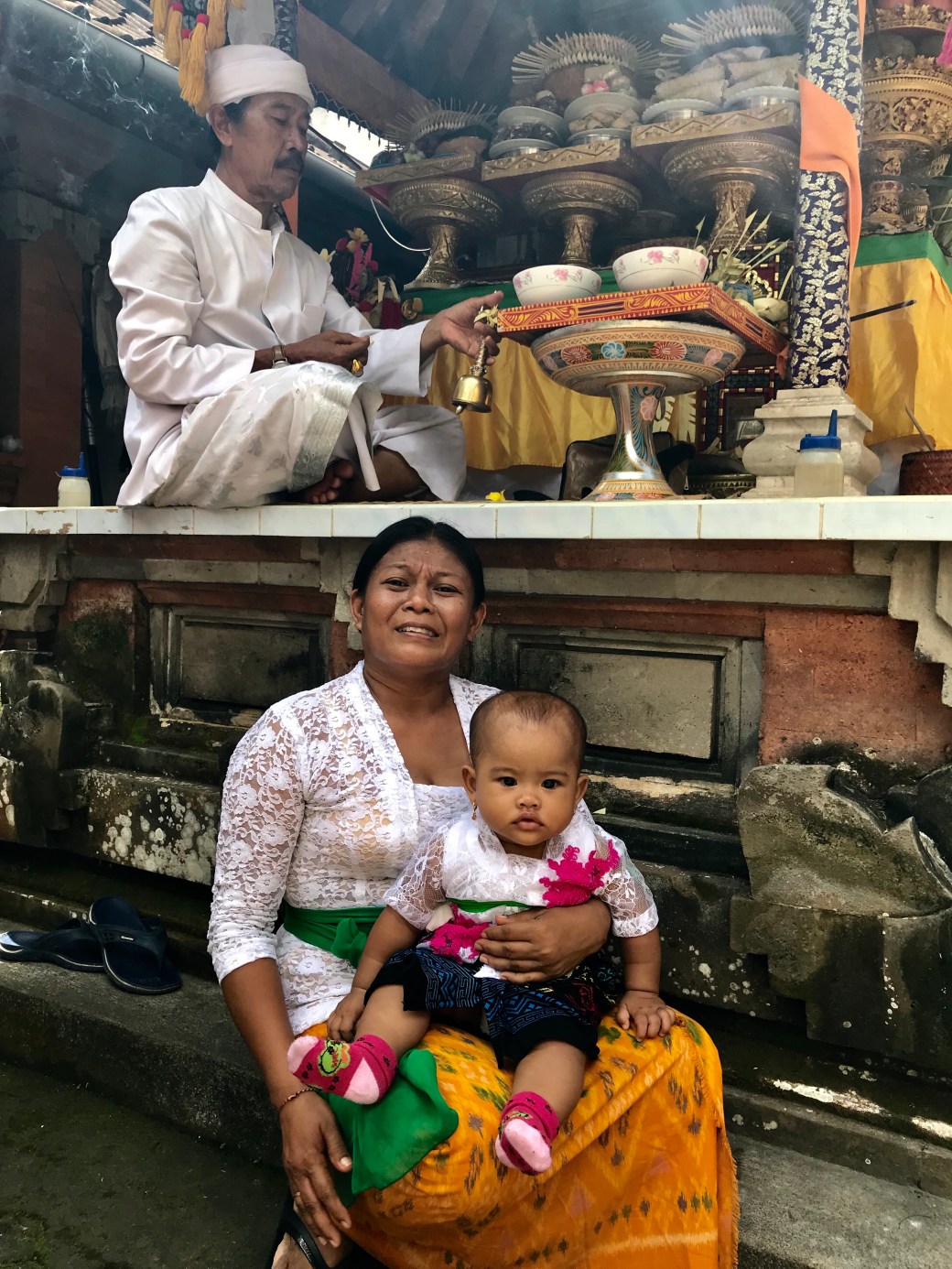
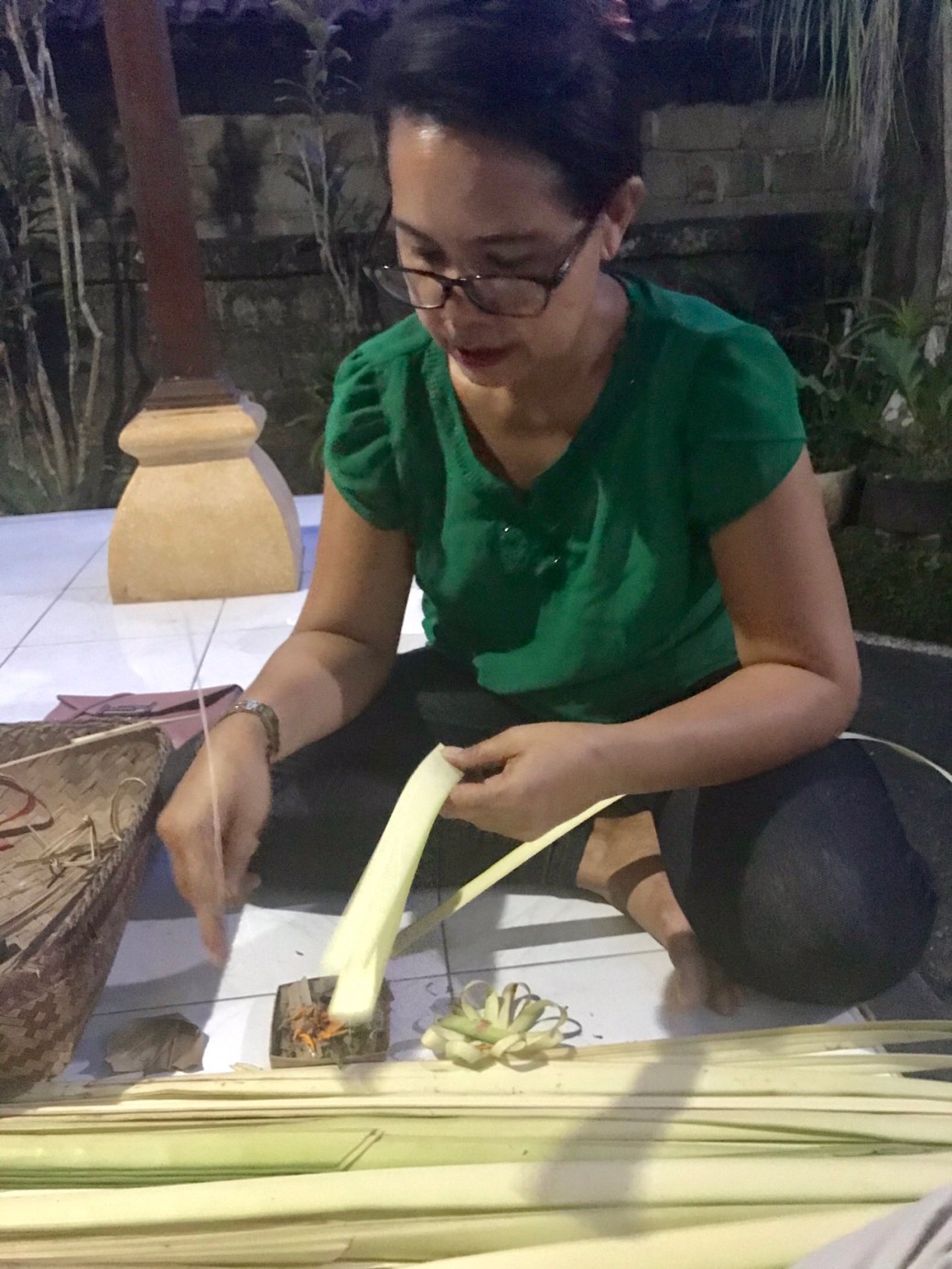
 Suddenly she says, “Western families are always nice to each other.”
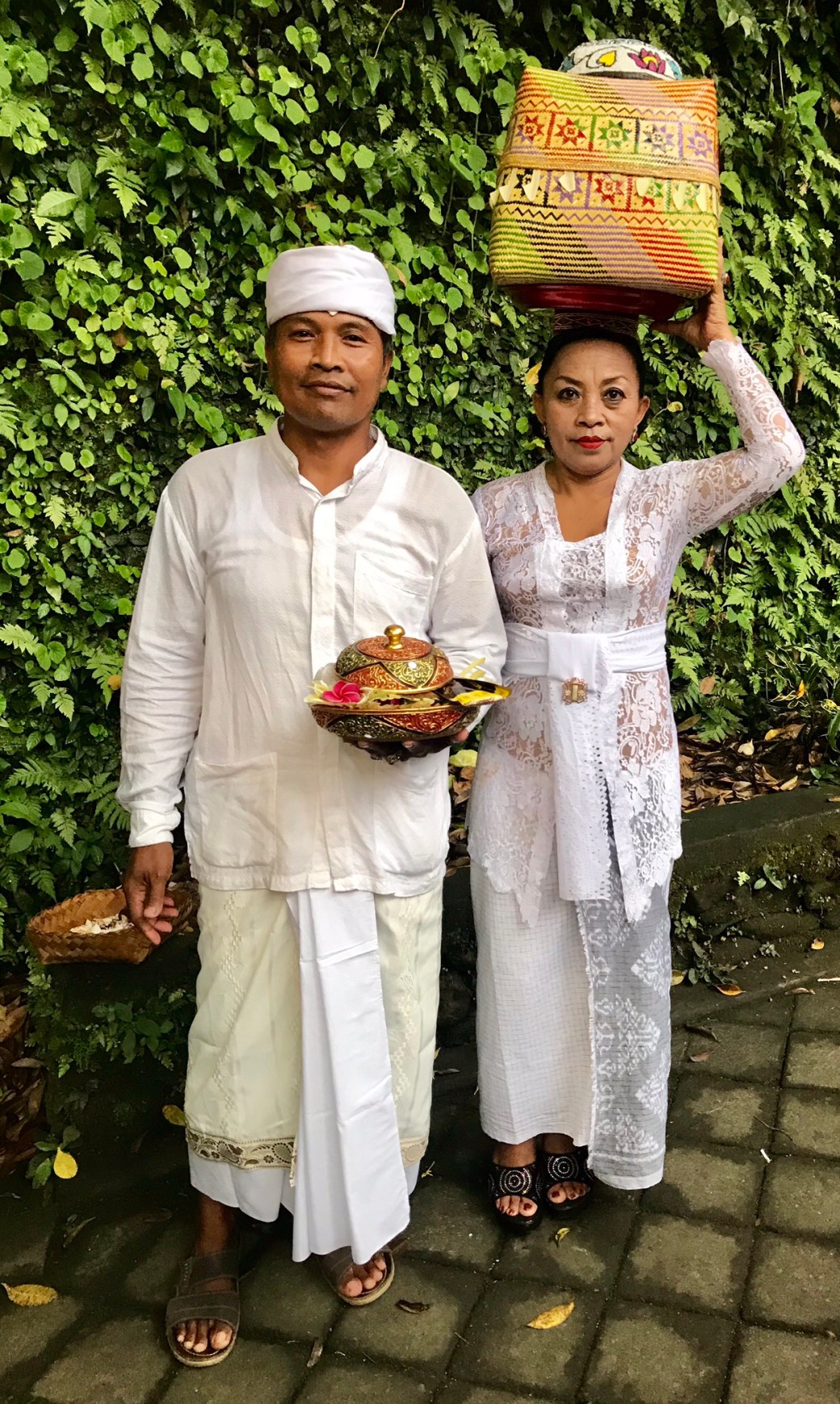 It took quite an effort to find appropriate (=fitting) clothes and Ibu Ayu had a lot of fun stuffing me into their traditional elastic stomach belt. She then proudly paraded me around at her local temple and introduced me to all her women friends, all dressed in identical white lacy blouses. And all that without a word of English spoken. We then all headed out with pretty girls in the front carrying tall offerings of many tiers of fruit, flowers, and cakes on their heads and men supporting their giant scary Barongs and Rangdas on their shoulders.
 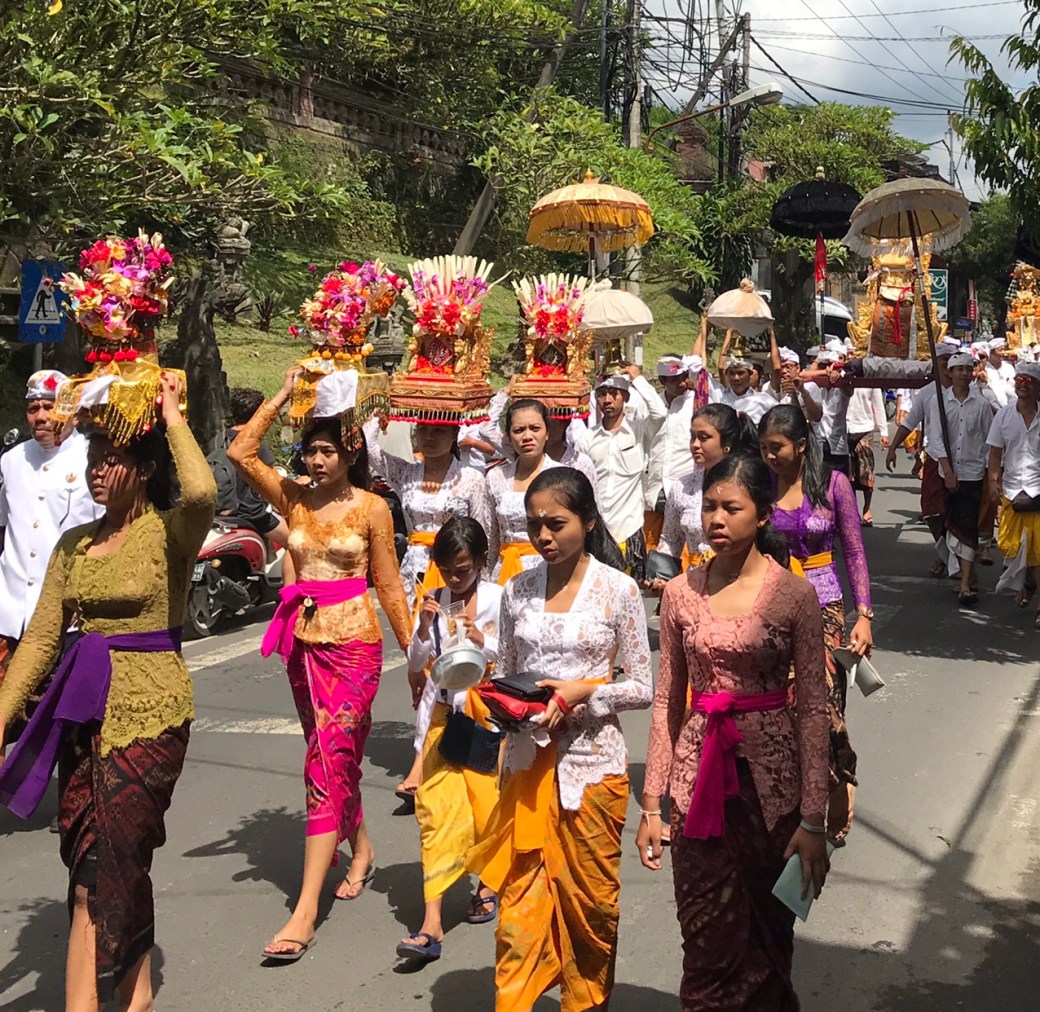 On the main road Jalan Raya (King’s Road) we joined the river of the processions from other banjars. The whole traffic was stopped for miles. All along the road the curious tourists were gawking and taking pictures. And for once I was not amongst them, but held firmly by the hand of Ibu Ayu, who trotted along in her high heels, with every single hair of her fanciful coiffure in place, (while carrying a large donation basket on her head), red lipstick accentuating her beautiful white teeth.
  This might be a religious ceremony, but it is also a place and time to show your beauty and your collection of best gold jewelry. I, on the other hand had to hike up my tight sarong to be able to stumble along in my flat sandals, wiping my sweaty face every few minutes with a soaked through bandana. When we got to the big Campuhan temple, she grabbed my disheveled self more firmly.
 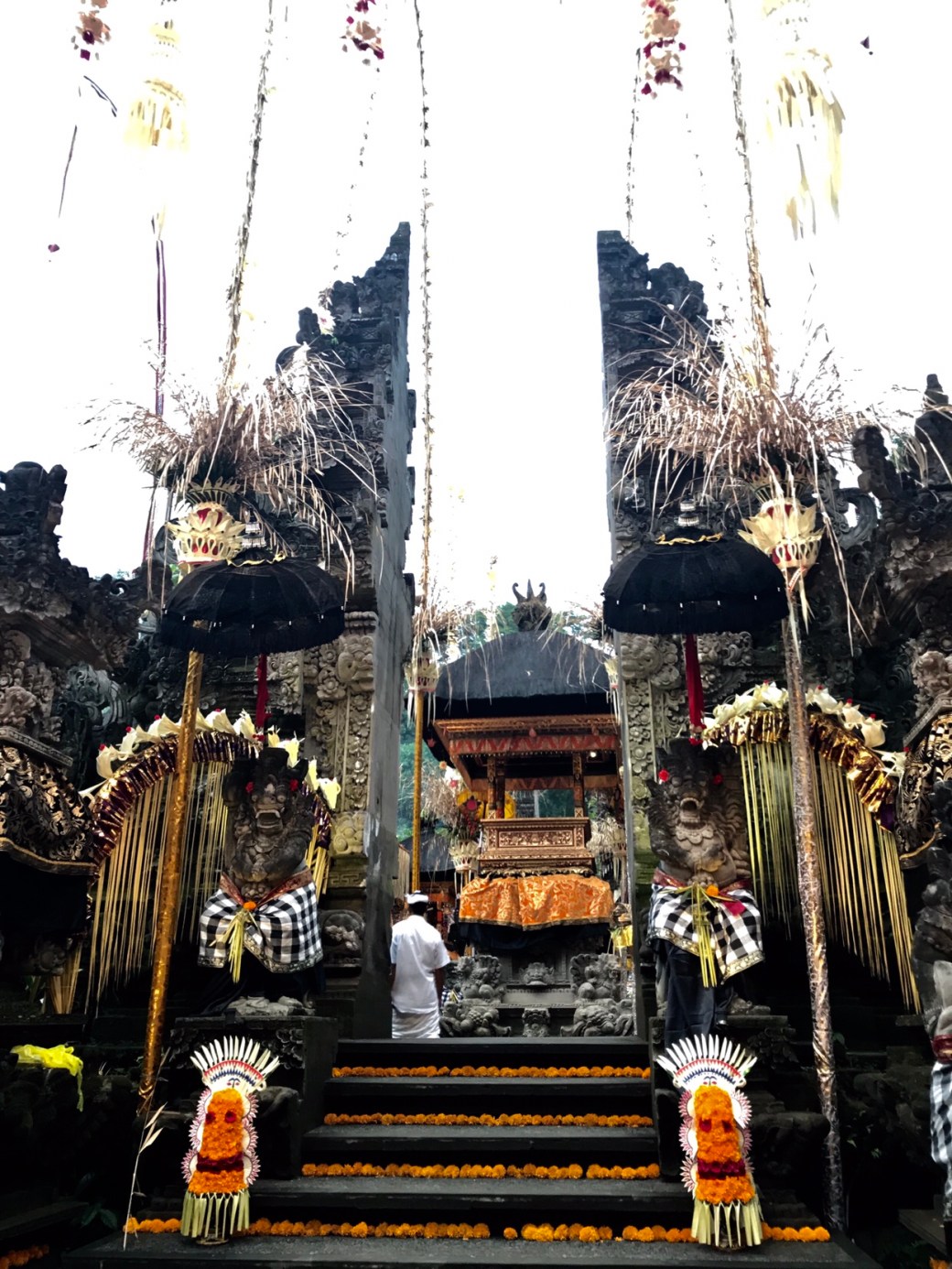 We went through the first gate and then amassed with all the other women and their baskets at the stairs leading through the gate to the inner circle. As dusk fell there was a surge and we all squeezed through and I was buoyed along to the top balustrade where the baskets were offloaded. We then walked down to the flat area where everyone sat in straight lines waiting for the blessings.
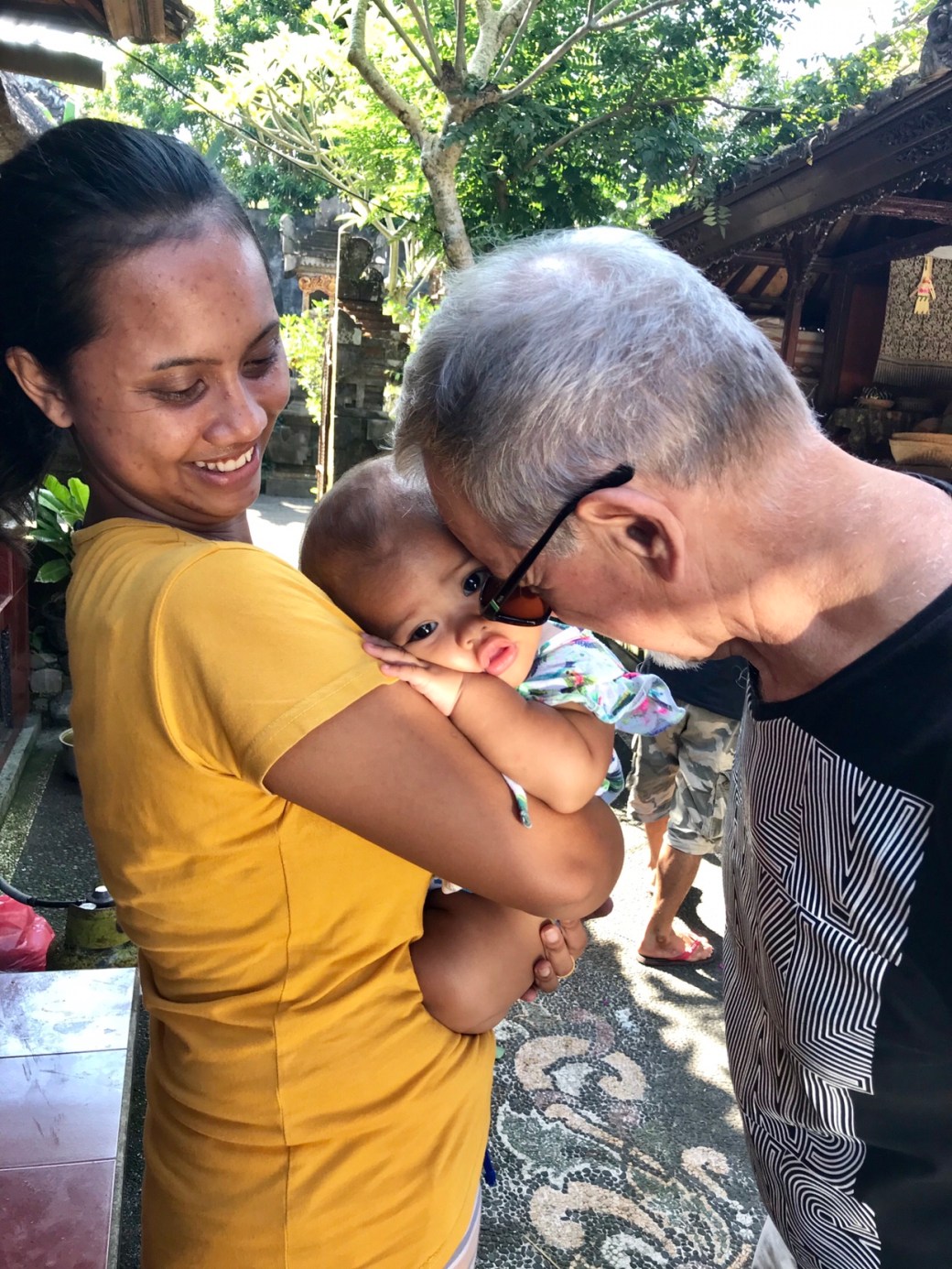
  it was sweet to see the families in their Sunday best. It was especially gratifying to see the dads so caring and attentive to their children. Balinese children are indeed loved, cared for and appreciated as few others. In fact, for the first three months a Balinese baby’s feet are never to touch the ground for the baby still connected to the spirit world and considered holy. And indeed they do not , as the baby is always in someone’s arms.
 The way I see it it is the music and dancing and drama and socializing that is the more exciting part of the celebration rather than the “religious service” itself.
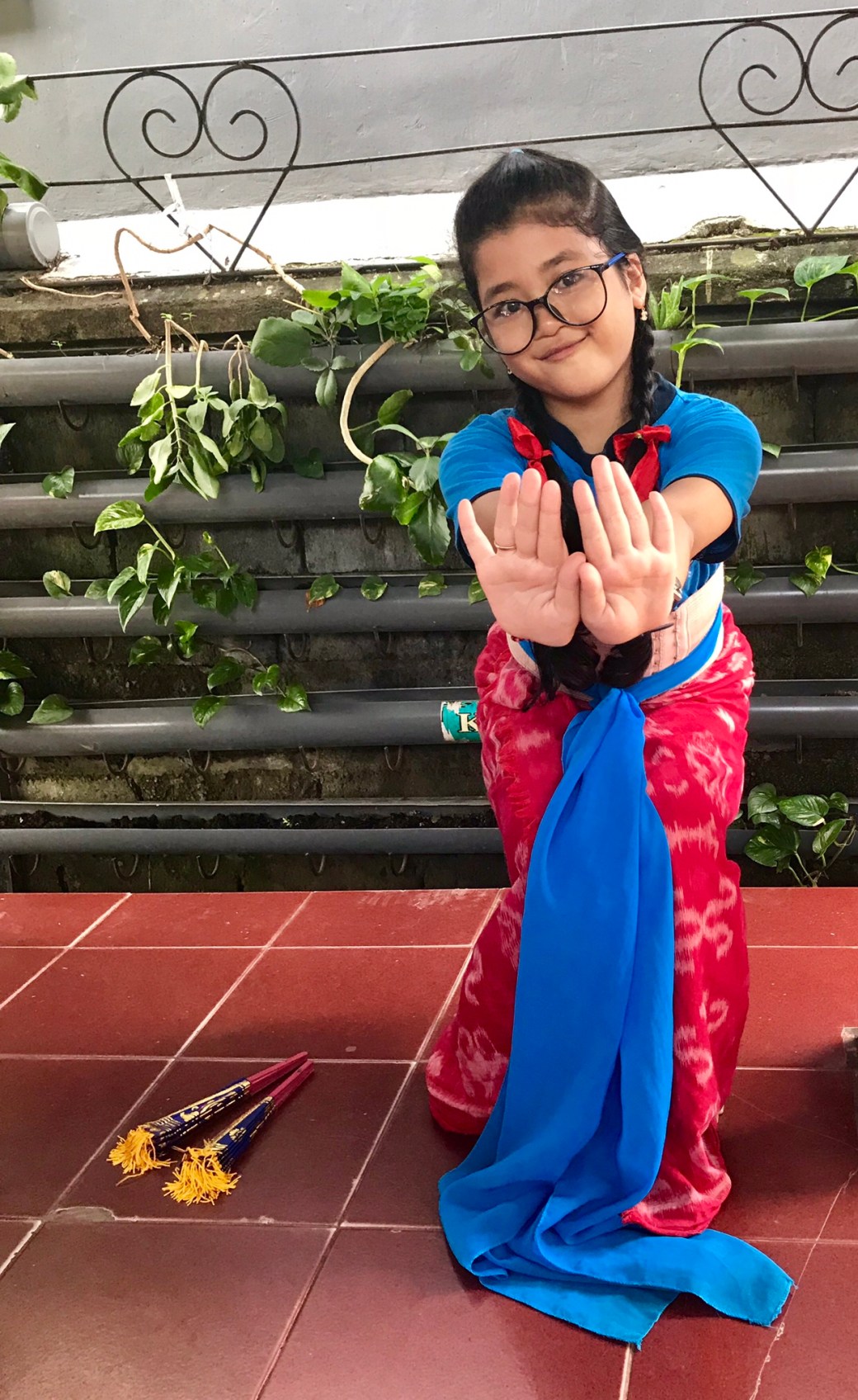
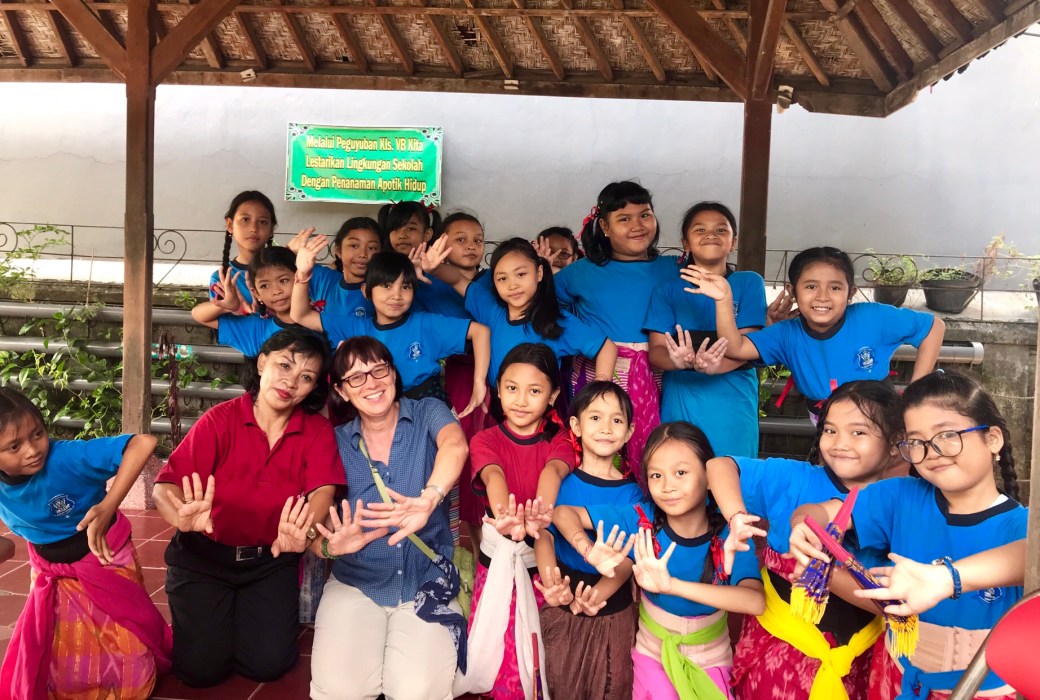 Learning that Ibu Ayu was a traditional Balinese dance teacher I arranged (=invited myself) to visit her class in her elementary school in Denpasar. You have to start young to be able to bend those fingers backwards and move your neck side to side. I don’t know who was more excited by the visit, me or the little girls. It was clear that some have been taking classes for awhile and some were just beginners, but as this was part of their daily school curriculum they were all together for the hour.
  It was wonderful to see their teacher so animated when showing the movements and making jokes all the while. Even without understanding the language I could see her funny imitations and the girls cracking up. At the end of class I asked each girl to take a photo in her favorite dance position. On the way back to Ubud I was showing her the pictures and she was classifying the girls by their talent.

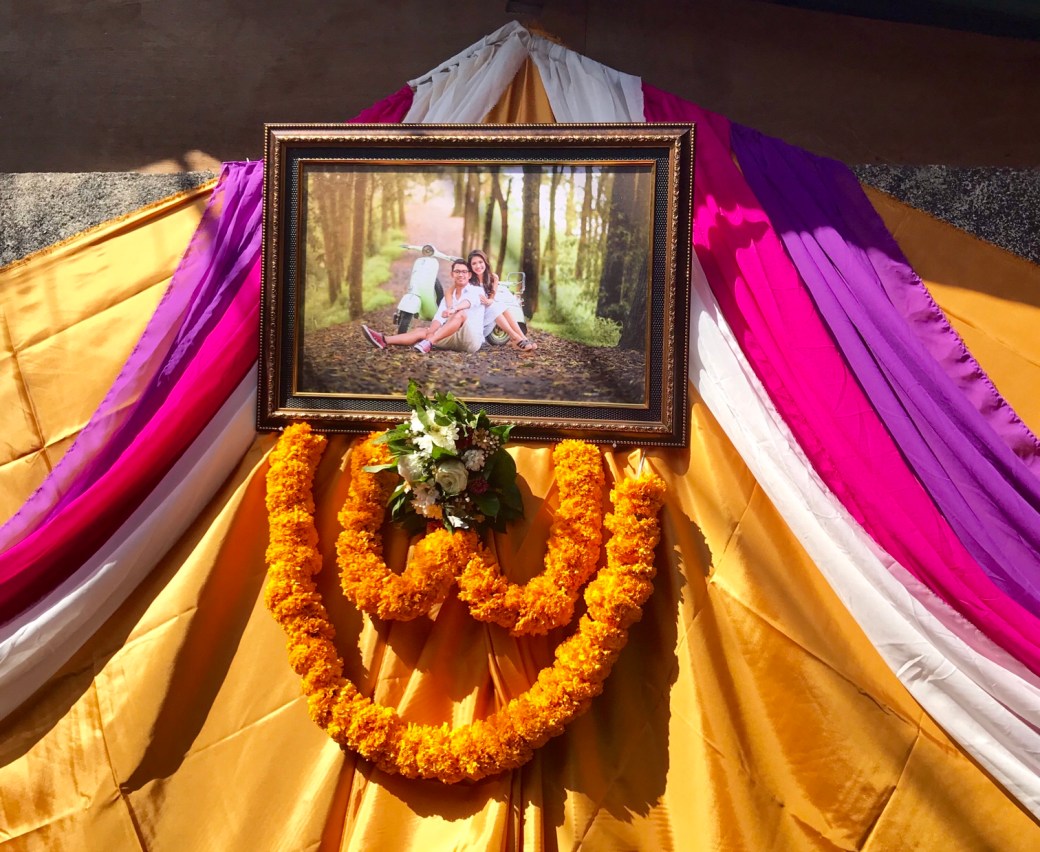
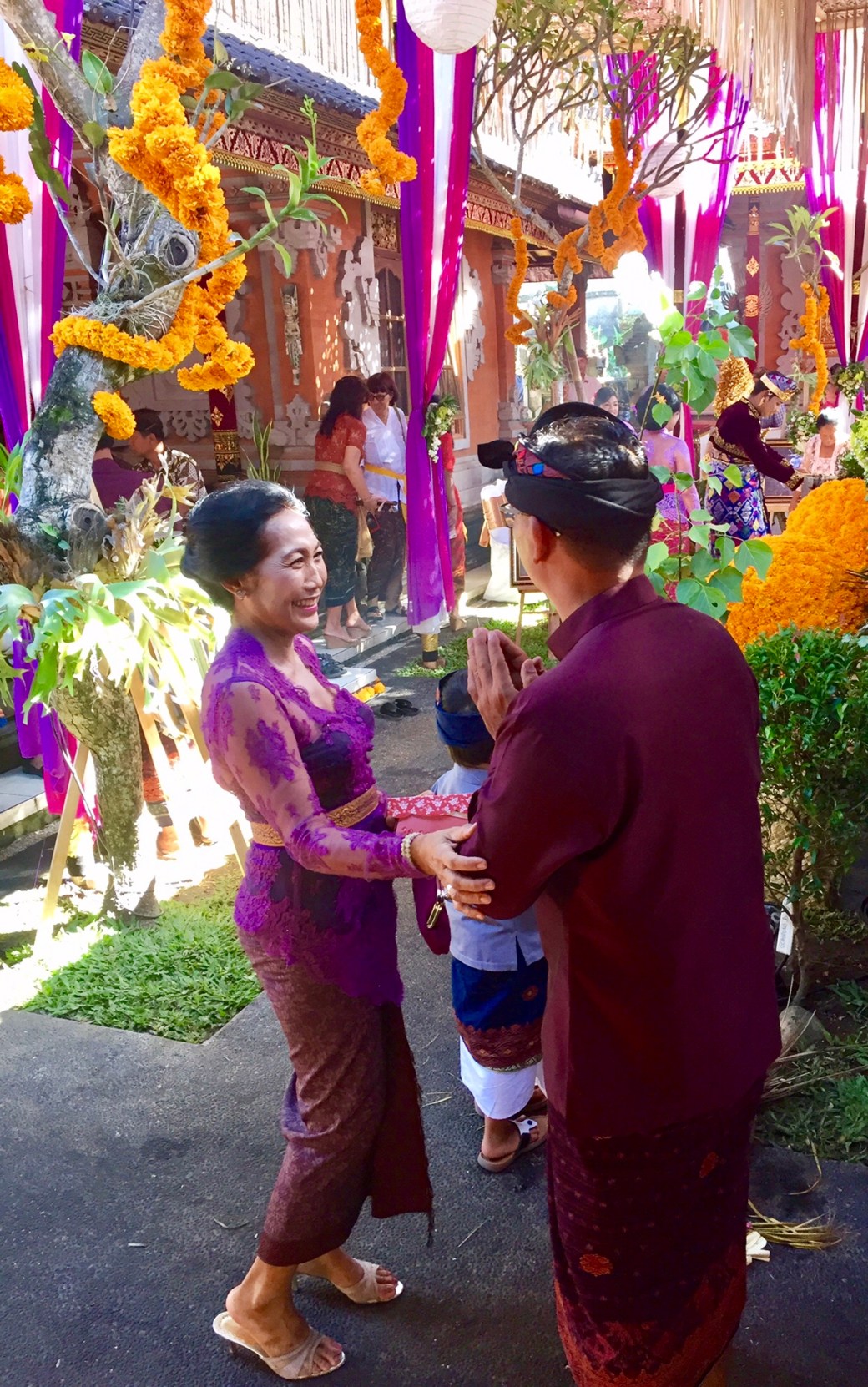 They all seem to be chatting amicably with little attention paid to the wedding ceremony going on. I am tickled pink that I can gauge the gist of the actions without understanding the language.
 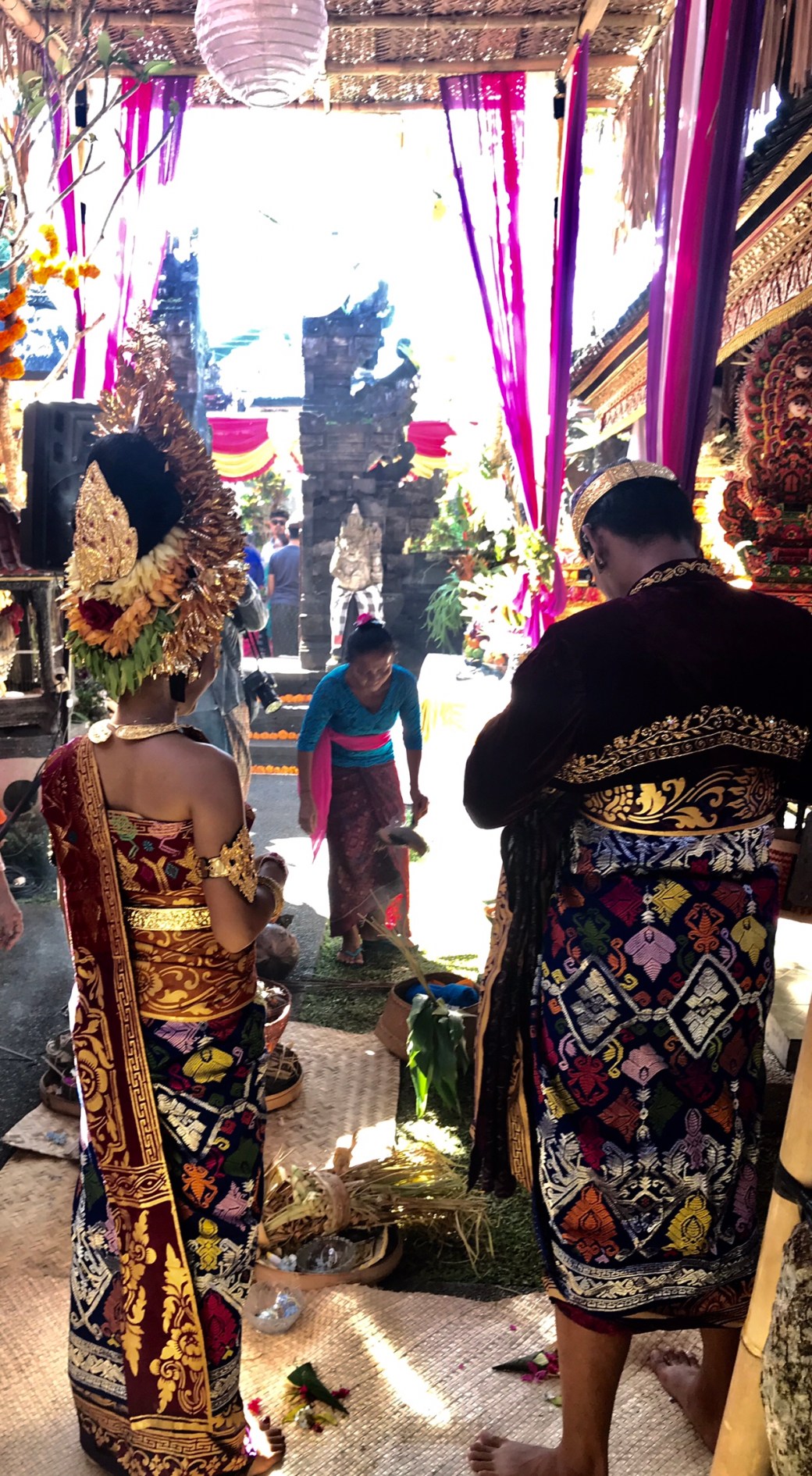 A woman is giving advice to the elaborately bedecked couple, and there is some embarrassed laughter. The bride and groom are symbolically acting out the traditional work, working in the rice field, going to the market.
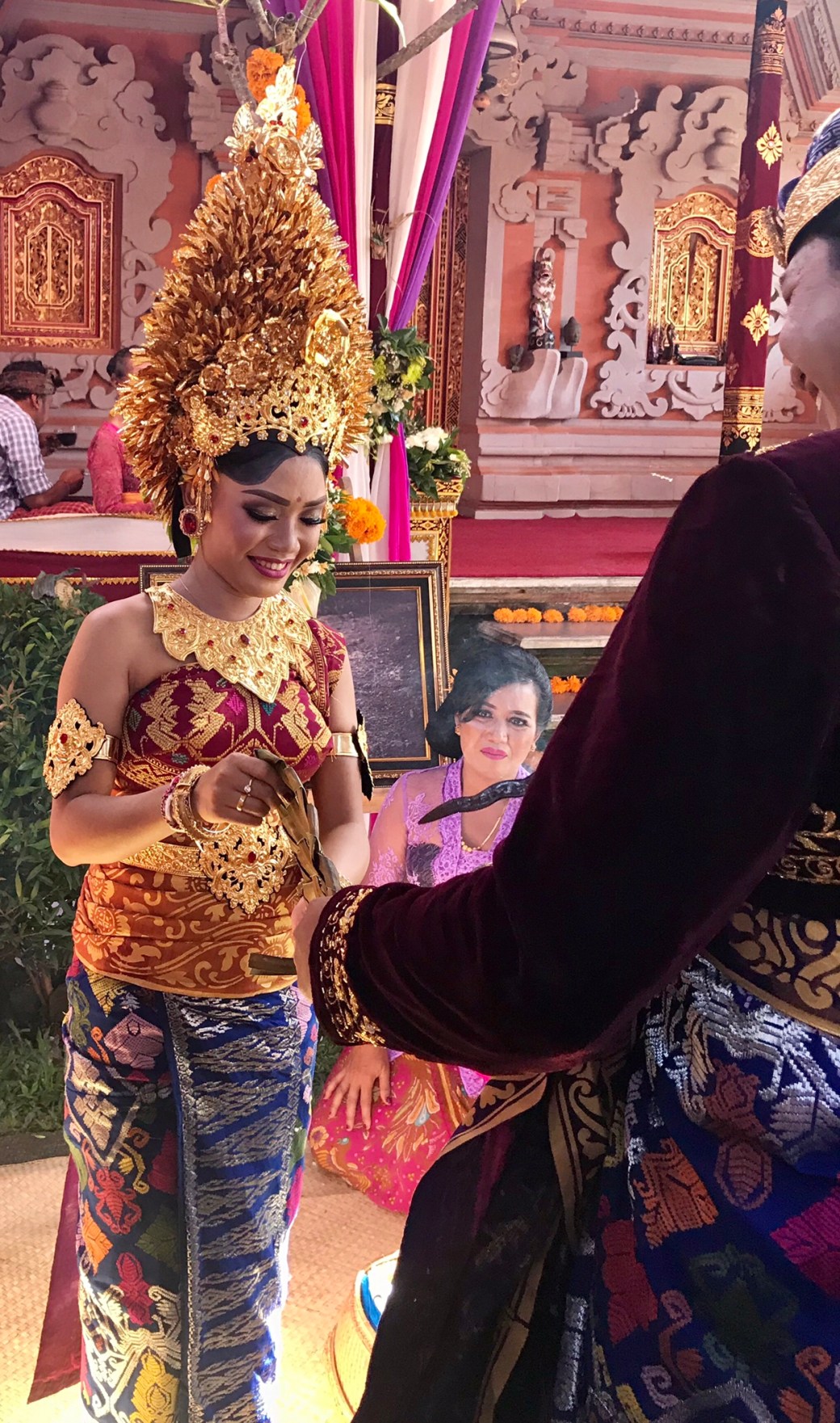 Not much room for different interpretations here, hm! Though in this case it really has a very symbolic and somewhat redundant role, as it is a well known fact that the bride is pregnant. Nobody is much bothered about that, in fact, it seems this is becoming a norm in Bali. People only get married when both sides have proven they are capable of begetting a child. Which is a very important duty of a Balinese couple to fulfill so the family traditions and the worship at the home temple and the core of the whole Balinese social structure continues. In fact having a child as a couple is so important that if a couple can not have one, they will be able to take on one of the relatives’ babies to bring up as their own. When a young Balinese woman first told me this, I was not quite willing to accept it.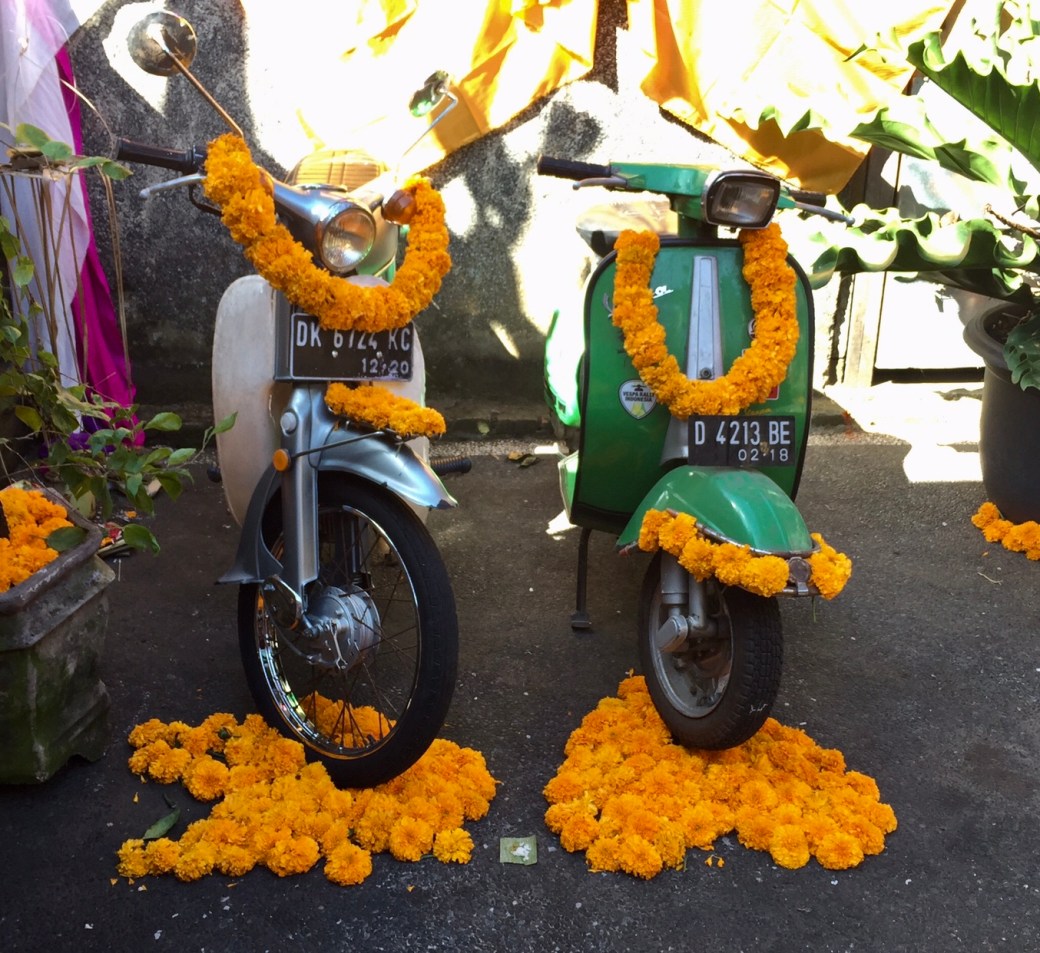



 As we kept on progressing on bumpy, windy roads and continued climbing and climbing, the question begged to be asked: “How high are we really going?”
 “Any iron bars in those walls?” Mirek would ask.
 A detailed guided tour around the center to see the music room and art classrooms, computers and DVDs. A craft production space making earrings, that I had to buy, of course. A small guest house and a cute store with finished products. A modern dental clinic. A peek into the kitchen. Everything organized and tidy. Many, many local kids and their families educated and helped. All accomplished by a Brazilian couple who moved here with their two teenagers 10 years ago. Unbelievable. Not a minute or a penny wasted. If only this blueprint could be replicated in every village on Timor Leste and beyond.
  True, they were poor but they did not beg or hurl stones like in some other countries we visited. They were sweet and most importantly, took care of each other.

 To stop my incessant demands to pull over so I could get yet another picture, the guide promised that he would take us first thing when we arrive at our destination in Maubisse to a Portuguese Pousada with a 360 degree view. And what a view that was. Holy crap!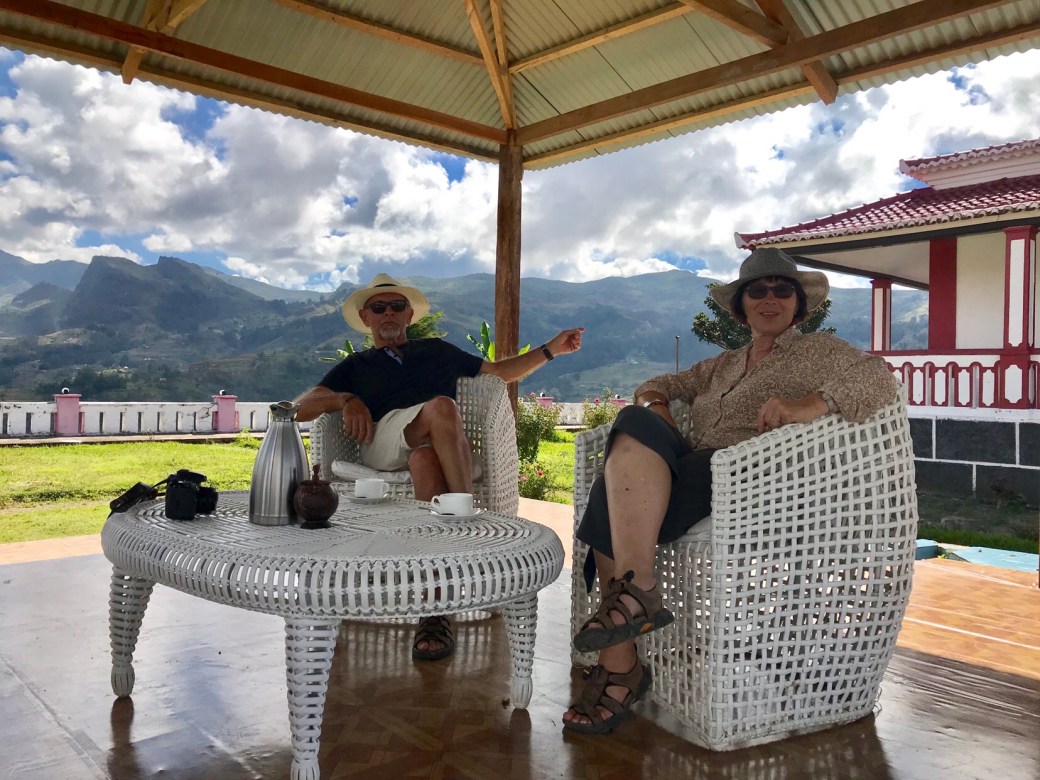

 Upon the suggestion of the good doctor we drove to the other side of the valley and pushed up and off-road to the top of a hill to find a traditional sacred house and a Christian cemetery in a peaceful coexistence overlooking another beautiful endless range of mountains.
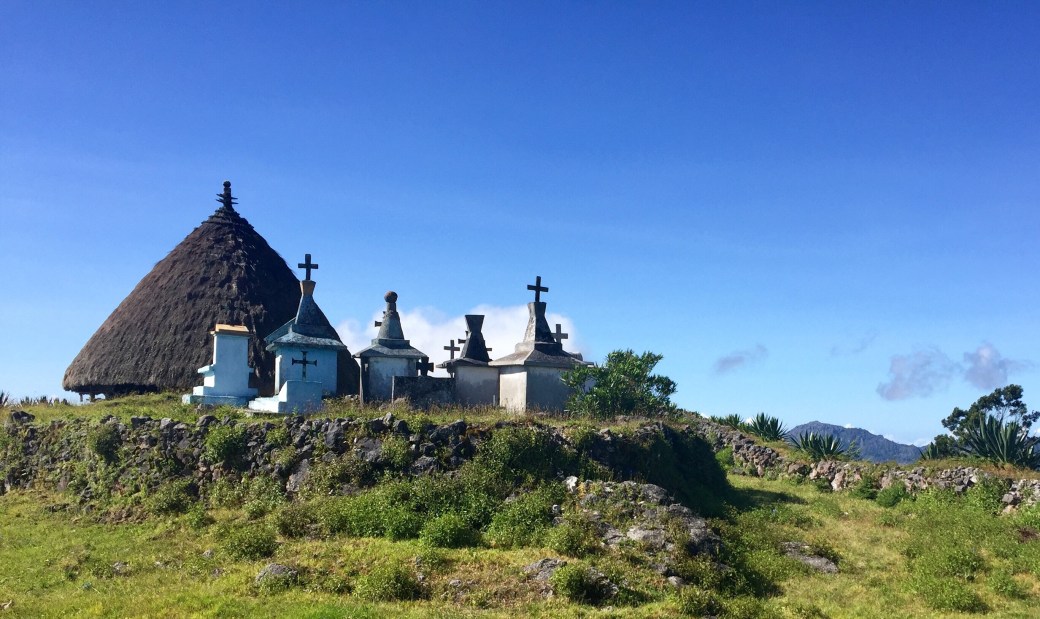 Bellow us a herd of small brown horses was munching contentedly on fresh mountain grass
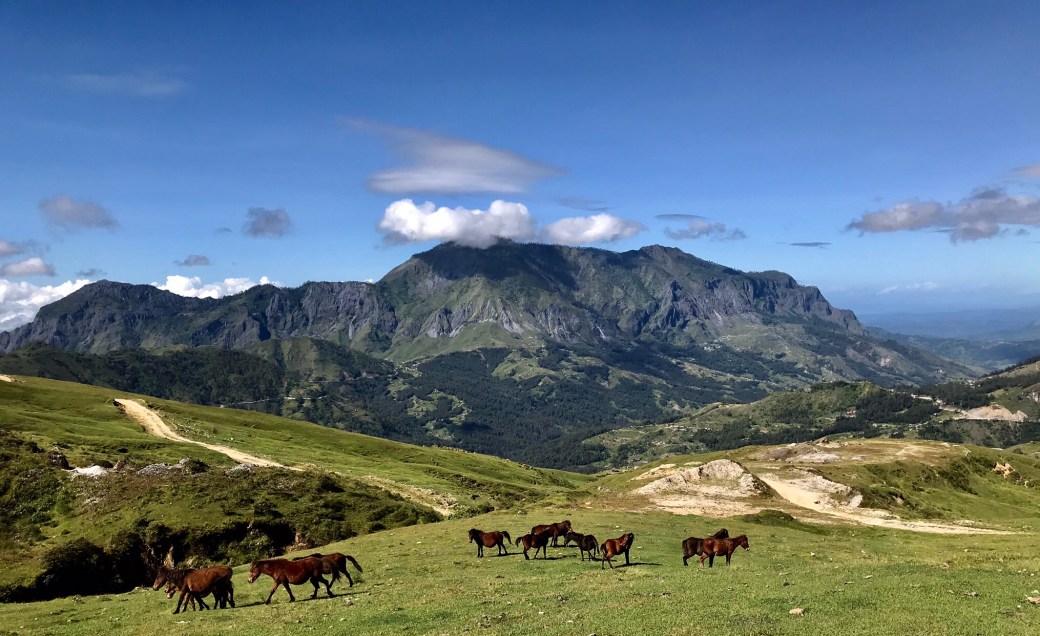 and on the other side were–3 cell phone towers! As in so many god forsaken places in the world, progress is coming not with reliable electricity or running water or sewer and garbage collection but with cell phone towers from competing providers. Not that our cell phone worked, mind you. So far Timor Leste is the only country on our travels where T-Mobile did not have a reliable partner.
 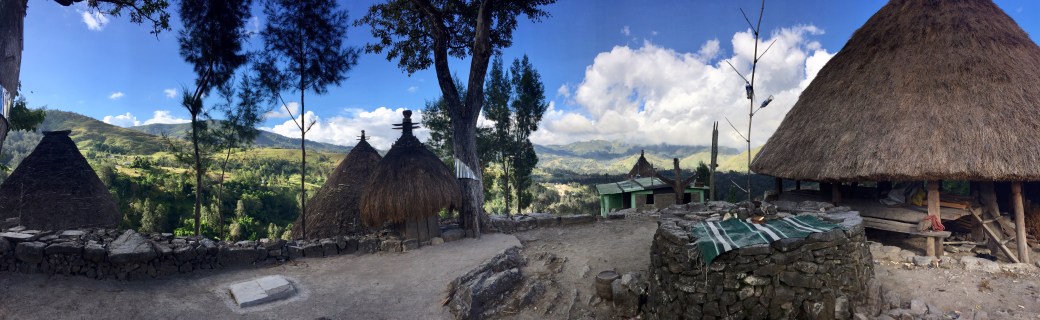 They are all called Uma Lulik and the only discernible difference to me is that the men’s house has a long rectangular wooden top and the women’s a short round stick with two pairs of “arms” through it. It rather didn’t vibe with my female-male symbolism but then I noticed that the male house top ended in a form of buffalo horns, a very masculine symbol of strength. Indeed their old religion was also their moral code and it functioned on the balance of feminine life giving power with the masculine power of protection. When both were respected and in balance all was well with the world.
  When you visit a sacred house, a box of bettle nut comes out as a welcome and is put next to the sacrificial totem. For us as foreigners there was no expectation that we would chew in the spirit of camaraderie, but there was an expectation of a few coins put in the box as a donation.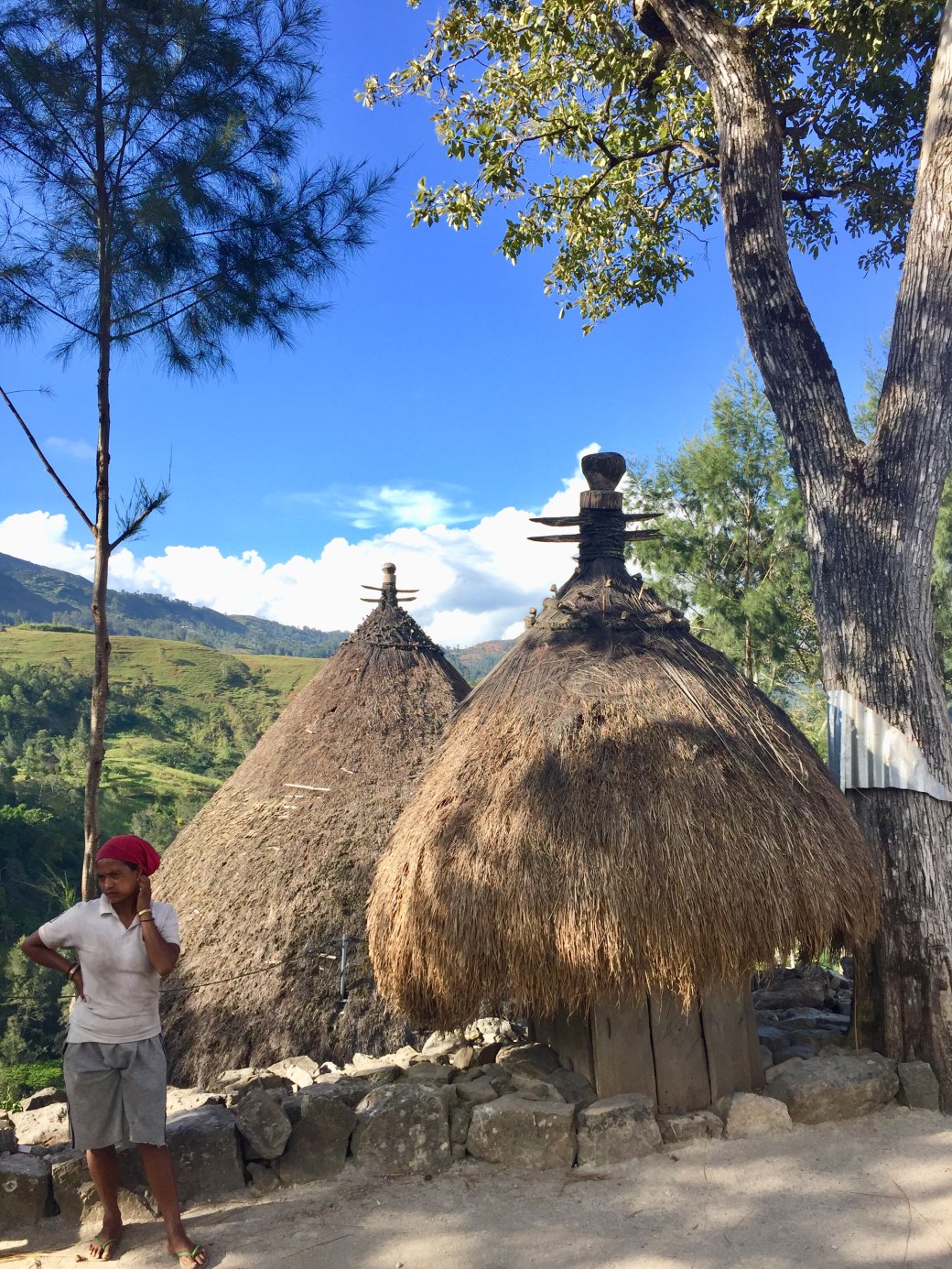

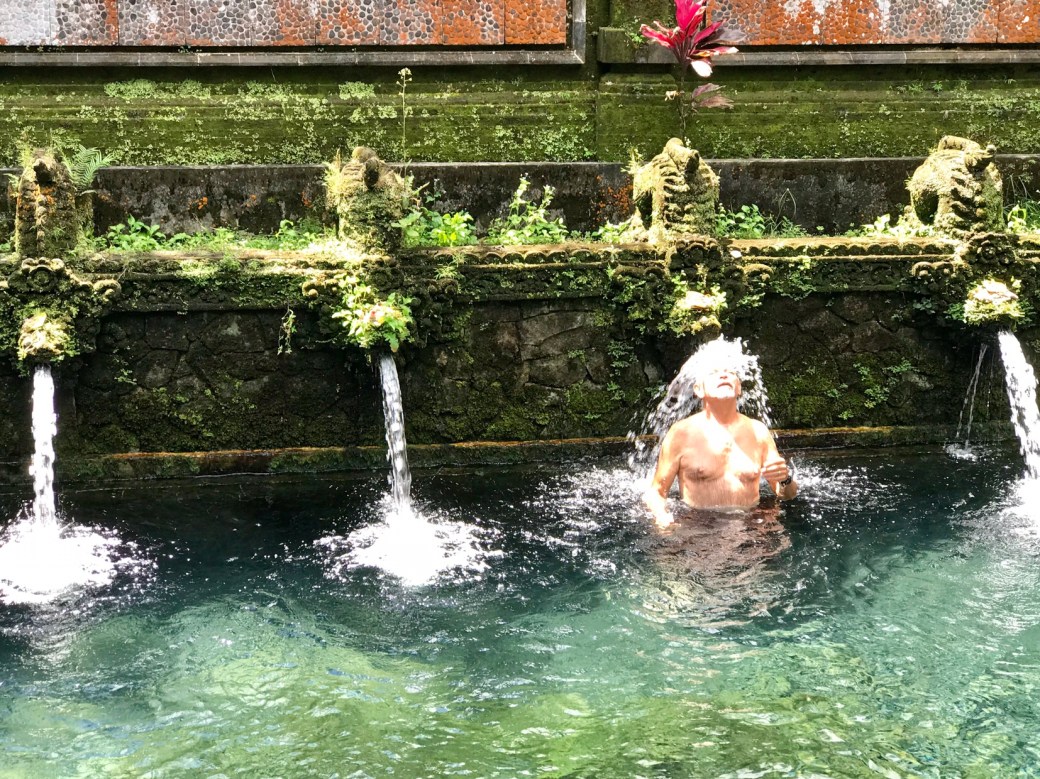
 I heard there was a sacred spring close by so I asked if we would be allowed to see it. I was happily surprised when they agreed. It might not have been true, but we were told that we were the first tourists they took there. Indeed our Timorese guide Charlie himself had never been there. The two small eternal pools were beautiful and they were female and male, as well. With the stones laid deliberately around the water, to me, they looked like yin and yang.
  When Charlie, who is a film maker when he is not guiding, showed them the pictures on his fancy camera, one of them frowned and said,
 “Don’t show me my ugly old face!” And everyone started laughing again.
 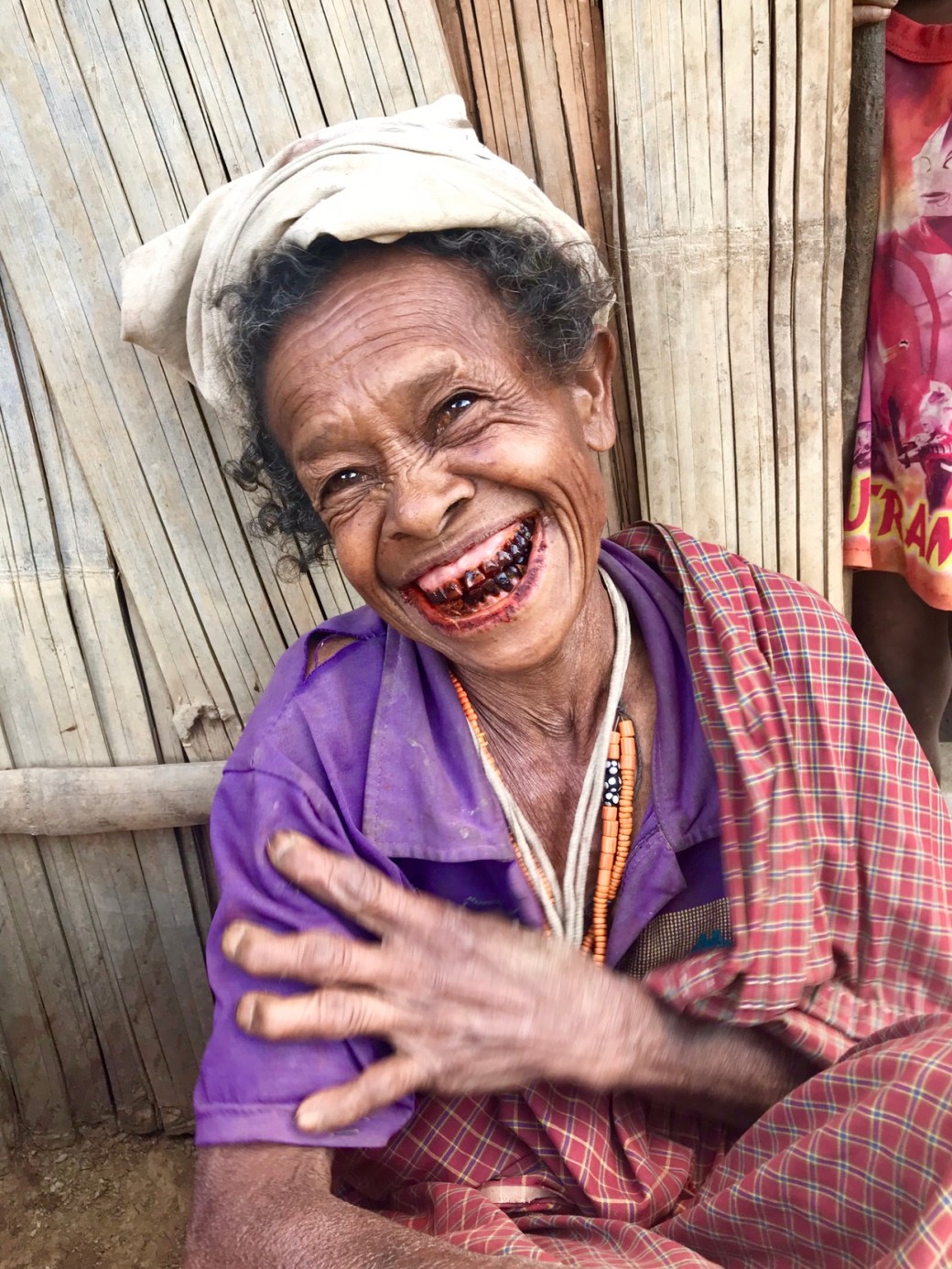 They both had hands worn out by hard work and prominent tattoos on their arms with their original clan, non-Christian names. Why? So many questions, hard to get the answers through interpreters. Charlie ended up being gifted fresh ears of corn to take home to his wife. It is always touching to see people who have so little, being so generous.
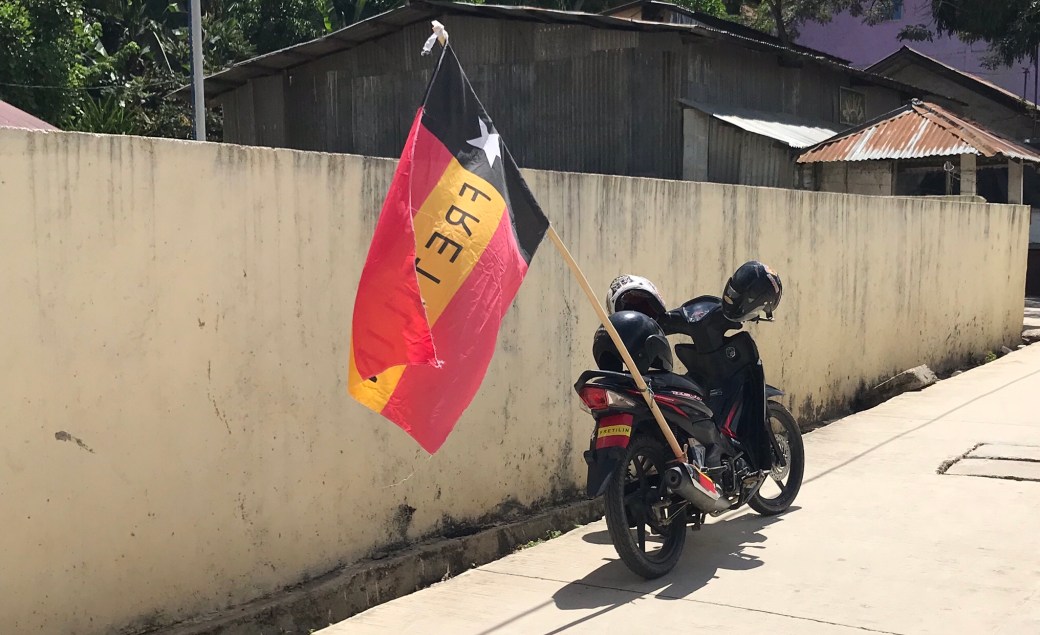
 While I must say that Kashmir had been one of our biggest travel disappointments, Timor Leste was one of our biggest delightful surprises.
 You might not know where and what Timor Leste is and even less so that there are actually two Timors. On the same island. Kinda like two Papuas. In both cases it is the Indonesians that control the West half and the East is independent. Independent Papua New Guinea and Timor Leste. To make it a bit more complicated Timor means East (in Indonesian) and Leste means uh, East (in Portuguese). So we have a country of East East. A nice tautological toponym. Oh yeah, I am just showing off my googling skills.
  Oh, all right, enough already. Get to the chase. The travelogue!! OK, OK. Here’s the deal. After doing some precursory Internet exploration on Timor Leste we just about gave up for as the tourism goes the picture was very bleak. Not many flights going there. Really expensive and not just by Asian standards. Tough to travel through. Not a single road finished, only one or two hotels outside the capital. Oh, and the only local currency accepted is, no kidding, US $. Which of course we don’t have on Bali.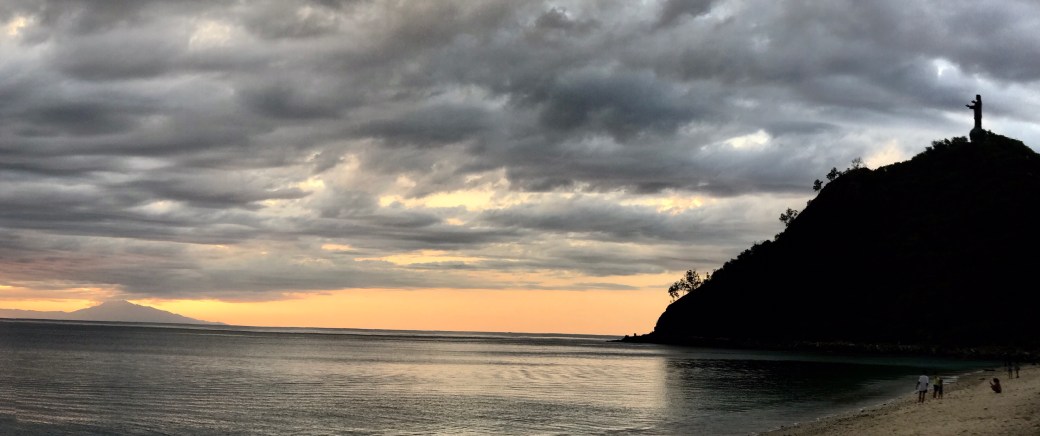
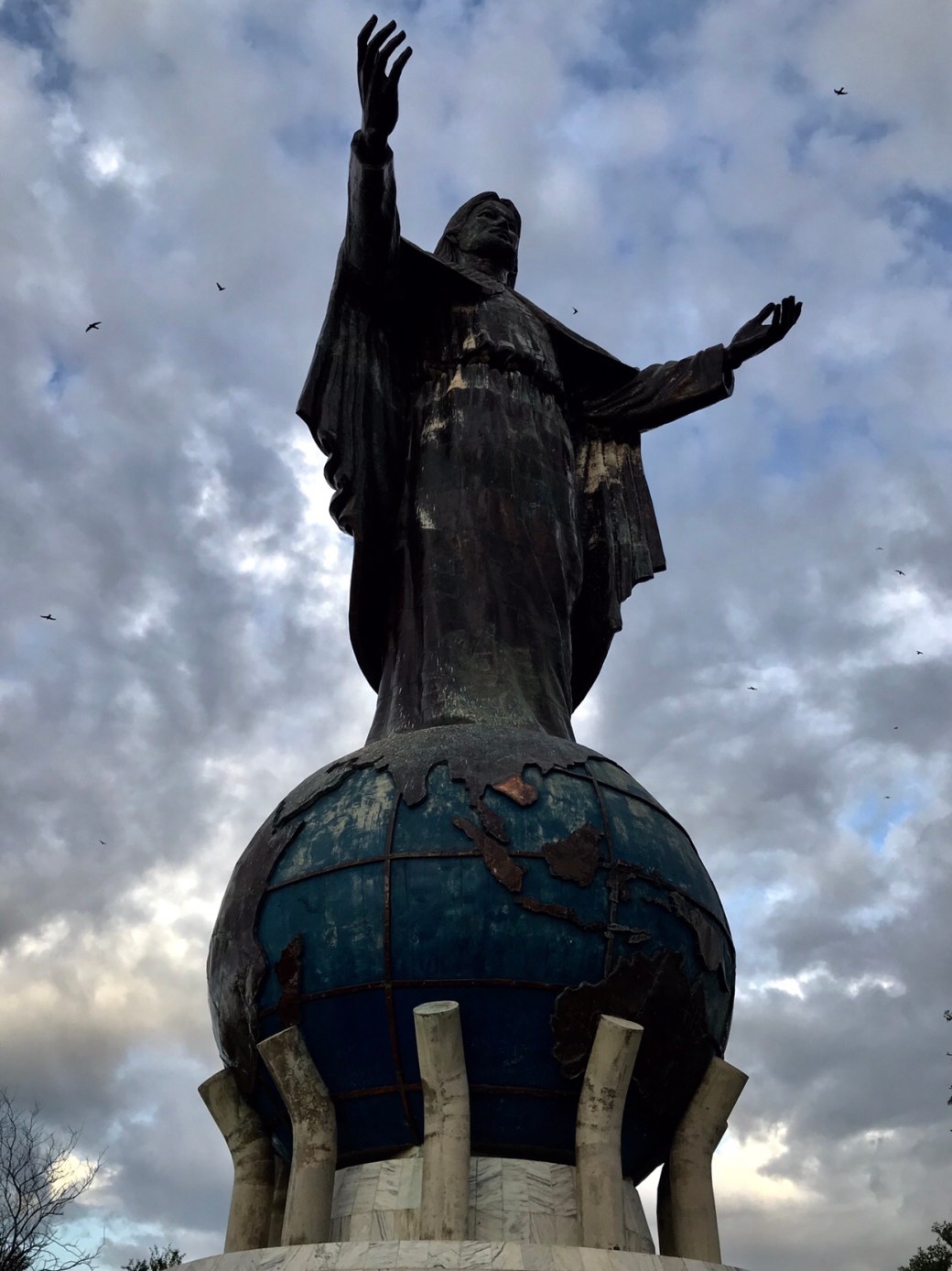 The capital Dili is really not much to write home about: a presidential palace, a bunch of embassies behind high fences, some Catholic churches (that saw massacres of protesting students seeking sanctuary- a concept not familiar to Indonesian Muslim soldiers) and two anchoring statues: a decently large Christo Ray (second only after the one in Rio) looking over the bay and a stately Pope John Paul II. While pope was all alone but for a team of cleaning ladies languidly sweeping, Cristo Ray was besieged by an army of local joggers. There is always money for churches and religious sculptures, even when it is lacking for roads or children’s hungry stomachs.
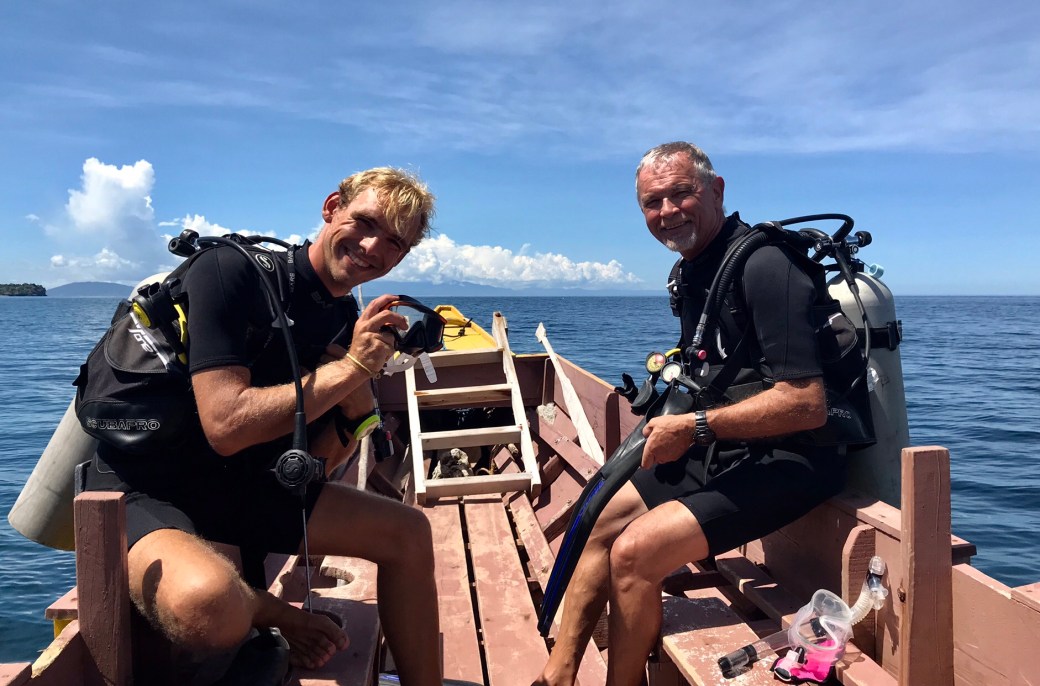
  I am under oath by Mirek and his few diving buddies not to disclose the name of the first one, a small island where we spend three days on and under water. They simply don’t want anyone to find out and encourage the influx of diving outfits and liveaboard boats. Or god forbid fancy resorts.
  As it stands now there is on this secret island only one hotel with 4 rooms. We were the only guests there and were very well taken care of by the numerous staff even if our conversations were rather limited with a few words of English and Portuguese not quite sufficient on both sides.
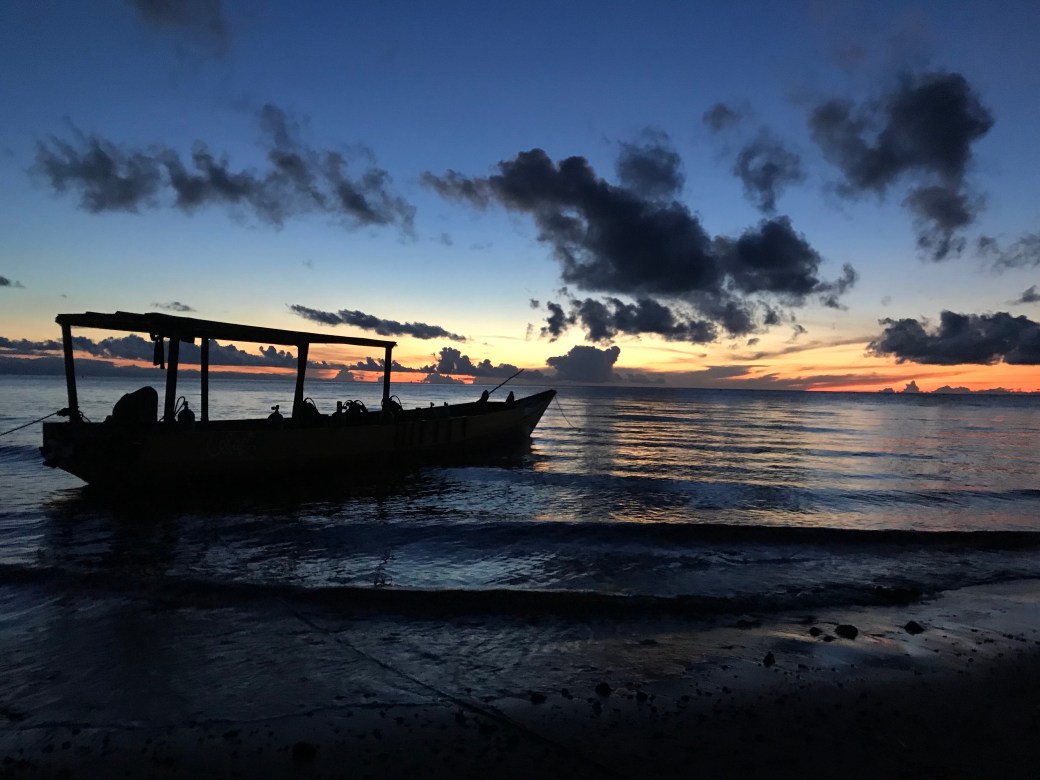
  Oh, did I mention that sunsets and sunrises here are spectacular?
  There are two places to get food, that cannot really be rightfully called restaurants. There are only a few miles of rough roads and then walking paths over the green hills.
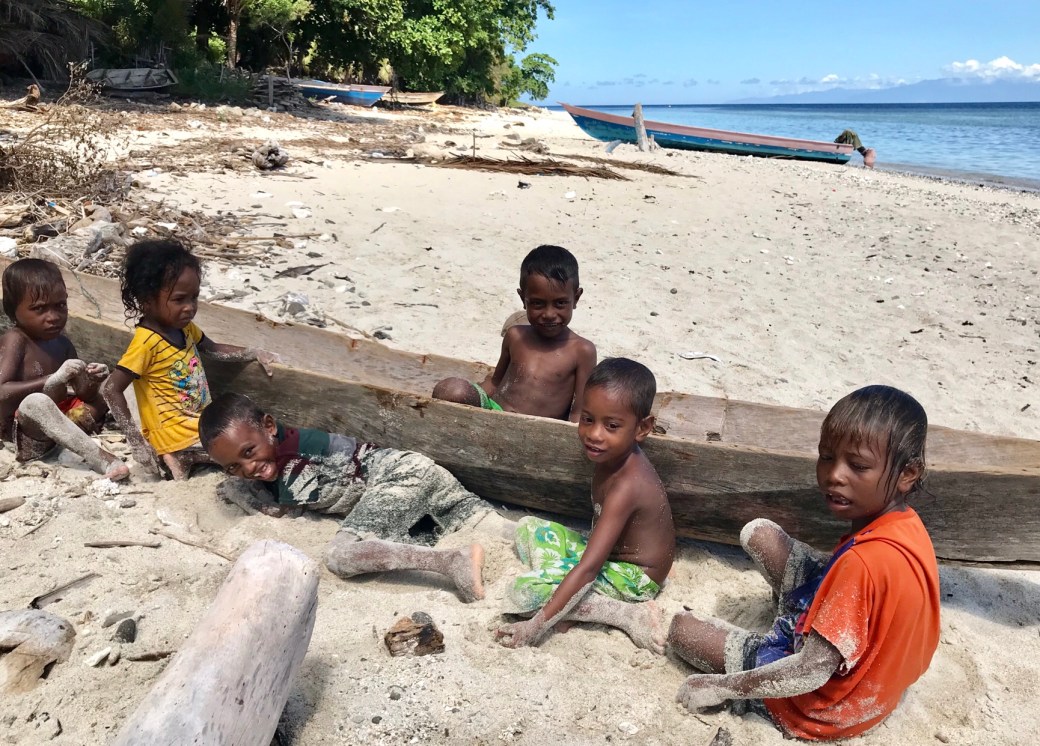
 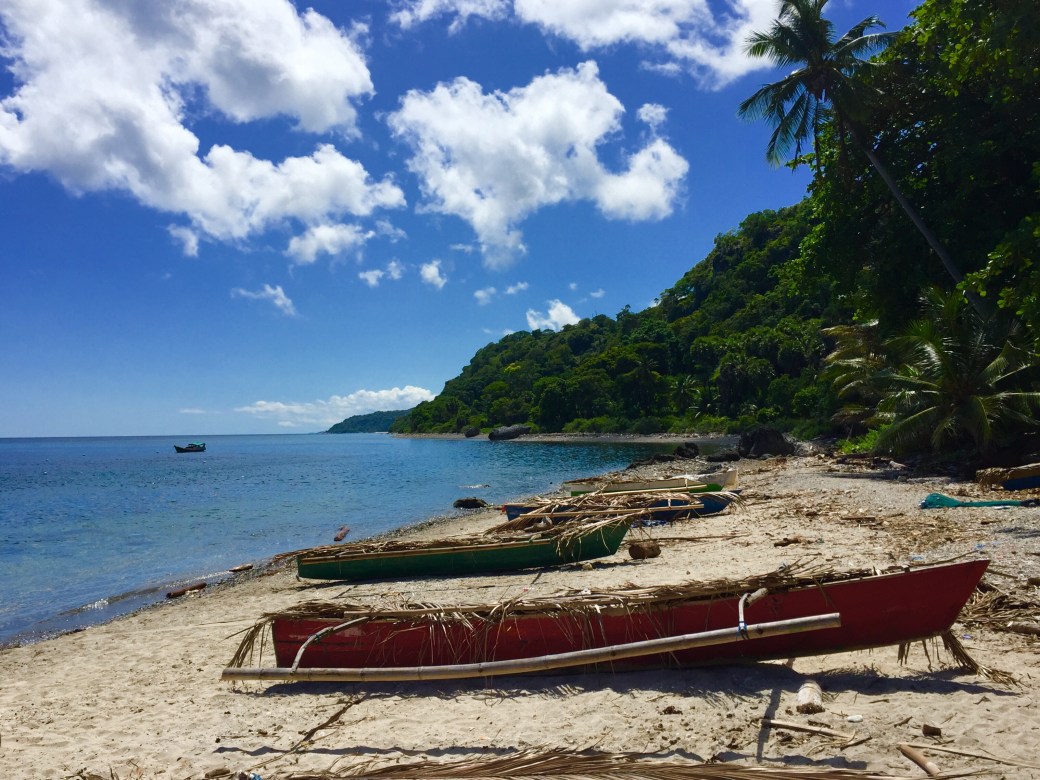 The beaches are clean, littered only with fishermen’s colorful boats and their children spending endless days full of laughter, playing and swimming, and paddling a small canoe, free range, unsupervised, not one of them older than 5.
  The clear warm water is screamingly blue and teal and turquoise and green. The reef is the healthiest you will see anywhere, with huge coral walls and gardens with shapes and colors never found before. Zillions of different sizes and colors of fish are fluttering about. Some are like stripped yellow bumble bees buzzing around the blue sky, some are clown fish playing peekaboo in swaying anemone and there are schools of silvery fish traveling down endless freeways taking curves in perfect unison.
  When we first approached the island by boat we were welcomed by a pod of some 100 dolphins swimming, gracefully diving and gleefully breaching. What is it about watching dolphins that makes us humans so happy? There is just such a joy in their whole being!
 We found the men and women already gathered in the shade with their wares, ready for inspection. As usual, women were surrounded by children, hands busy weaving mats and baskets.
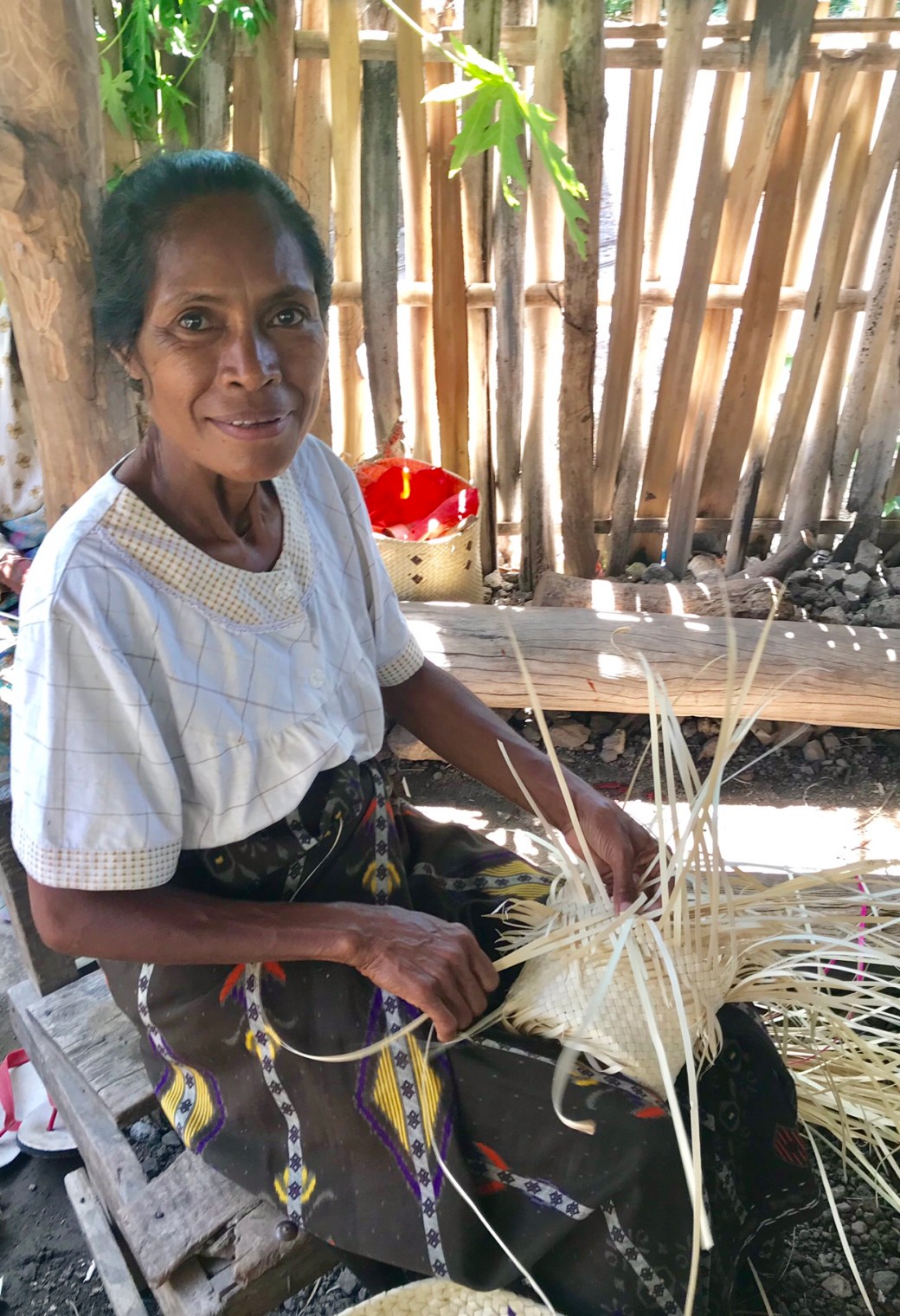 While the shop staff carefully selected and documented the products, the coordinator helped translate my questions. I was interested to find out where did the the wood carver find inspiration for his big stately statues of couples. A bit reluctantly he admitted that there were still two large old sculptures, one of a man and one of a woman standing in a circle of stones above his village.
 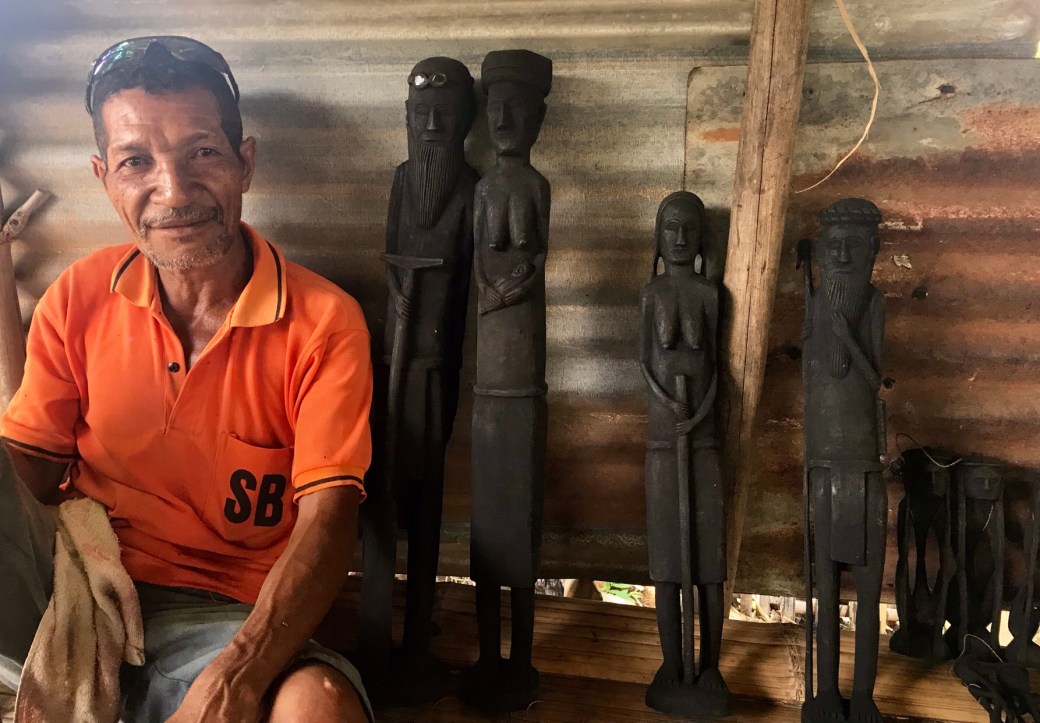 You see, the Timorese are all Christians now but in the villages they still practice some rites from the old religion. The old animistic, ancestors worshiping religion was very effectively suppressed by the Christian missionaries, and nowadays it is only somewhat revived under the guise of cultural traditions and national pride. I had a wonderful time sharing some photos on my iPhone from the different carvings and baskets brought home from our many travels. Everyone was very interested and animated to see the same materials used in different ways. Of course I could not leave without purchasing some items straight from the hands of their creators. And not the smallest one either. So much for traveling light! My husband will kill me…
 Difficult to choose, indeed…
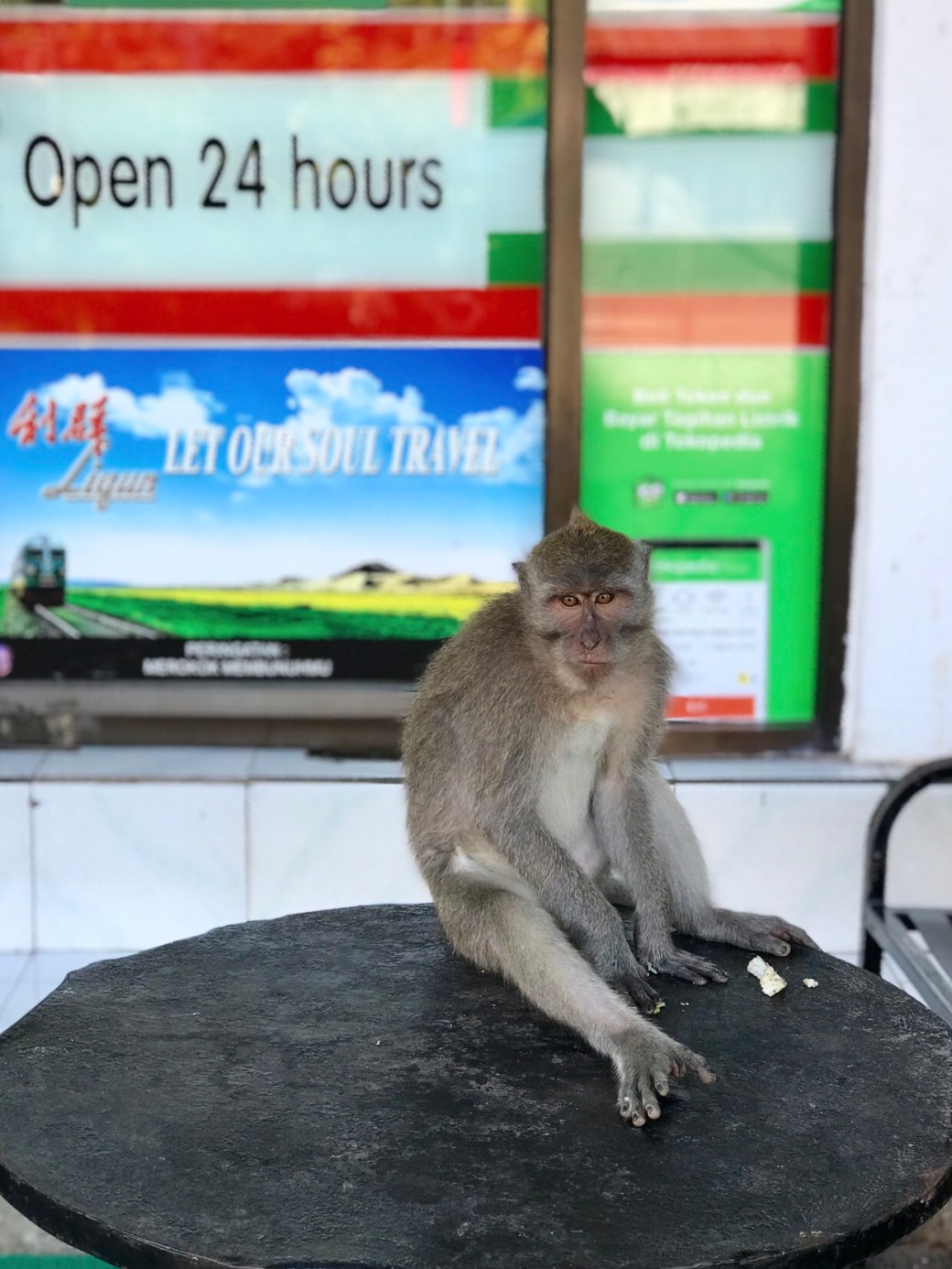 It might be open 24 hours, but I tell you, the service sucks…
 Hey, waitress…
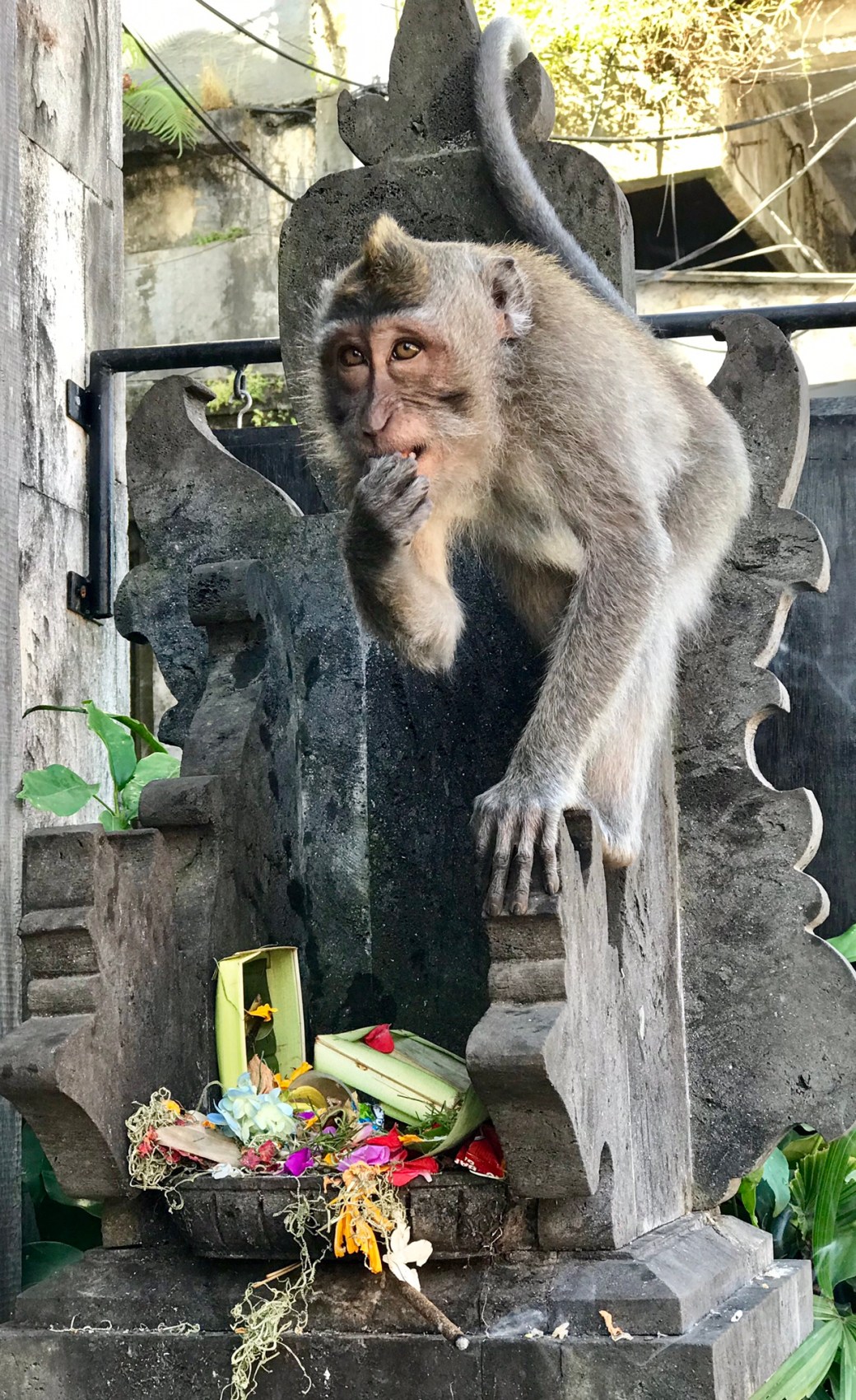 Little temple offerings offer a good selection.
 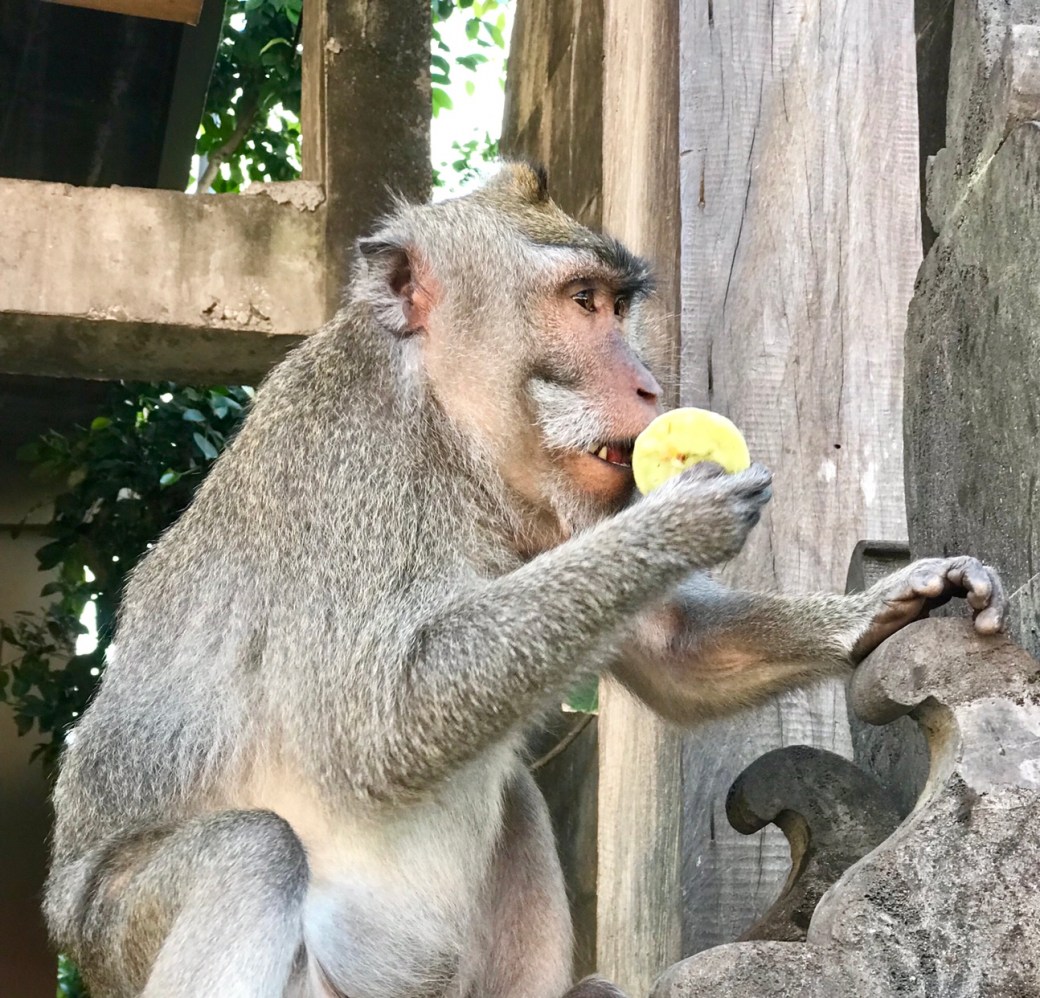 Yum, my favorite–sliced bananas!
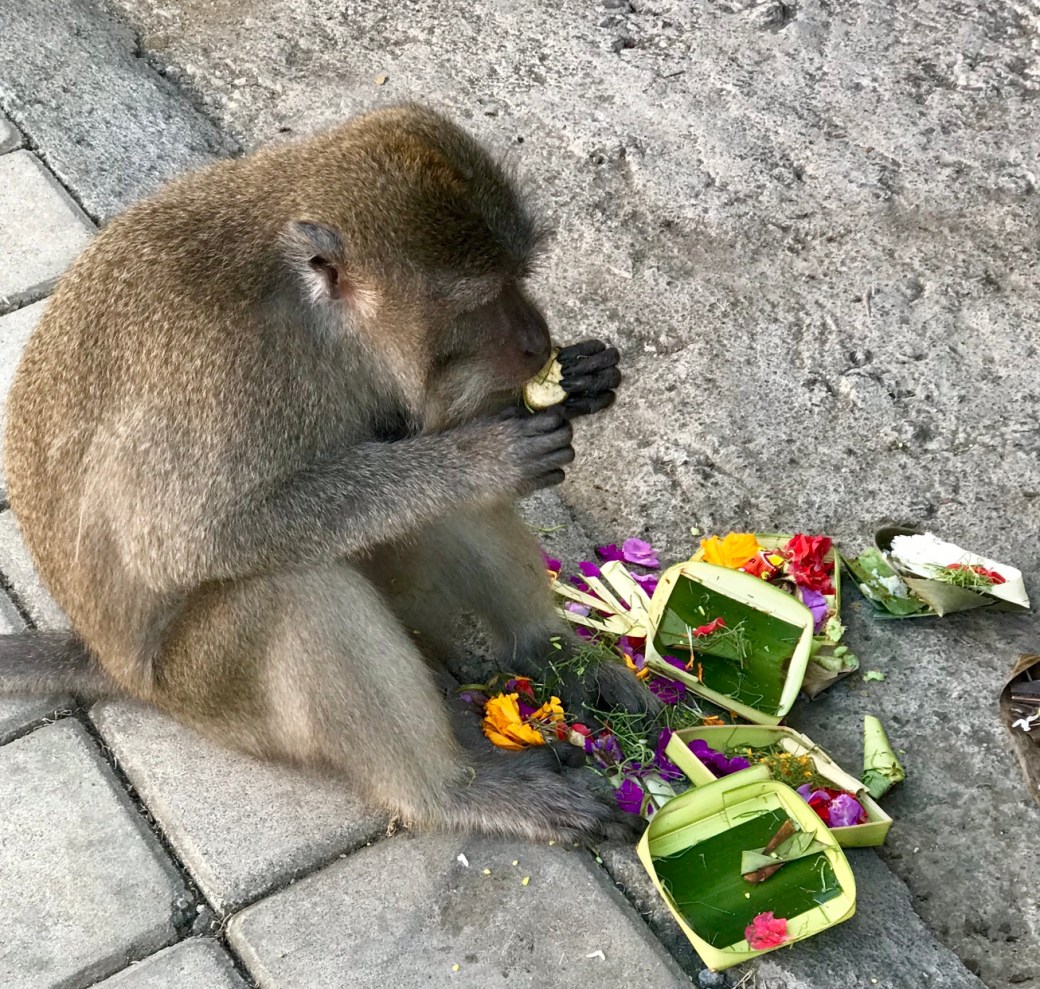 Not the best seating, though.
 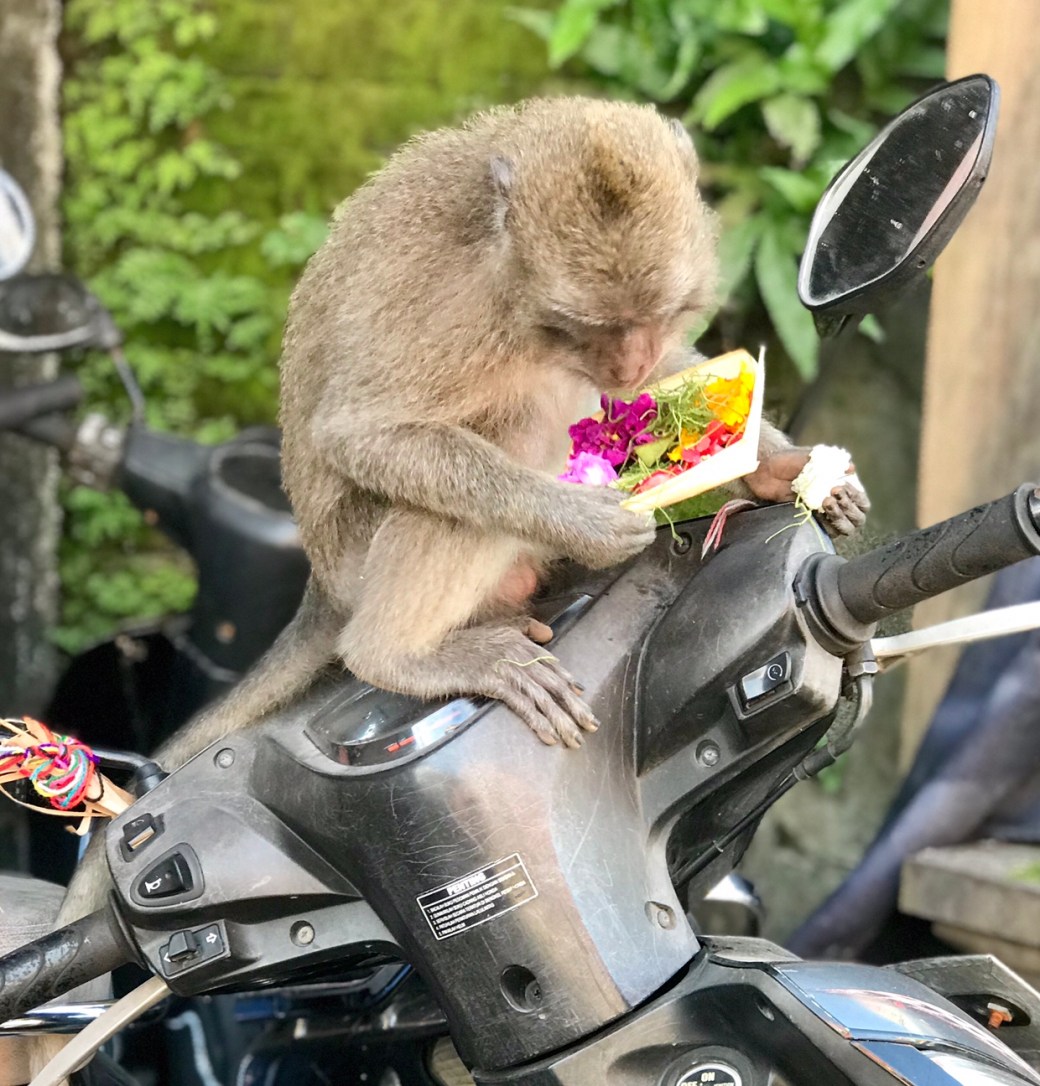 More comfortable, yeah!
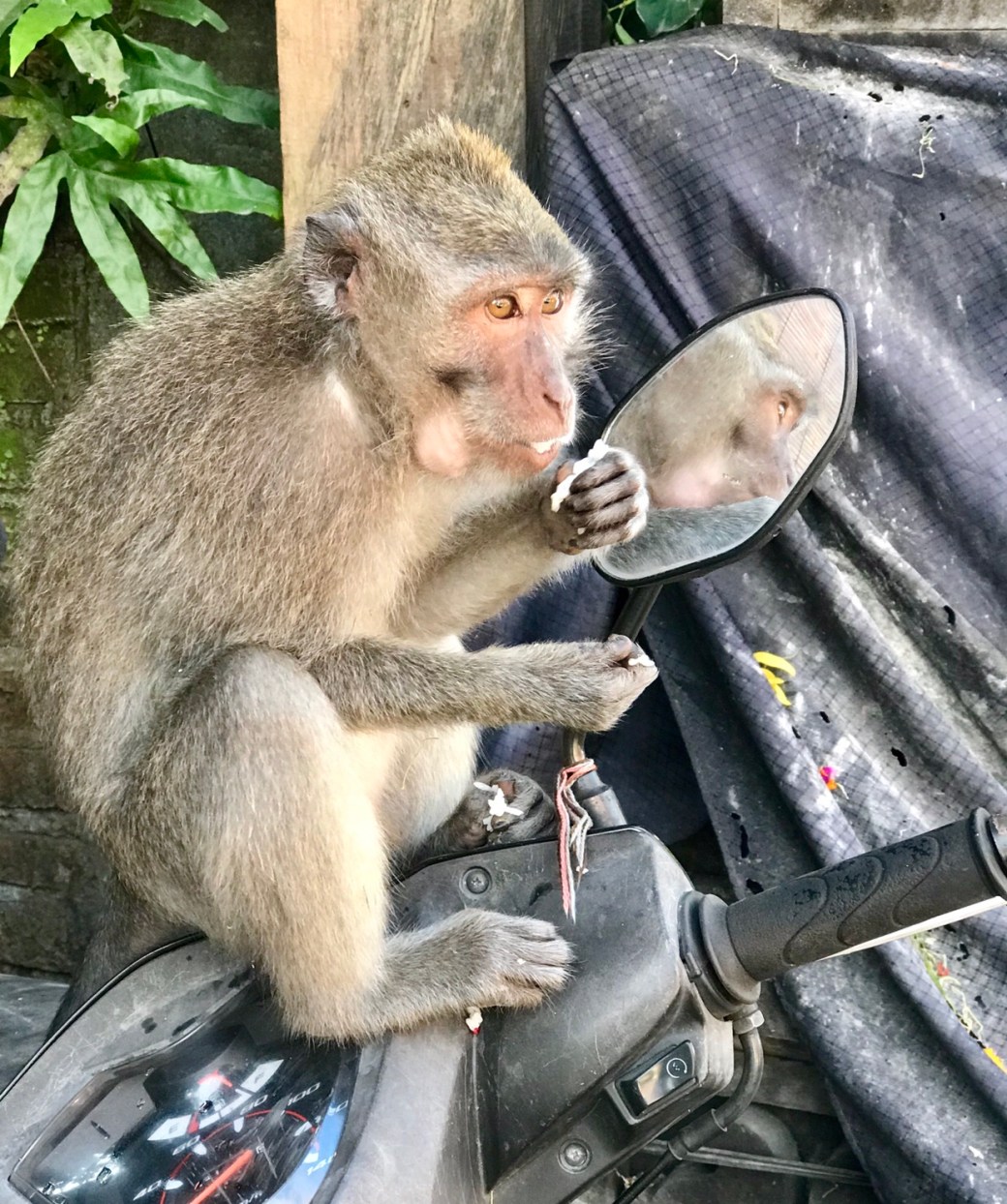 Yummy, yummy rice!
 Sticky!
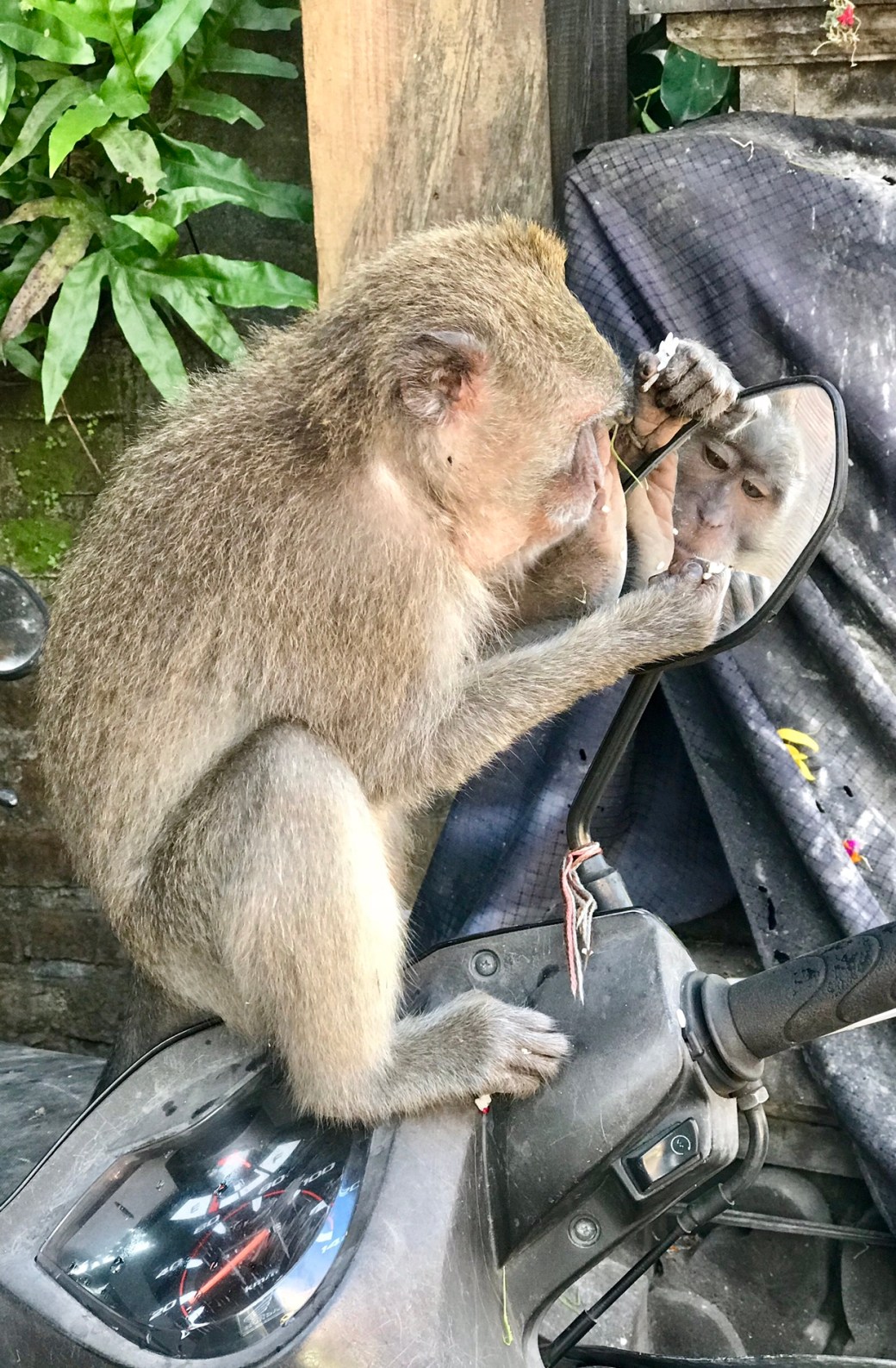 Hey, a friend! You hungry?
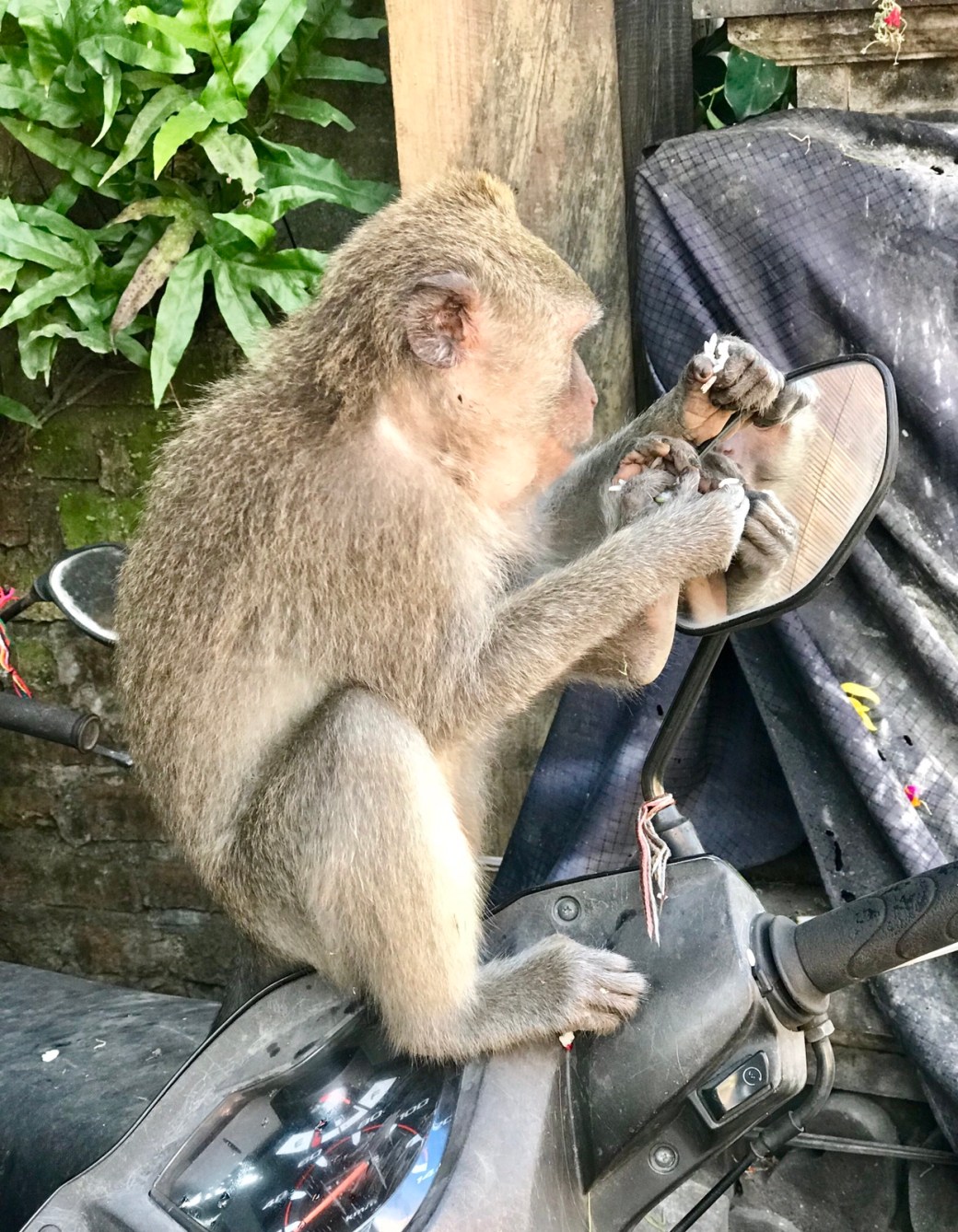 Want some sticky rice? I share.
 No? Wait! Where you going?
 Where’d she go? Oh, there she is! What? Can’t hear you!
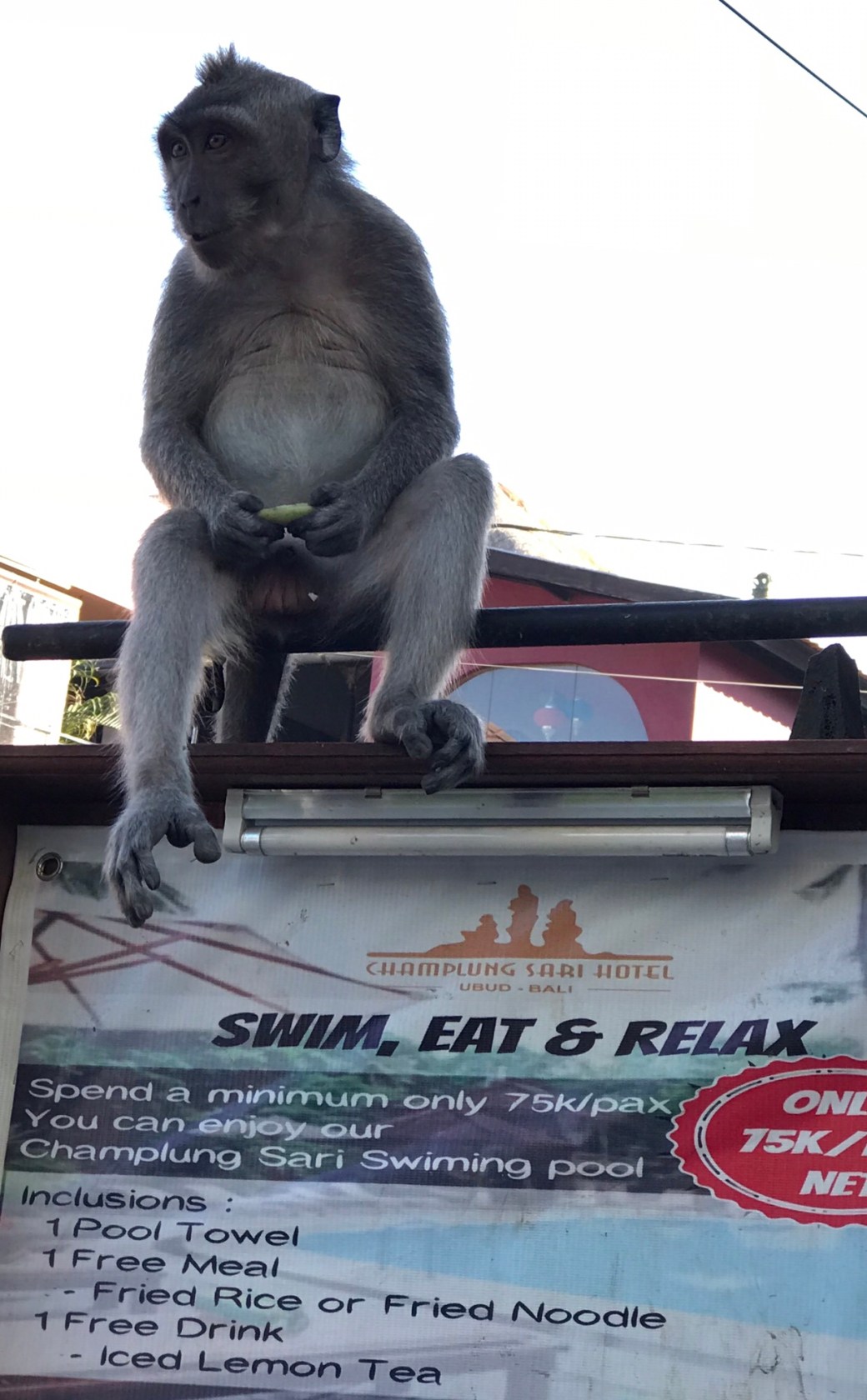 Oh, a new swimming pool! Nah, I think I am going to head back home. They won’t believe all I have seen!
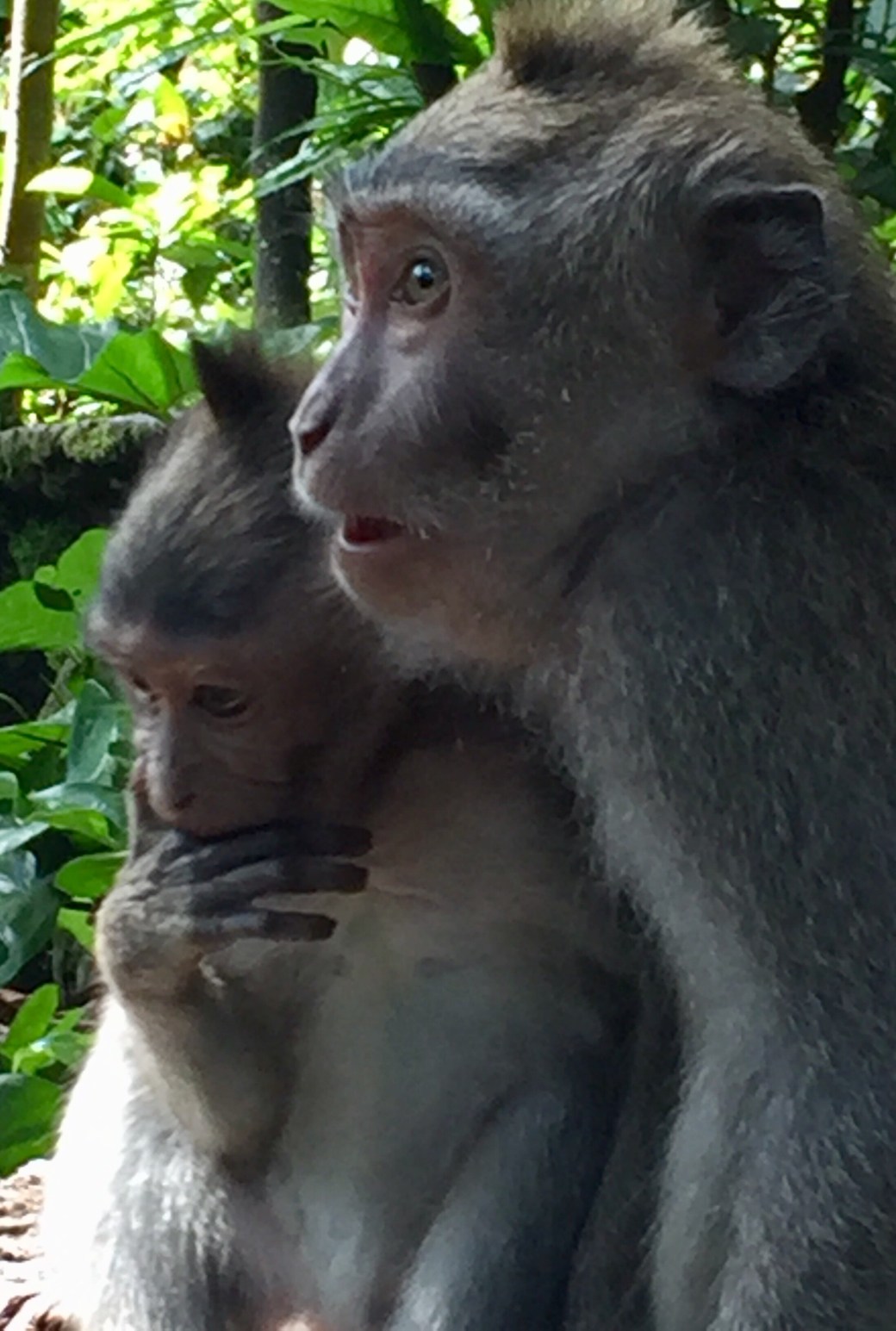 It will be told and retold in the annals of Monkey History.
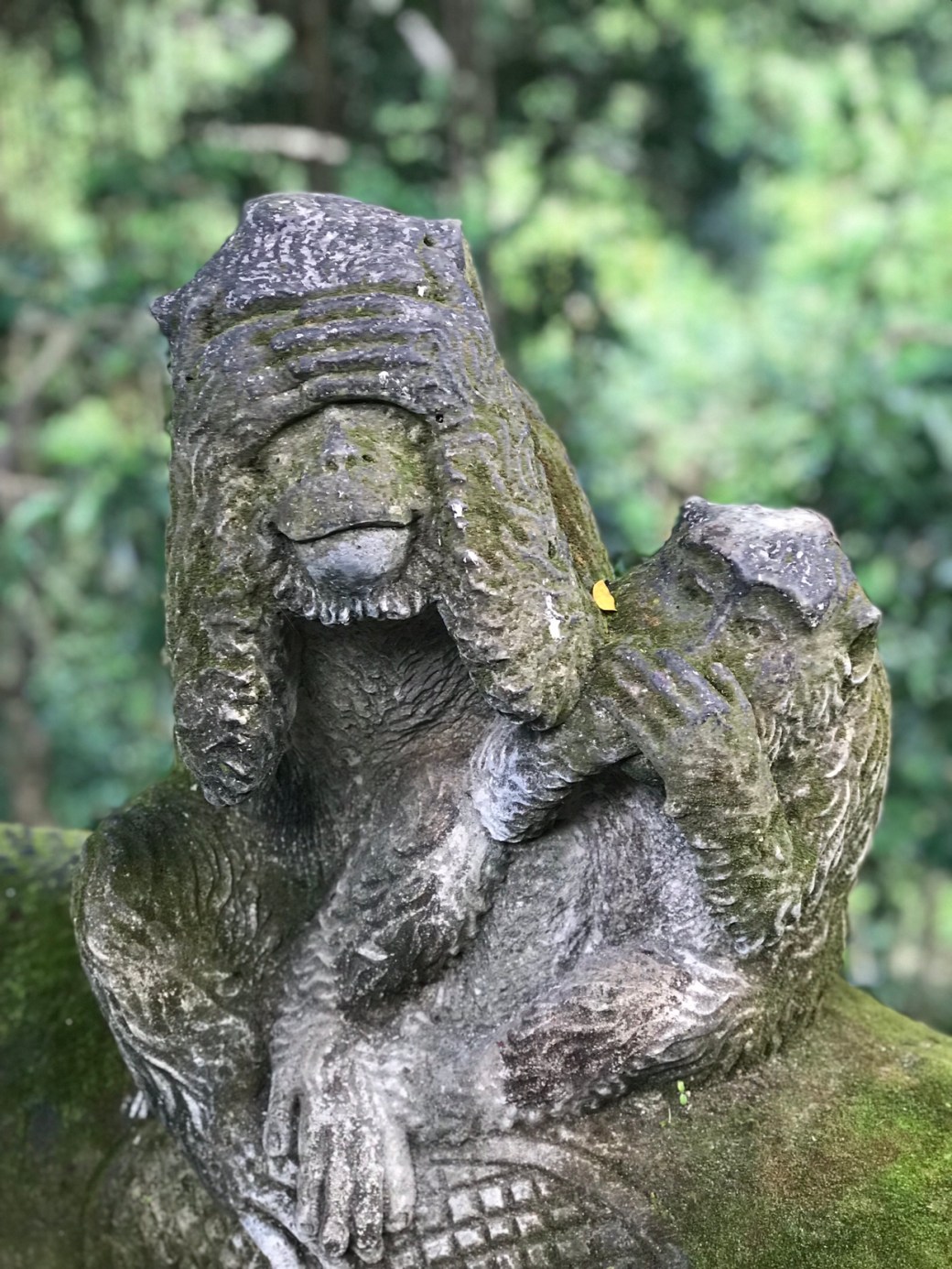 And I will be remembered as a famous explorer!
 Until my children and grandchildren are sick of hearing it…
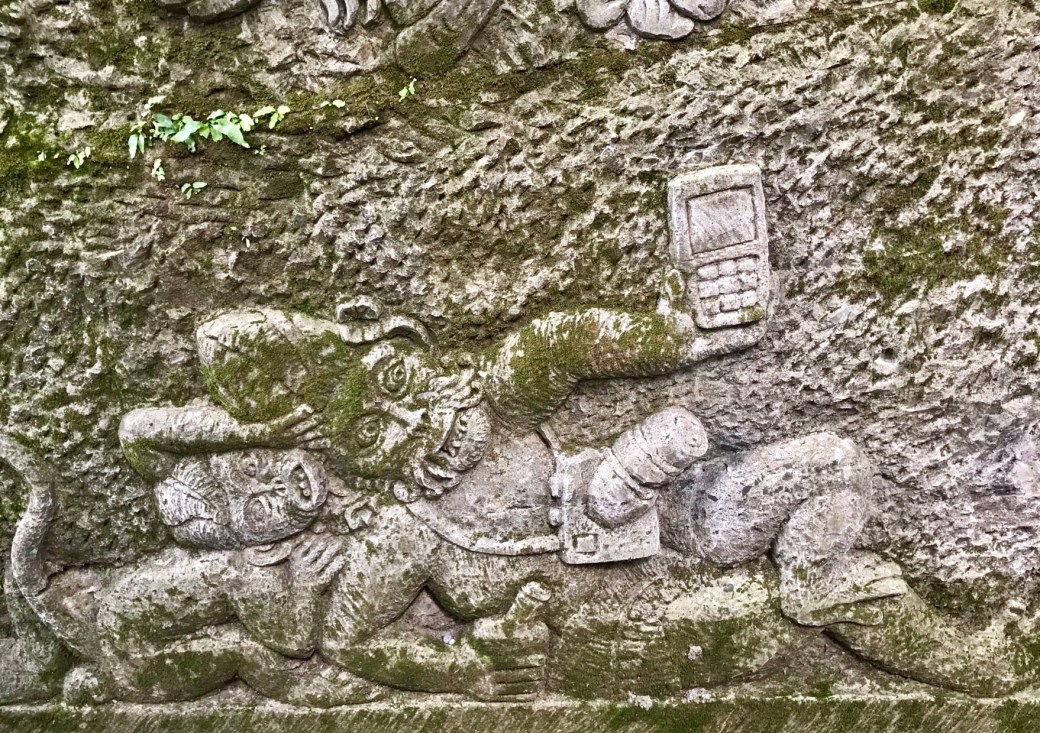 The End
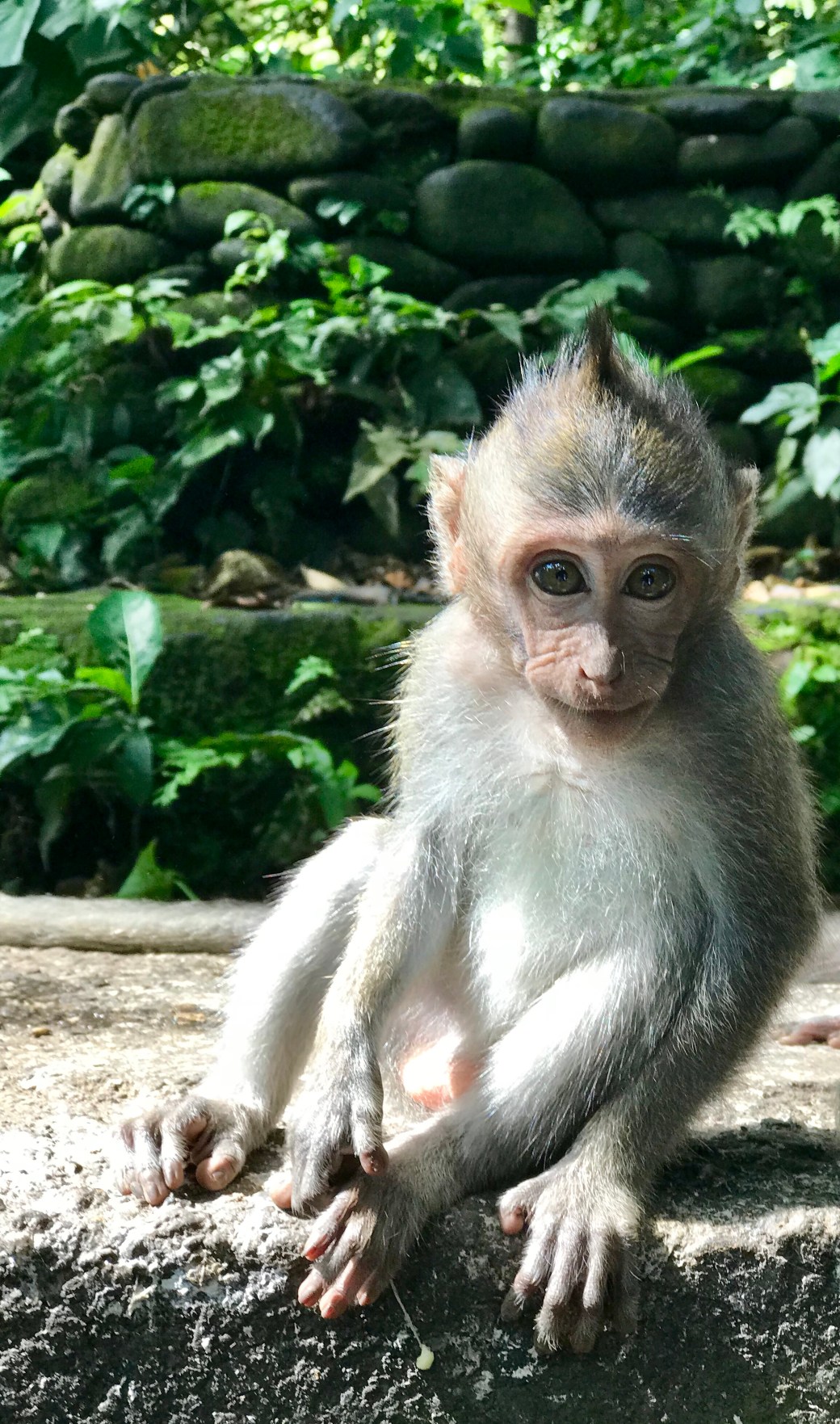 For morning yoga?
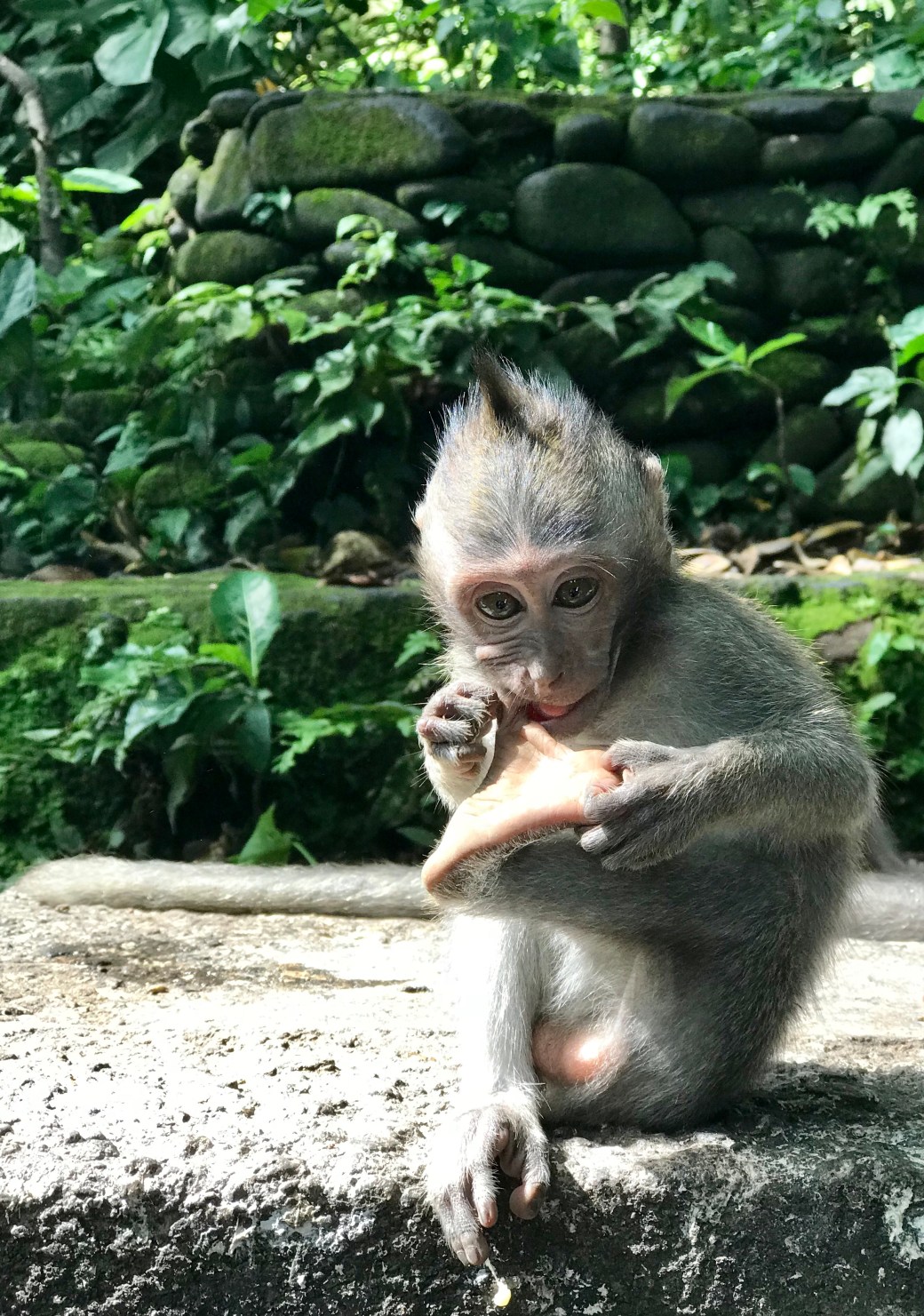 Ugh, some of these poses are really tricky. Monkey Pretzel.
 Some morning grooming next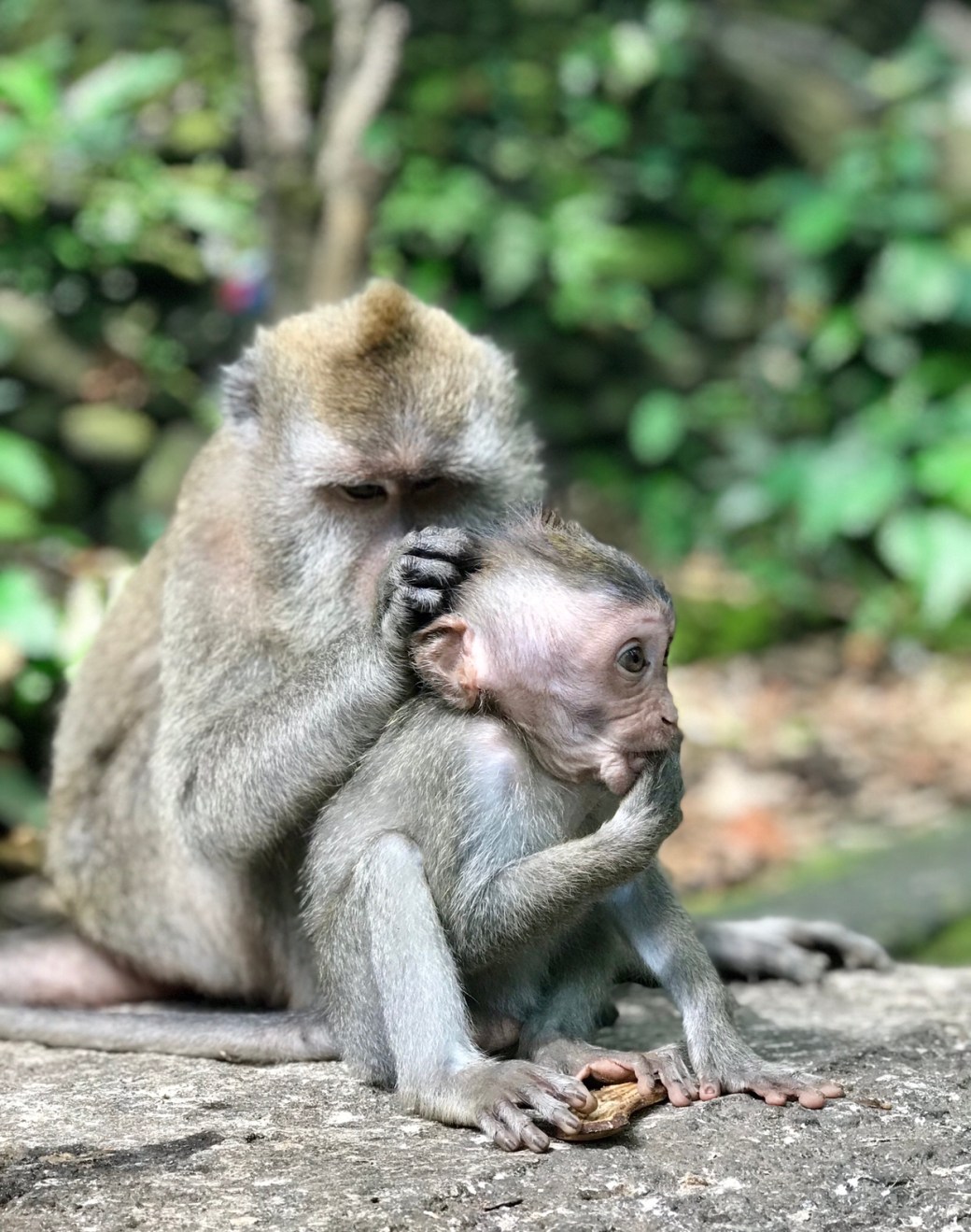
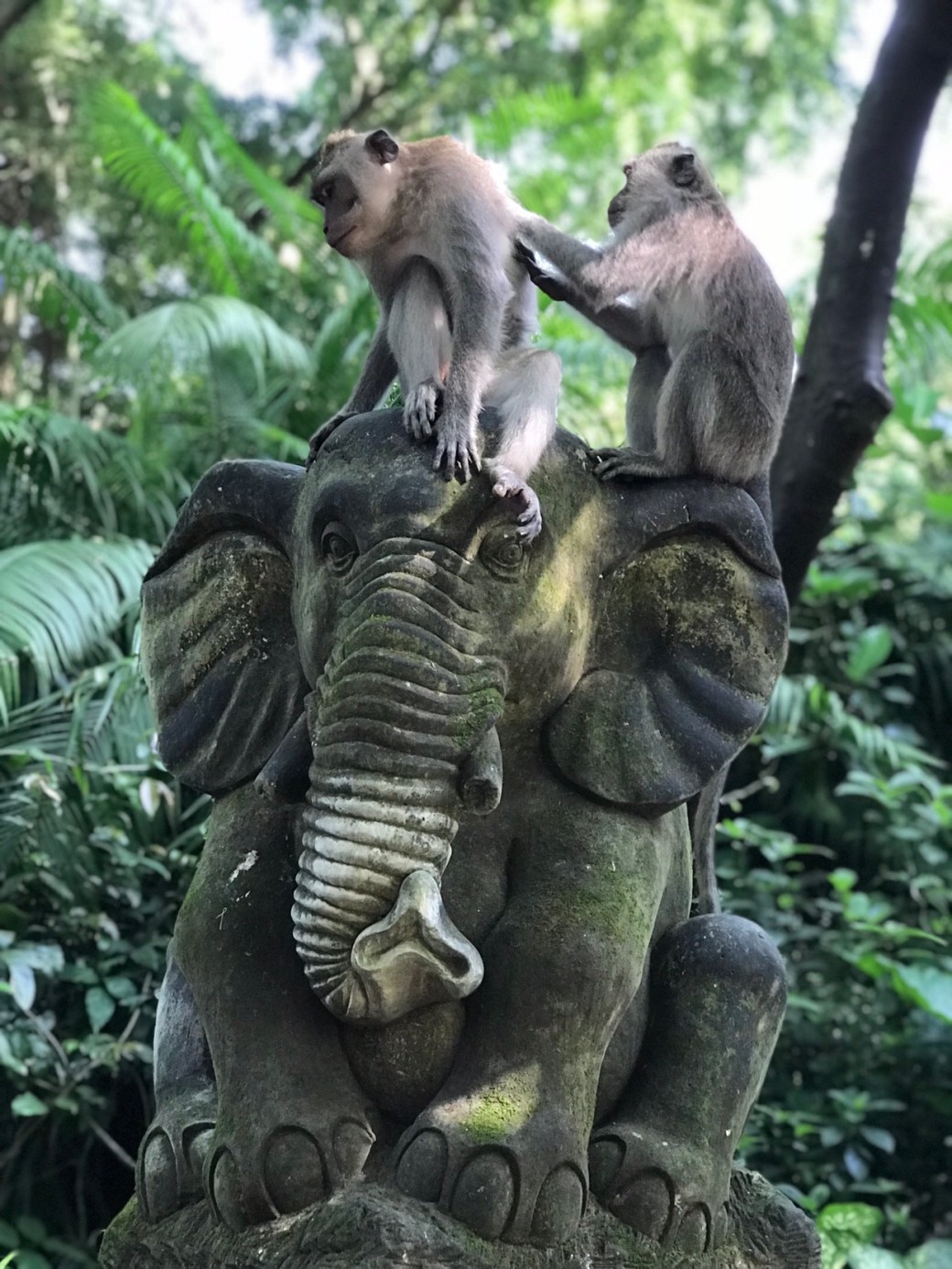
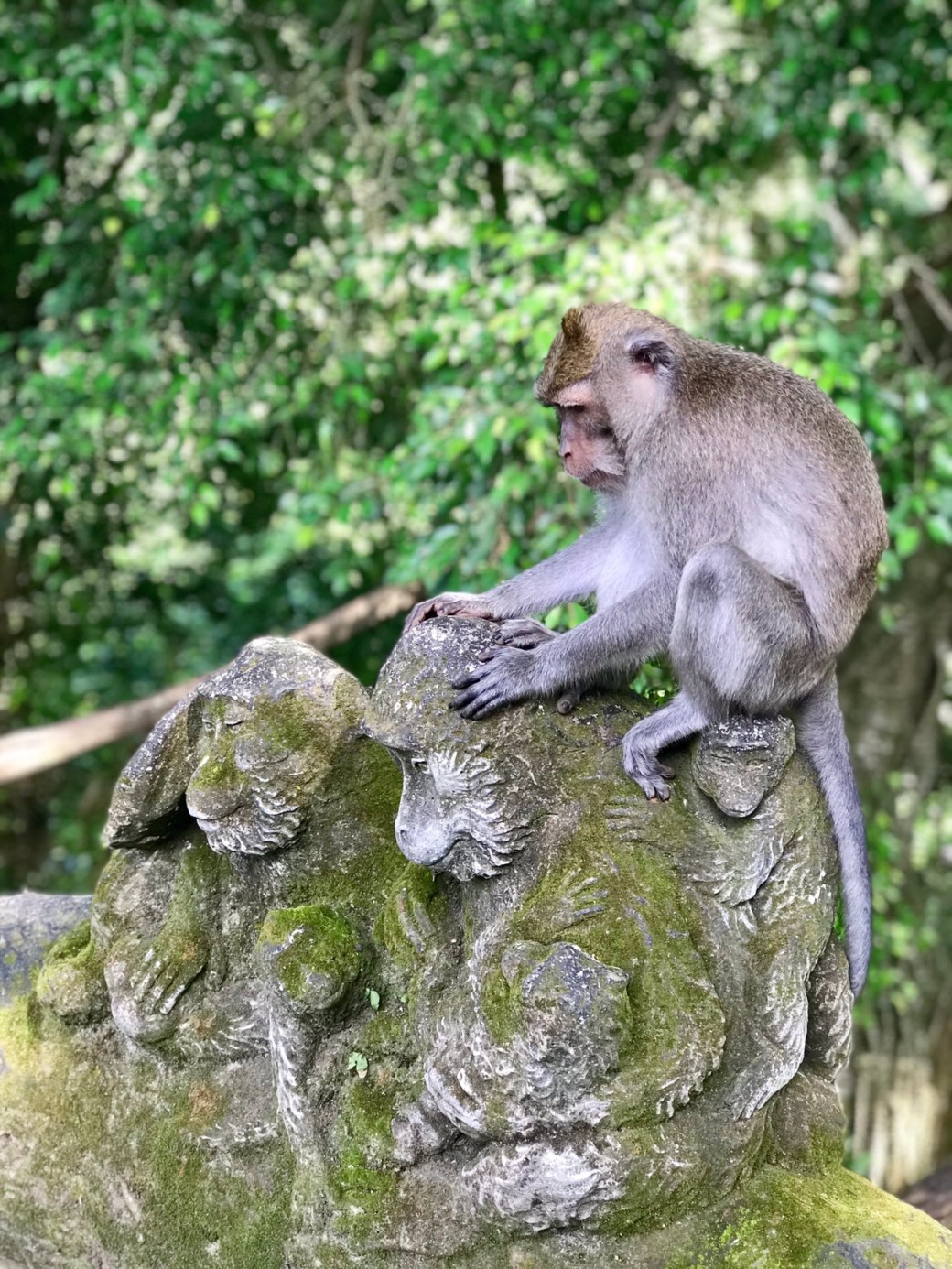 Hm, no fleas here!
  A deep tissue massage,
 a morning hug from mom
 one from dad.
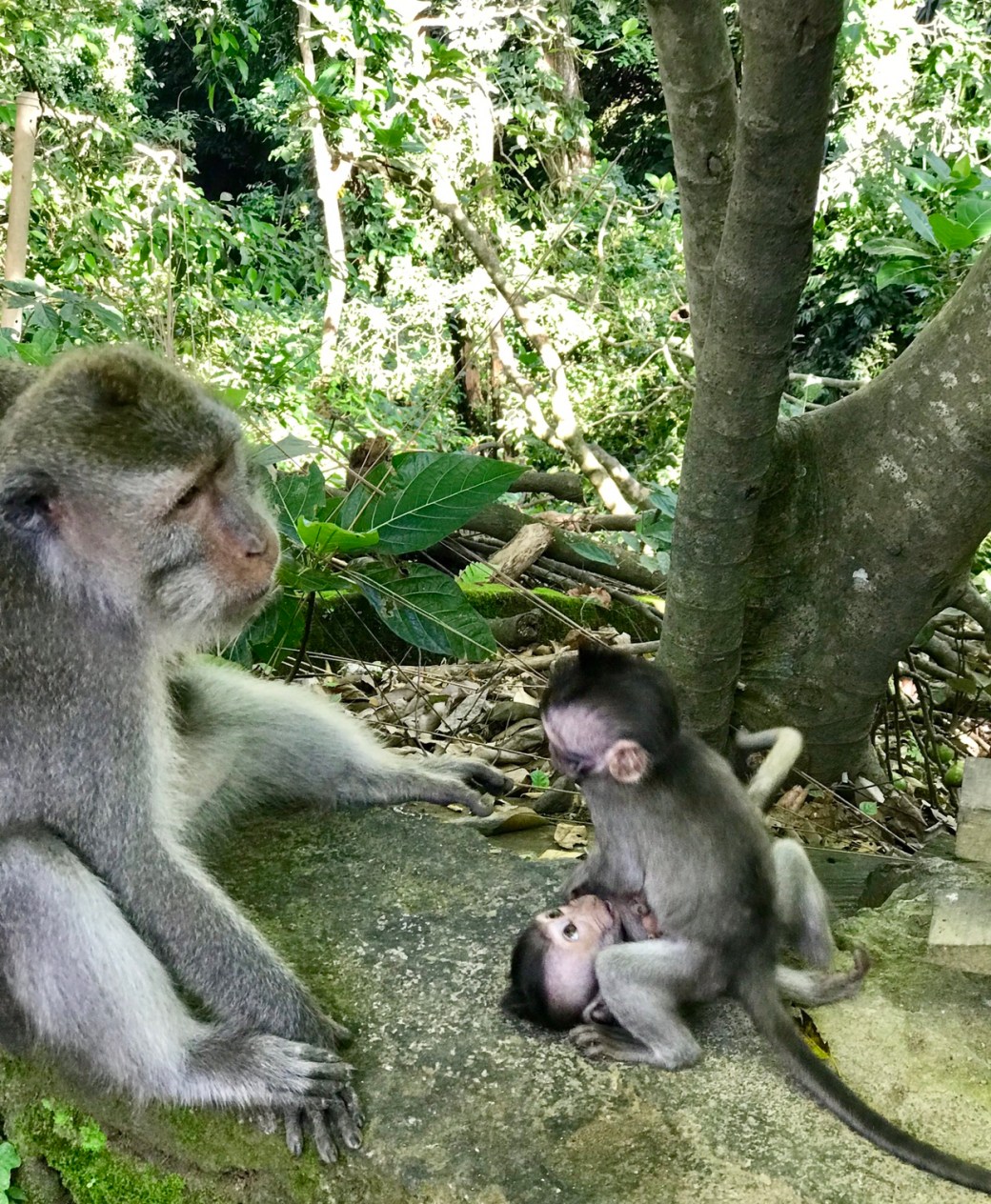 No roughhousing!
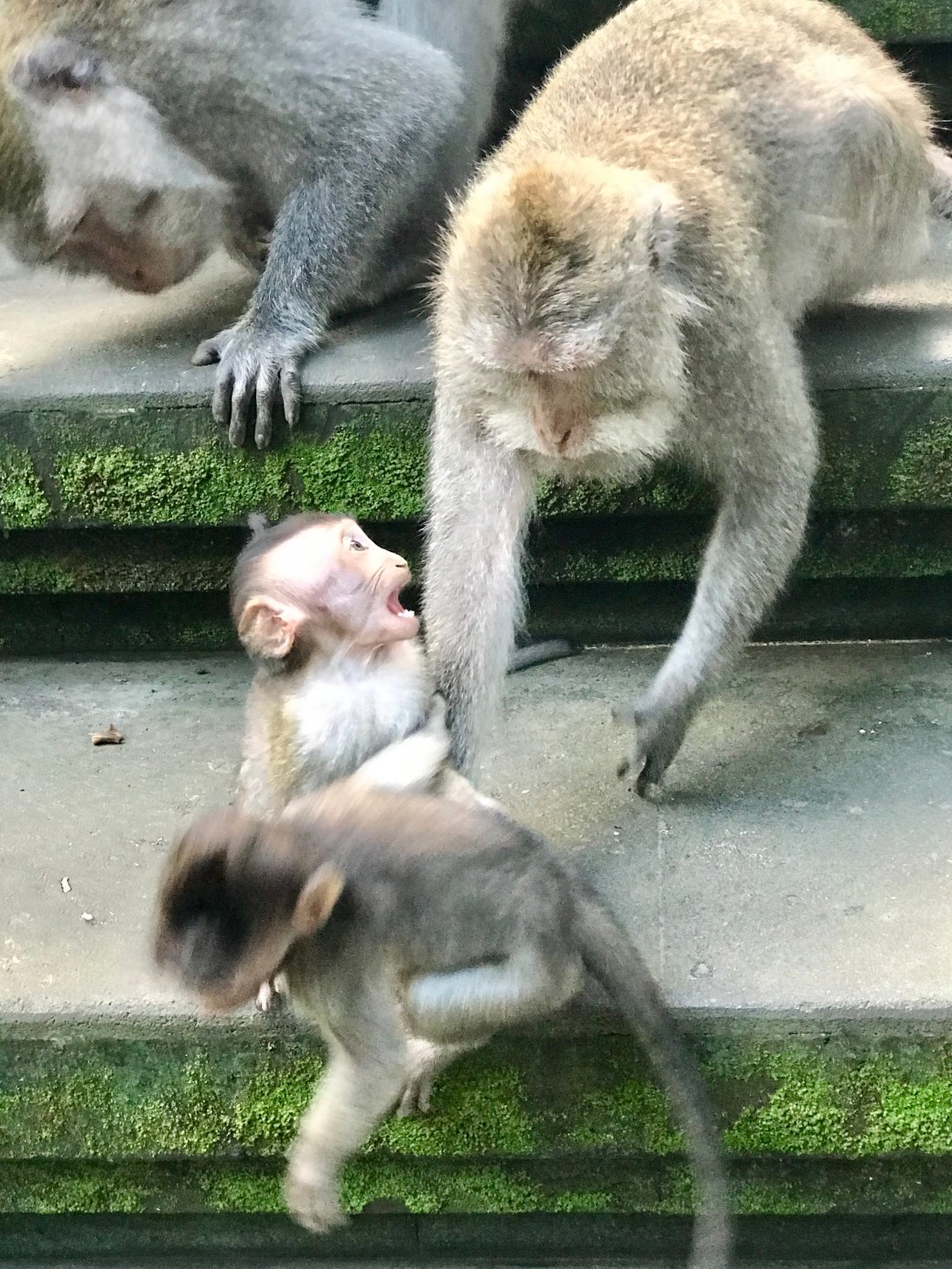 He started it…
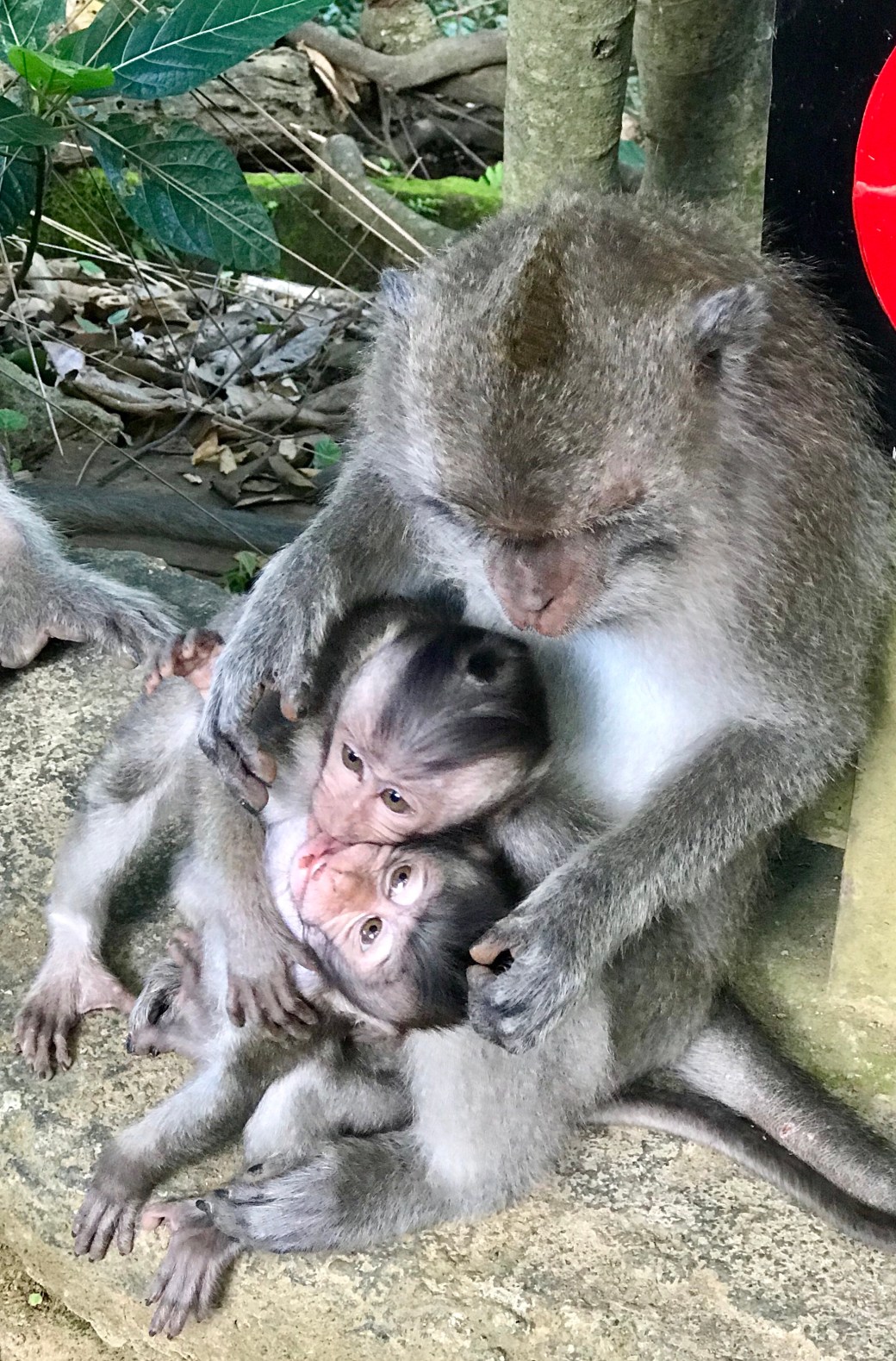 Friends again…
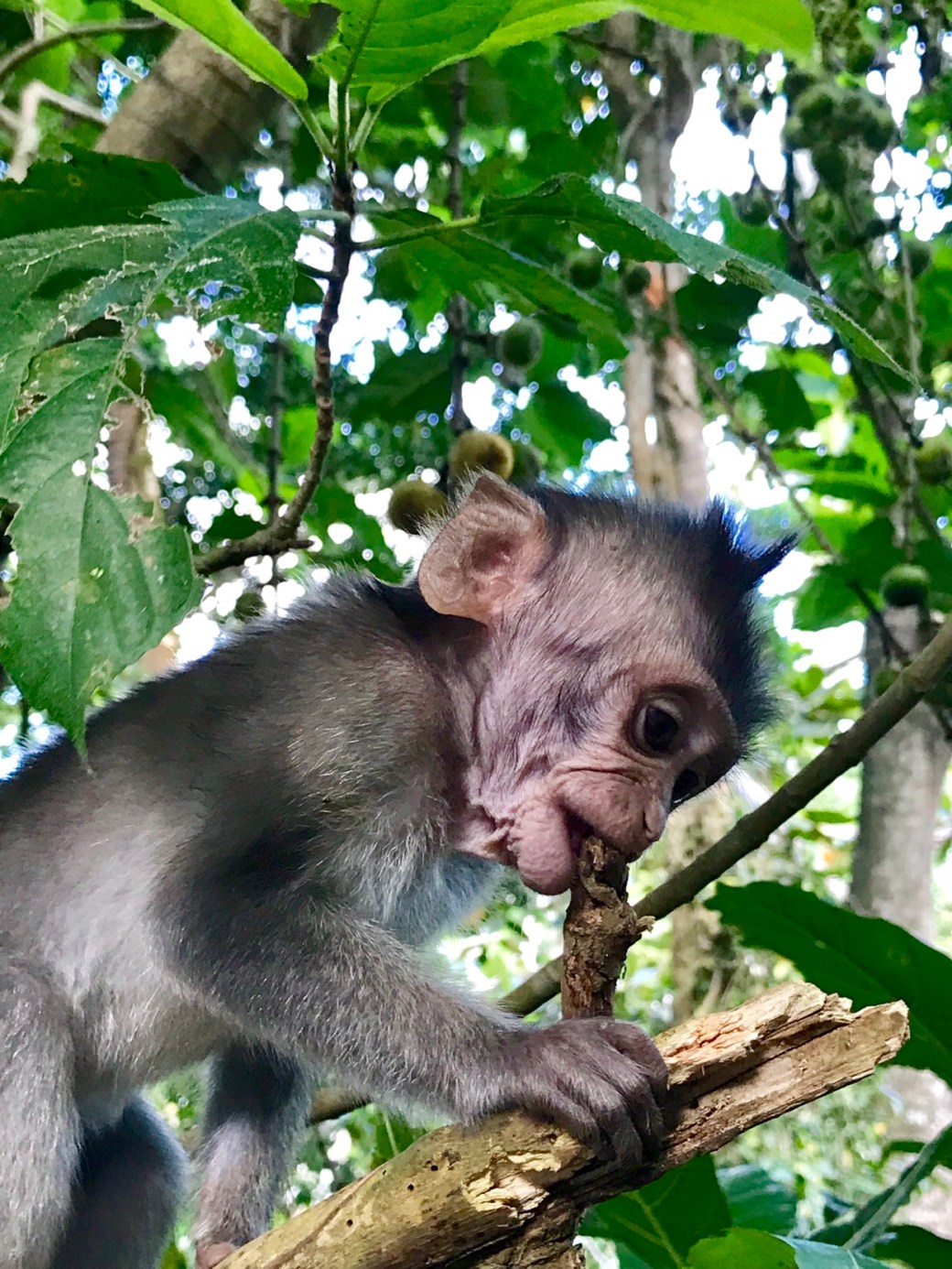 Yuck, too hard…
 too high up…
 Hey, who ate my banana?
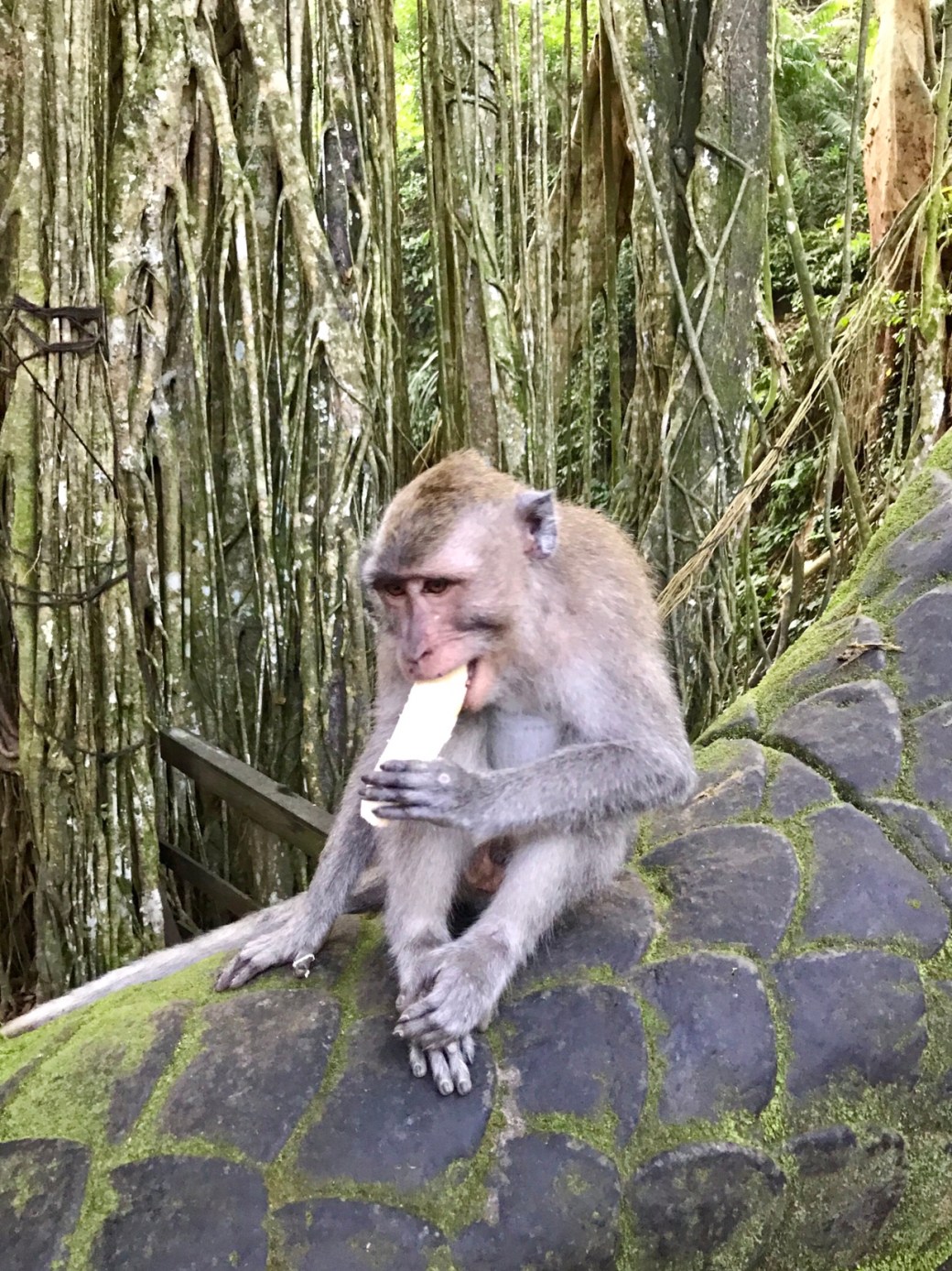 Ha, ha, I did!
 To be continued…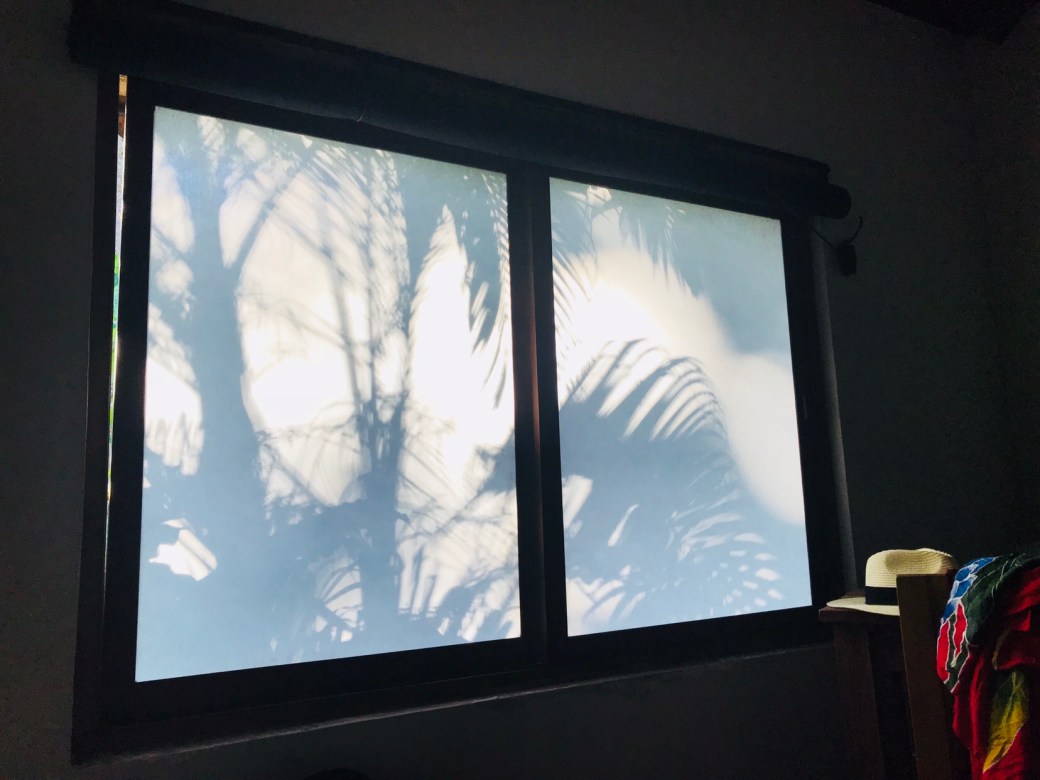
 I am easily reminded where I am. Not so many other times when traveling from one place to another for many weeks. We feel so lucky that we found this quiet port in a worldly storm–our House in the Hidden Garden. It is “ours” at least for a little bit, until we move on again.
 The morning air is filled with songs of birds by the time I get up, walk through the living room into the garden, and do our morning chores. I unlock the front gate so the gardener Mangko can get in and sweep the garden clean of last night’s fallen leaves.
 No, I cannot go back to bed. It is too tempting to stay and go for a short walk, enjoying precious minutes of peace and quiet before everybody wakes up and sounds of everyday life burst in with unstoppable energy.
 Both kitchen and the dining room are again spotlessly clean after yesterday’s Balinese lunch with Hans (not Christian) Andersen, Rana’s old Danish friend.
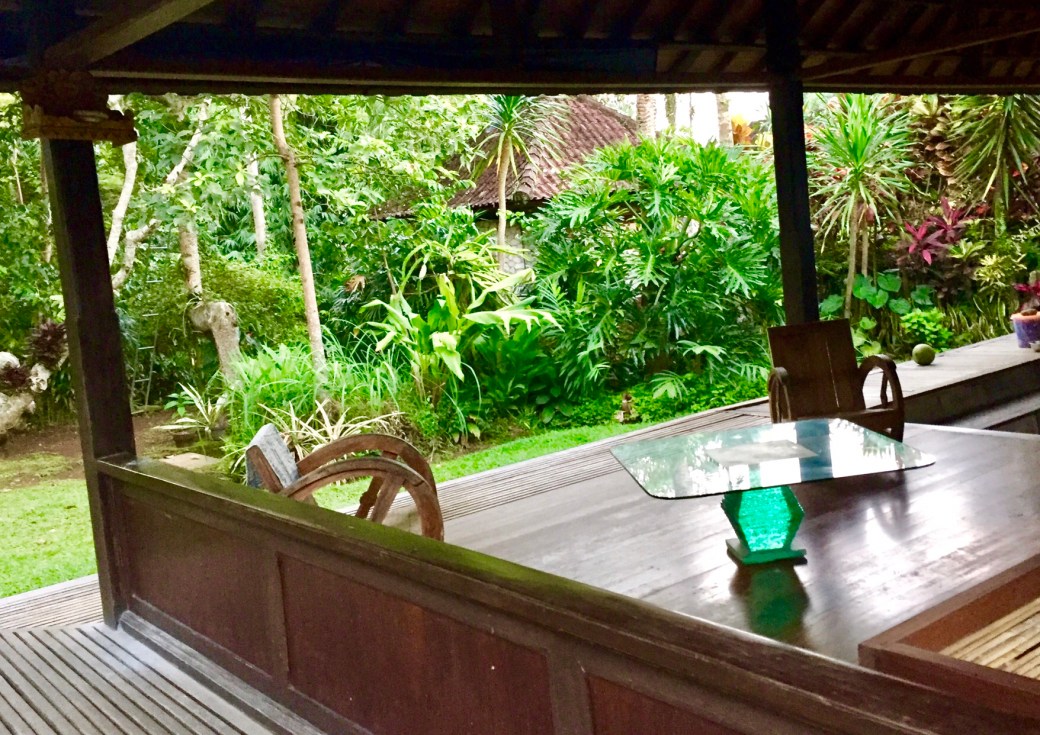 The flowers
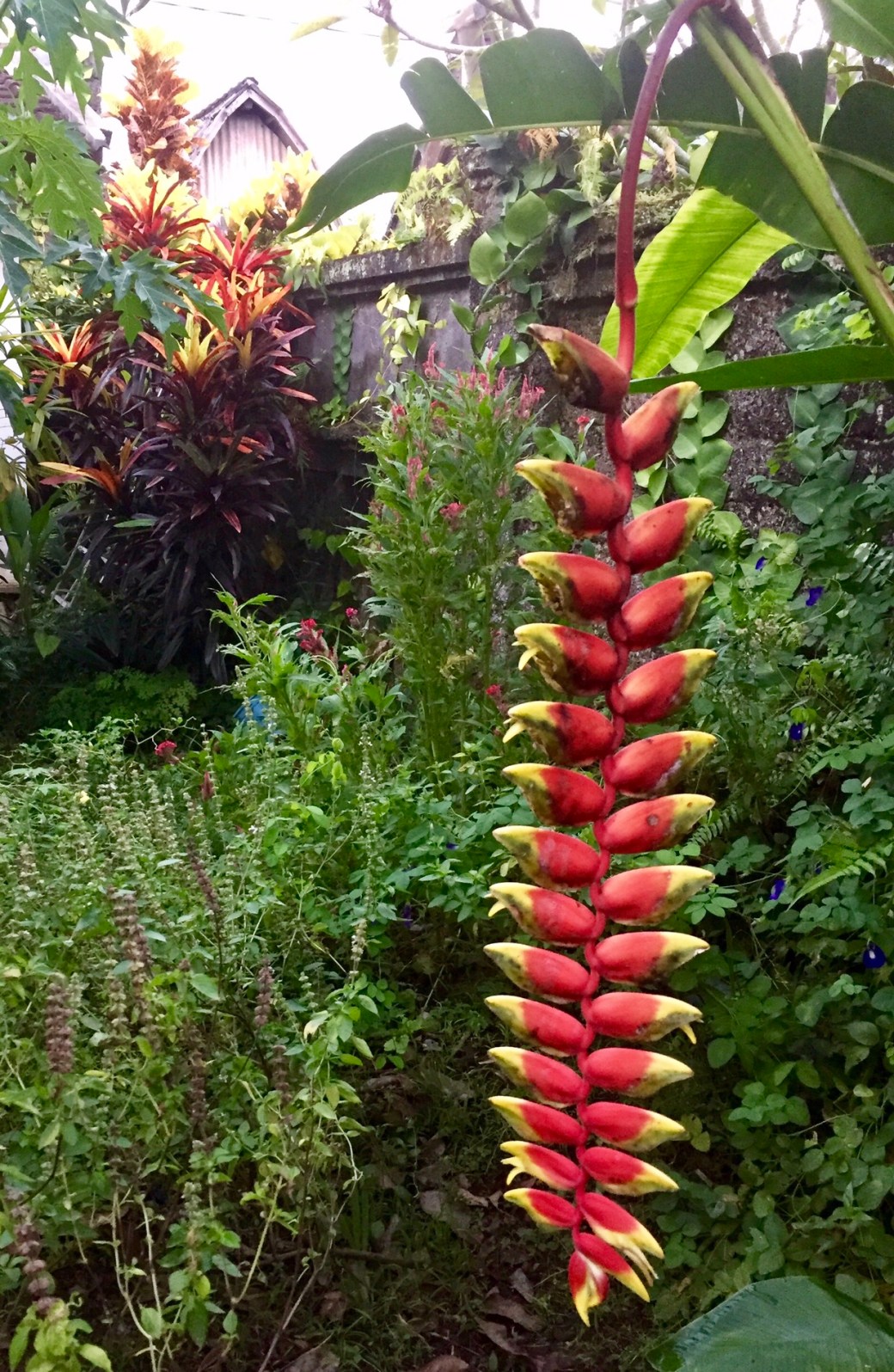 are still blooming all over the garden.
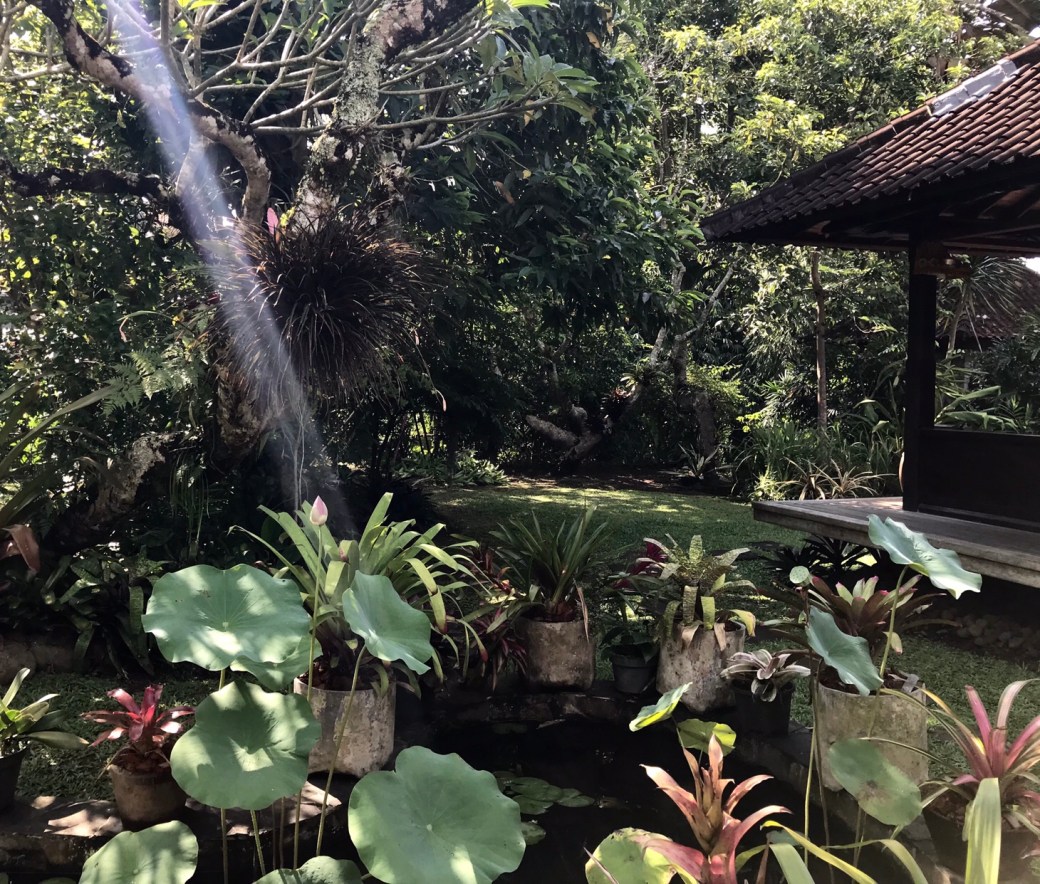 But wait, there is a new surprise at the koi pond. The Lotus that was still closed yesterday
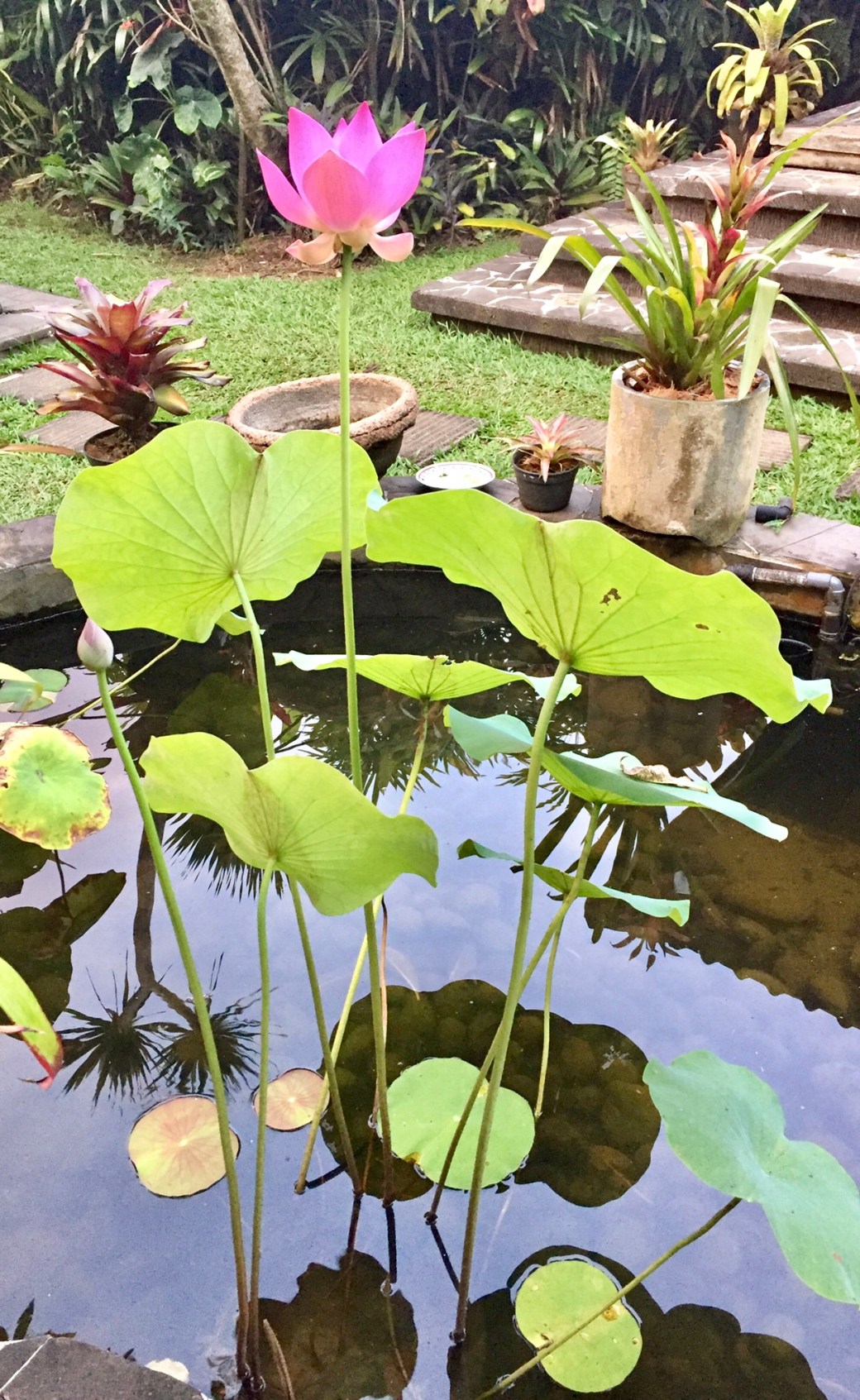 has opened, blushing fiercely.
 I better get back to bed before I wake up everybody.
 Life will soon be in full swing. Luna coming for a visit.
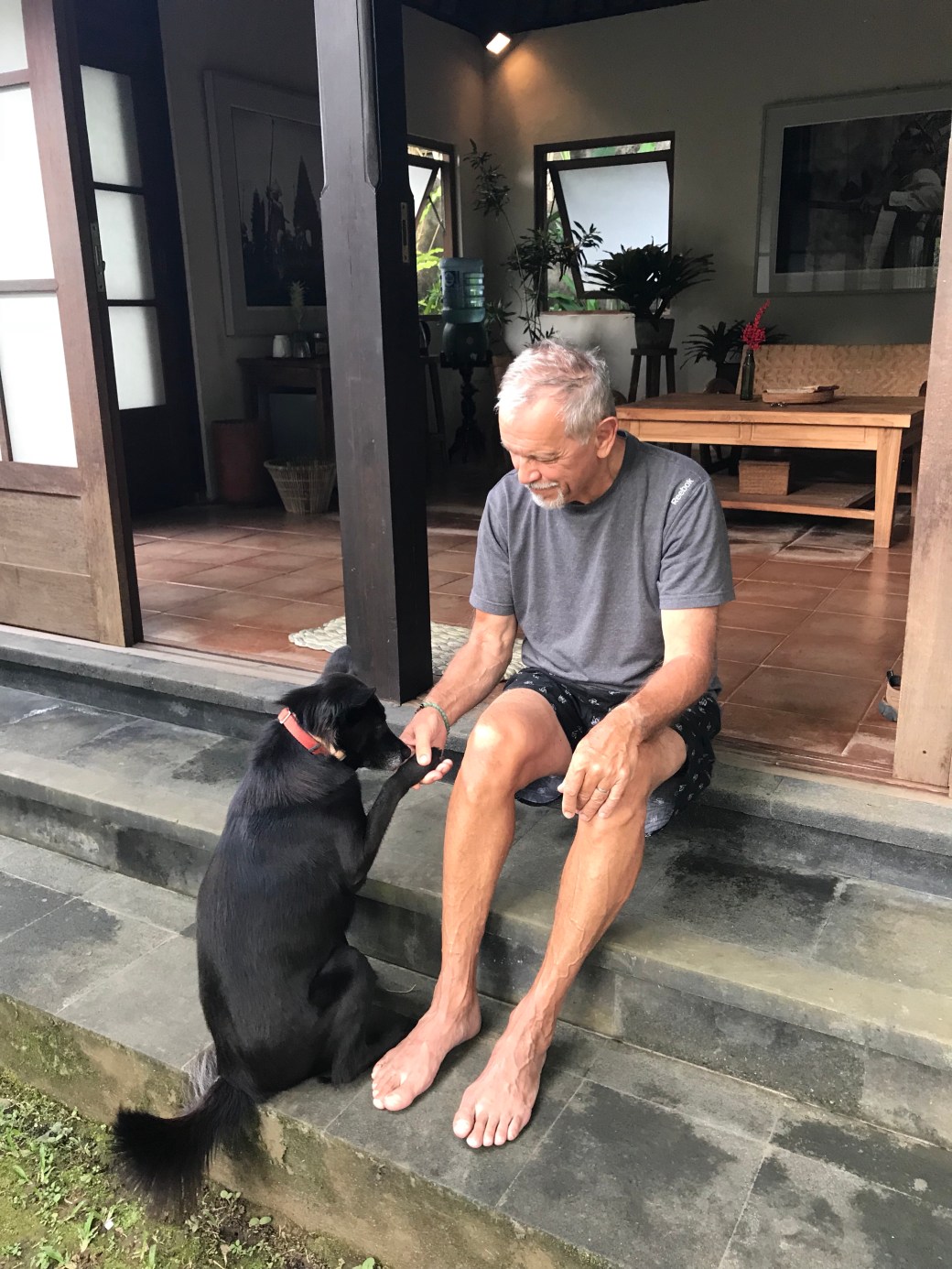 The gardener cleaning up the Balinese temple in the corner of our compound.
 Our lovely neighbor Ketut bringing offerings, as she does every morning before heading to sell her wares at the market.
 A new beautiful day in our secret slice of Paradise has begun.
 And was she right! Especially the first part, the day before the New Year’s eve when there are big, colorful celebrations. The day after, the first day of the New Year, called the Day of Silence is a day when people are supposed to stay inside their houses, in silence and with no use of electricity. Most tourist establishments are closed that day, there is no transport, even a single plane does not land or take off from the Denpasar airport.
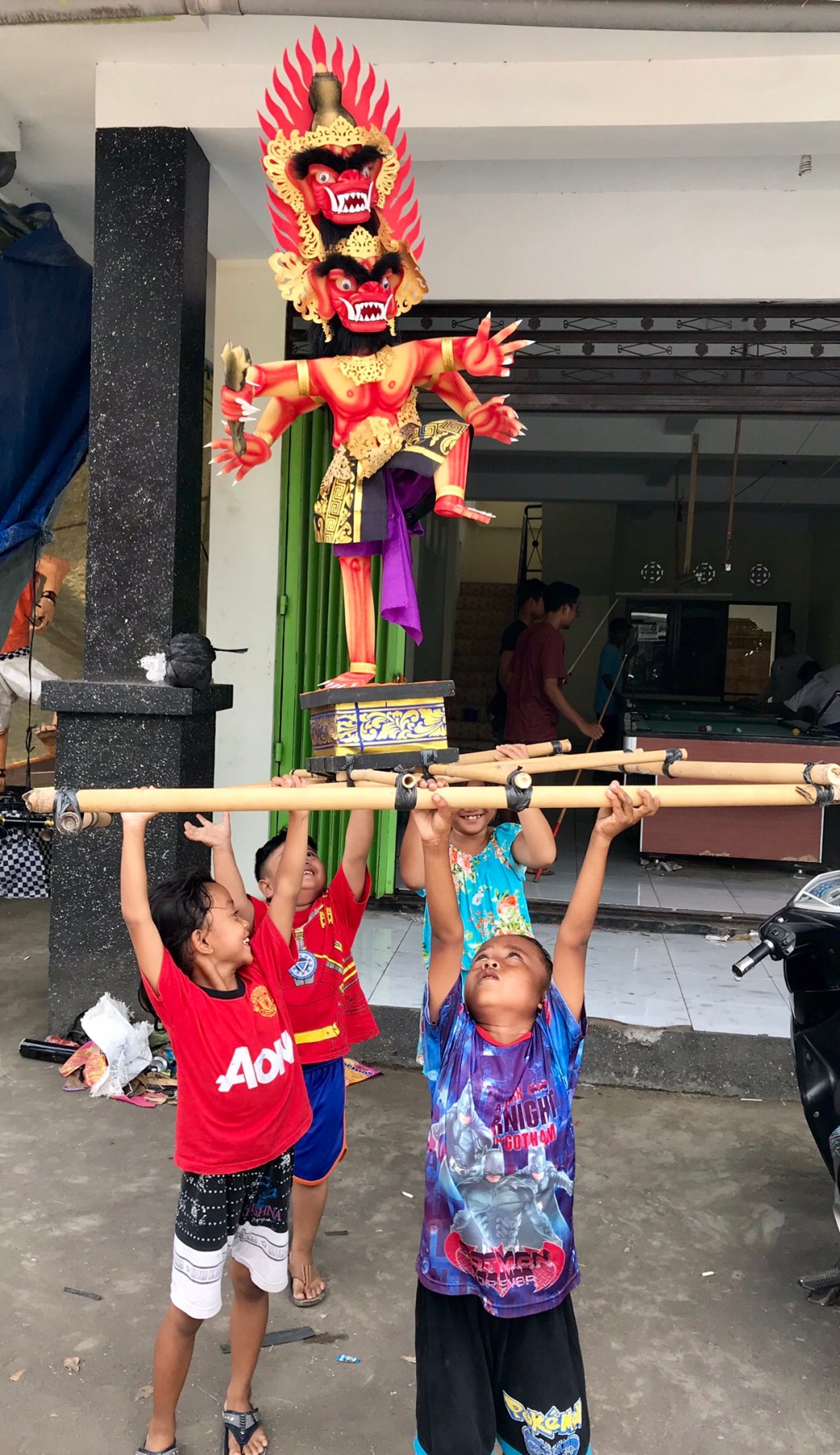
 When we told them how much we were looking forward to seeing the ogoh-ogoh, they quickly rustled up some sarongs and dressed us up to, as they said, “blend in with the locals”. We certainly did not manage to blend in gracefully, as we have not been schooled from an early age in walking elegantly in the tight sarongs.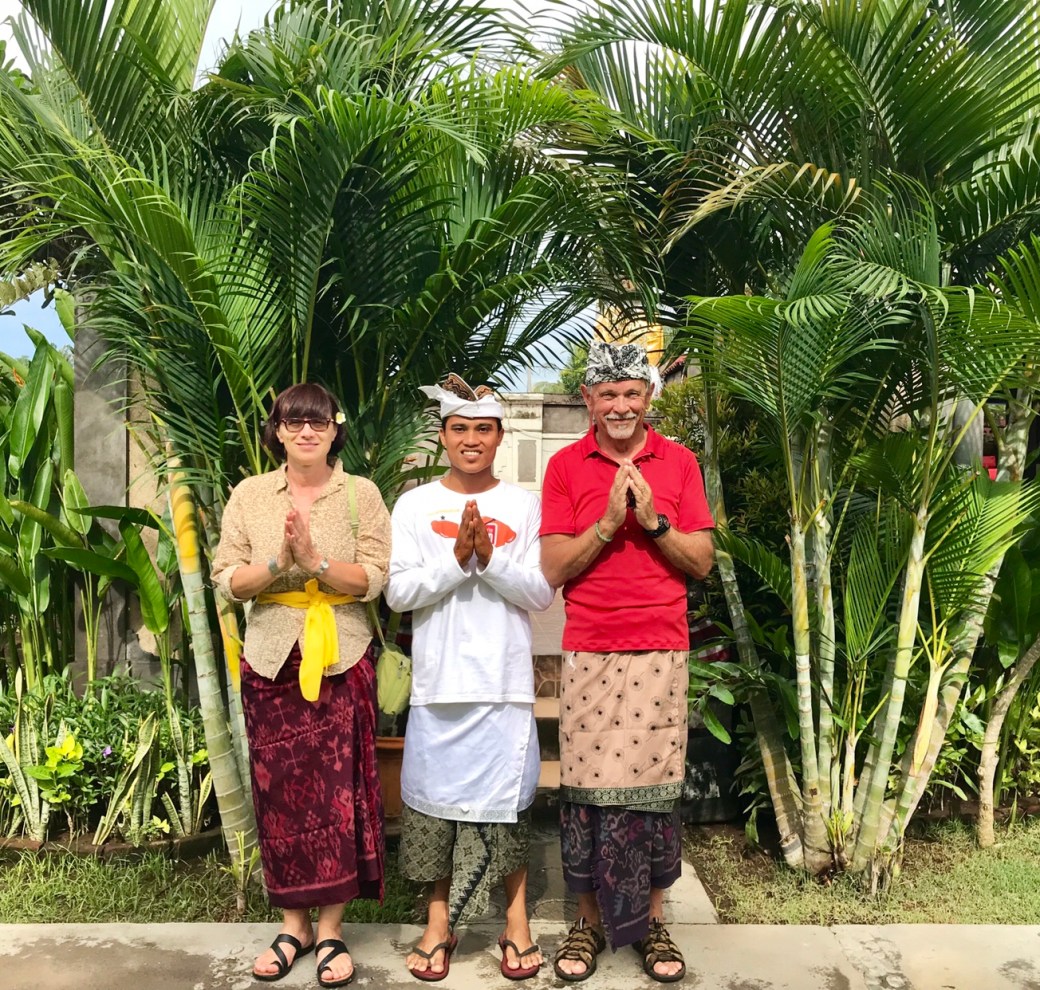
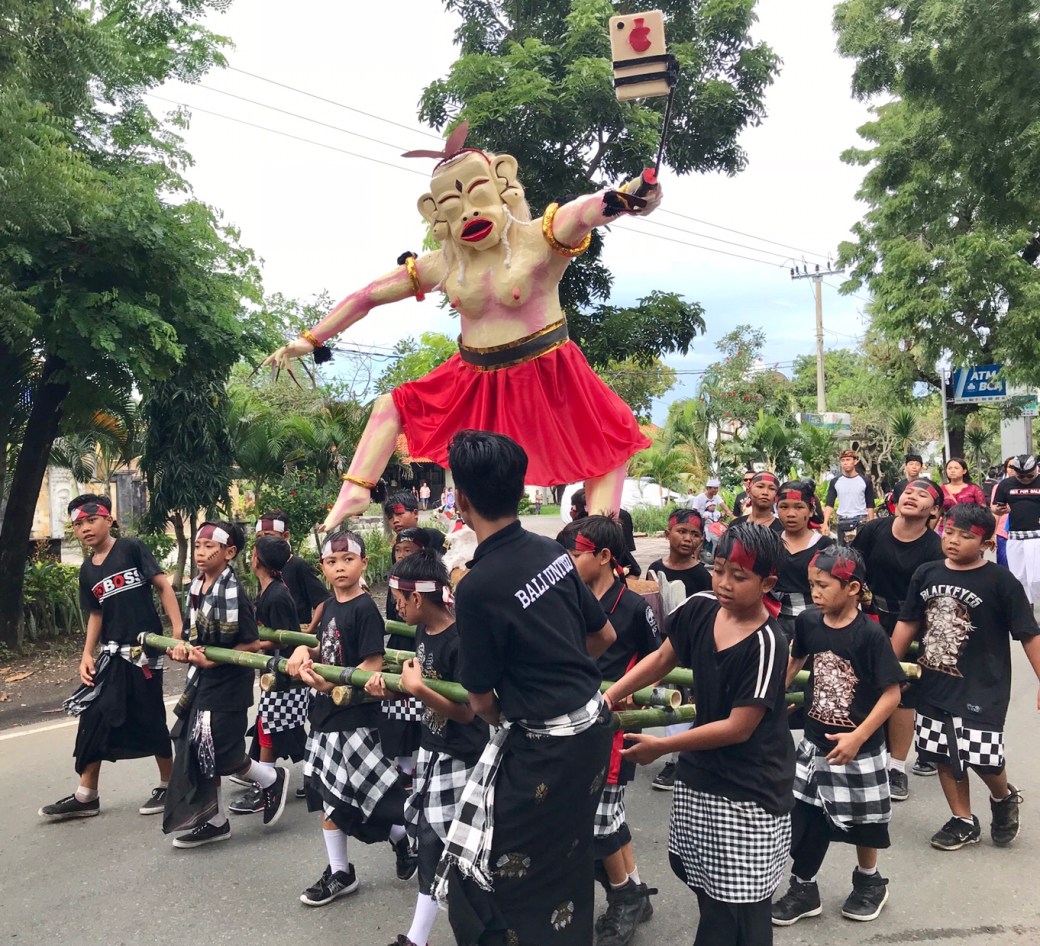 A lot of the little kids were fairly terrified and held on for dear life to the necks of their parents. I saw a grandpa trying to bring a little girl closer to the action cry in terror, until grandma came to her rescue, grabbed her from his hands and gave him a piece of her mind in no uncertain terms. No need to understand the words, the face expressions said everything.
 One of the groups was preceded by a young boy with a red mask with endless energy. He skipped and danced and enjoyed sneaking up behind unsuspecting kids and scaring them stiff.
 The creativity and engineering feats of the groups was amazing. Different villages had their own floats to show off, some were obviously the underdogs with less funds, making do with simple cloth and brown packing tape, and some spent significant amounts of money and time to create elaborate scenes of battling monsters with many hands, naked breasts and ugly faces.
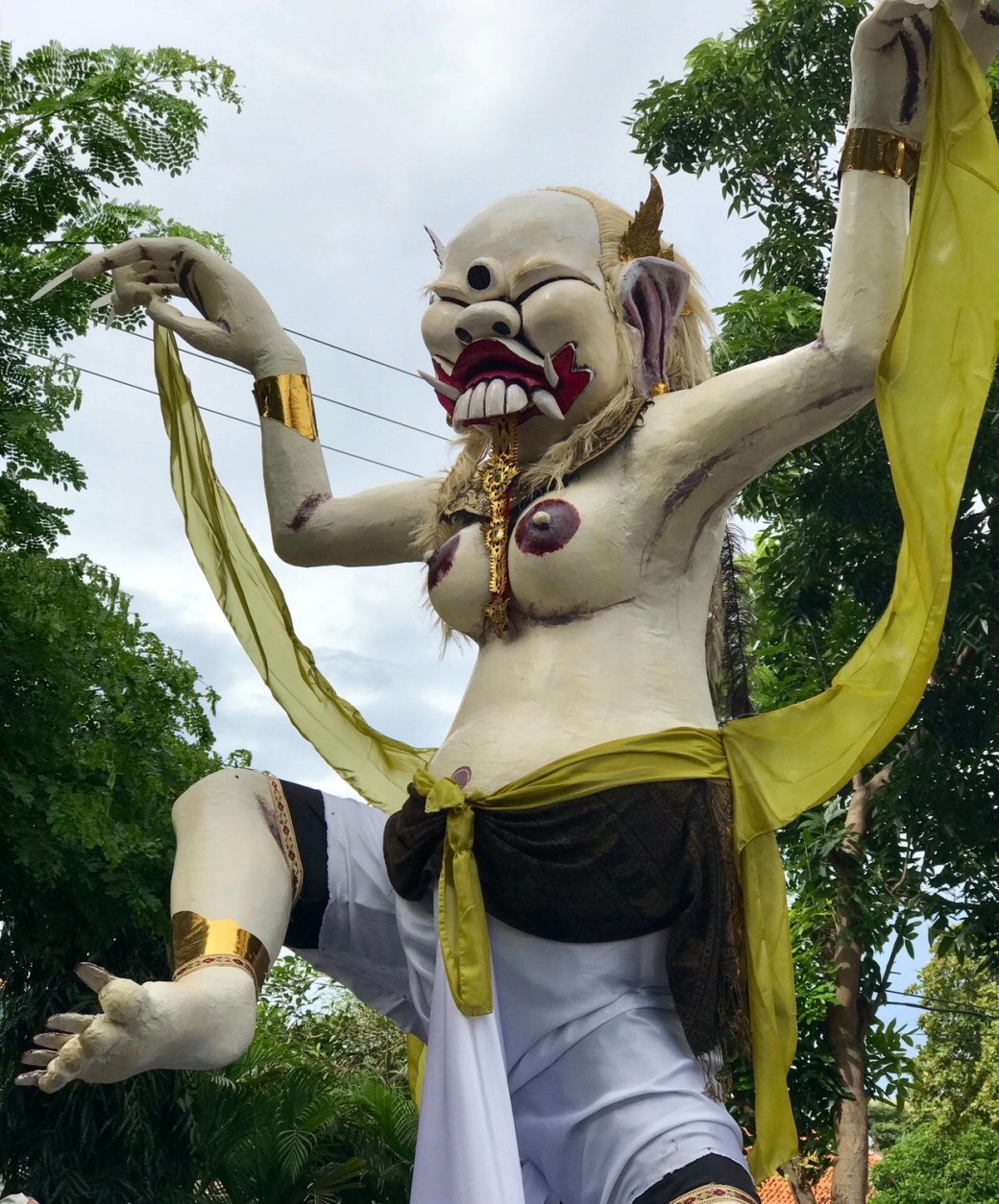 Surprisingly, many were carried by very young kids very long distances under the watchful eyes of their adult chaperones, who would now and then run up with cups of water or simply turn on the hose to cool the exhausted kids down.
 There was a large group of dark scary witches, who were dancing and wailing and throwing around “milk” and “blood”. They were companions to the demonic looking witch Randa with multiple sagging breasts and a deep male voice. The witches all ended up on the ground in a big heap and when they finally got backstage they had to carry one of them, as she fainted.
 These goings on went on the whole afternoon until they all turned around and carried their monsters back along the main road and down to the beach. There they set them down in a big cleared area and set them on fire.
 When the staff asked us when we wanted to eat dinner we suggested that we would have an early dinner and then they could all go home since we were the only guests. Their jaw dropped and then big smiles lightened up their faces. We asked them to tell the owner that those were our wishes and when he came by we reiterated that indeed we would be happy if he would let the staff go home early to celebrate. In a typical “can’t loose face” fashion he nodded and smiled.
 We spend a nice time talking about school and they asked us about our children. Practicing English outside the scope of serving meals is a rare opportunity.
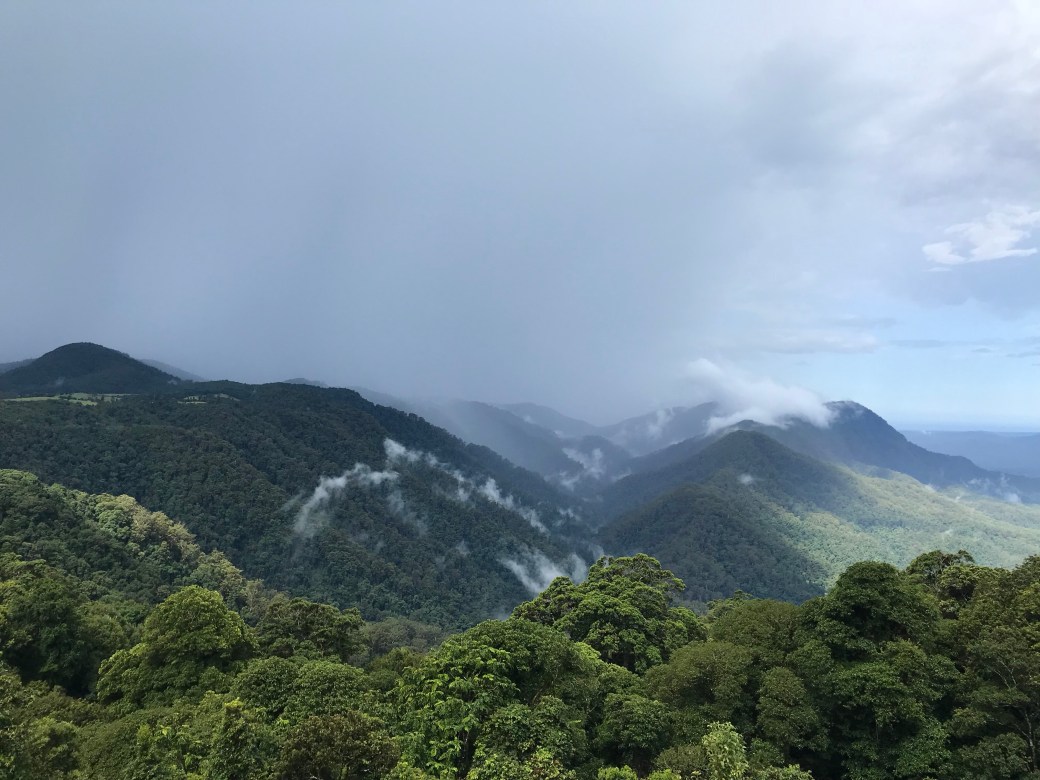 Quite like a Strangler Fig they gently wrap you in their green embrace and never let you go.
 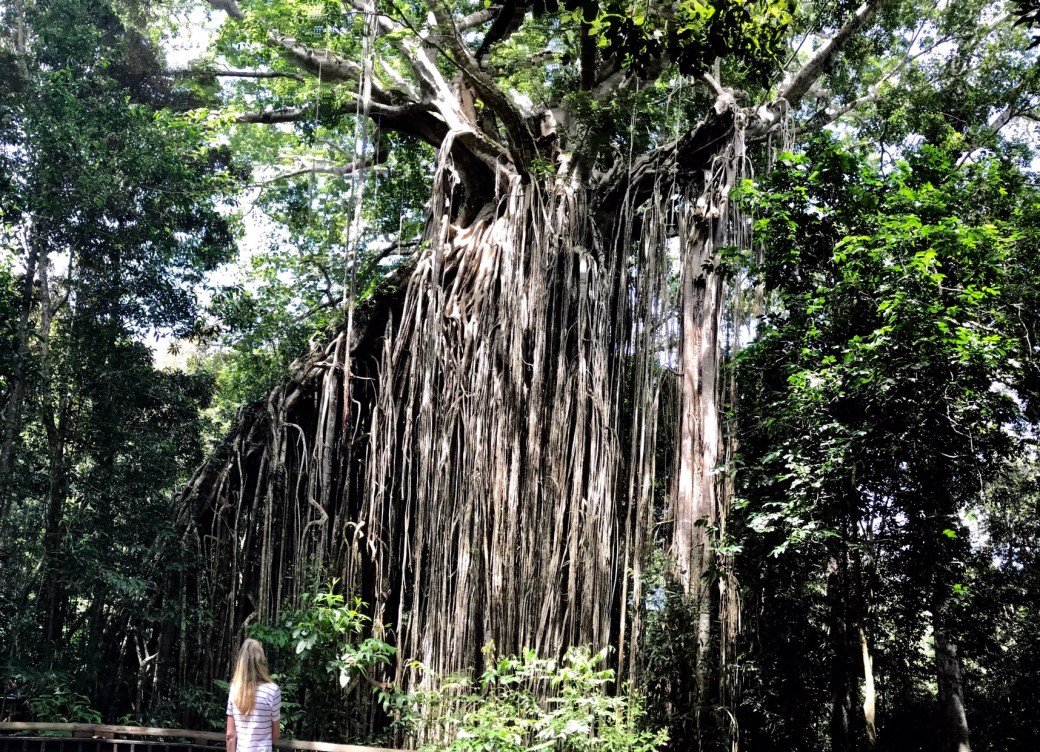 We fell under the spell of Tropical Woods like never before. We walked through them in the rain, hiked to their waterfalls, crossed over swollen rivers and suspended bridges, climbed canopy walkways and forrest towers to rest our weary city eyes in the endless sea of leaves. We spent hours strolling through botanical gardens, trying to remember all the wondrous sounding names: Hoop pine, Monkey Puzzle, Ironwood, Umbrella Tree, Swamp Gum.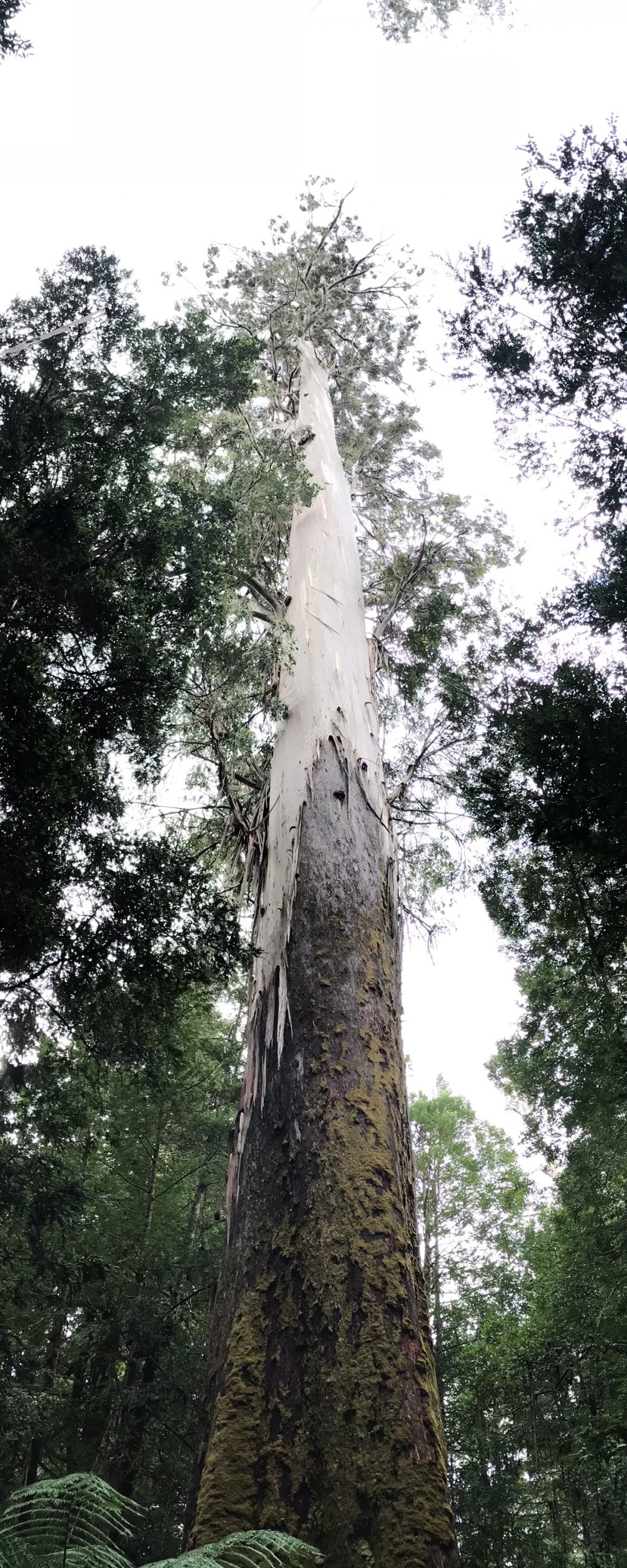
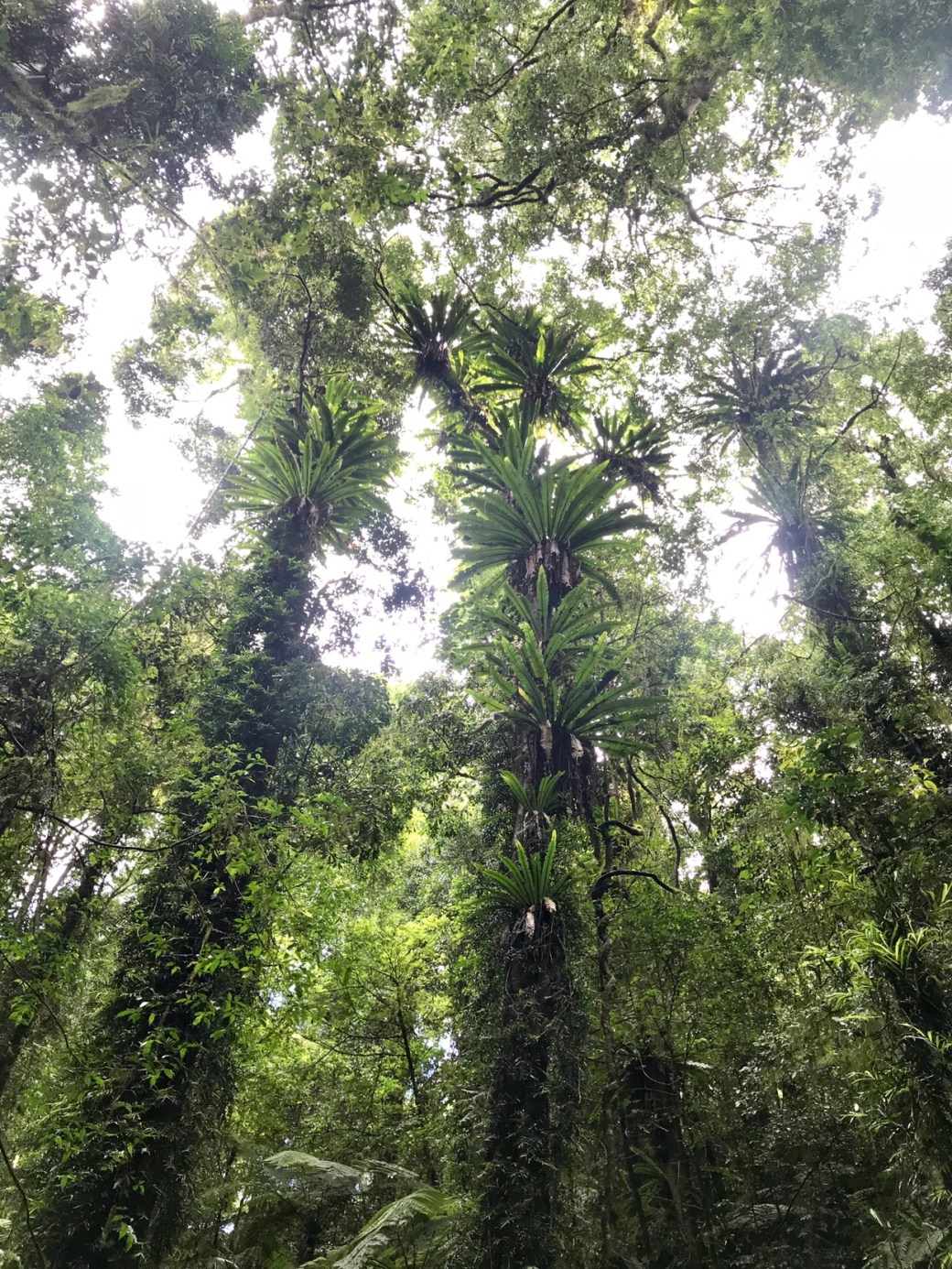 We marveled at the life force of trees shooting up two hundred feet and more into the air, to bring their faces to the oh, so vital caresses of the sun.
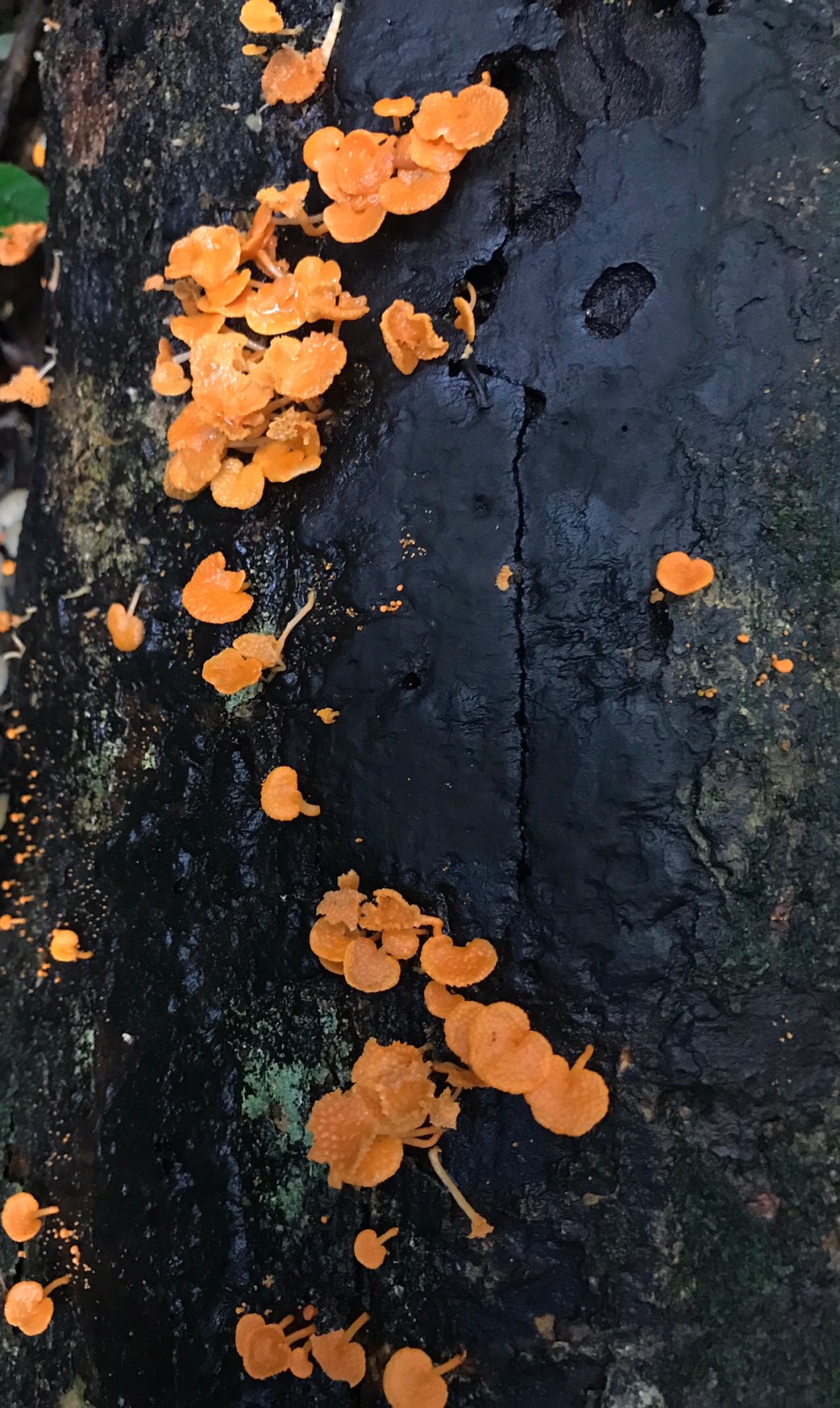 Above our heads unknown birds flitted about and joyfully sang unfamiliar melodies.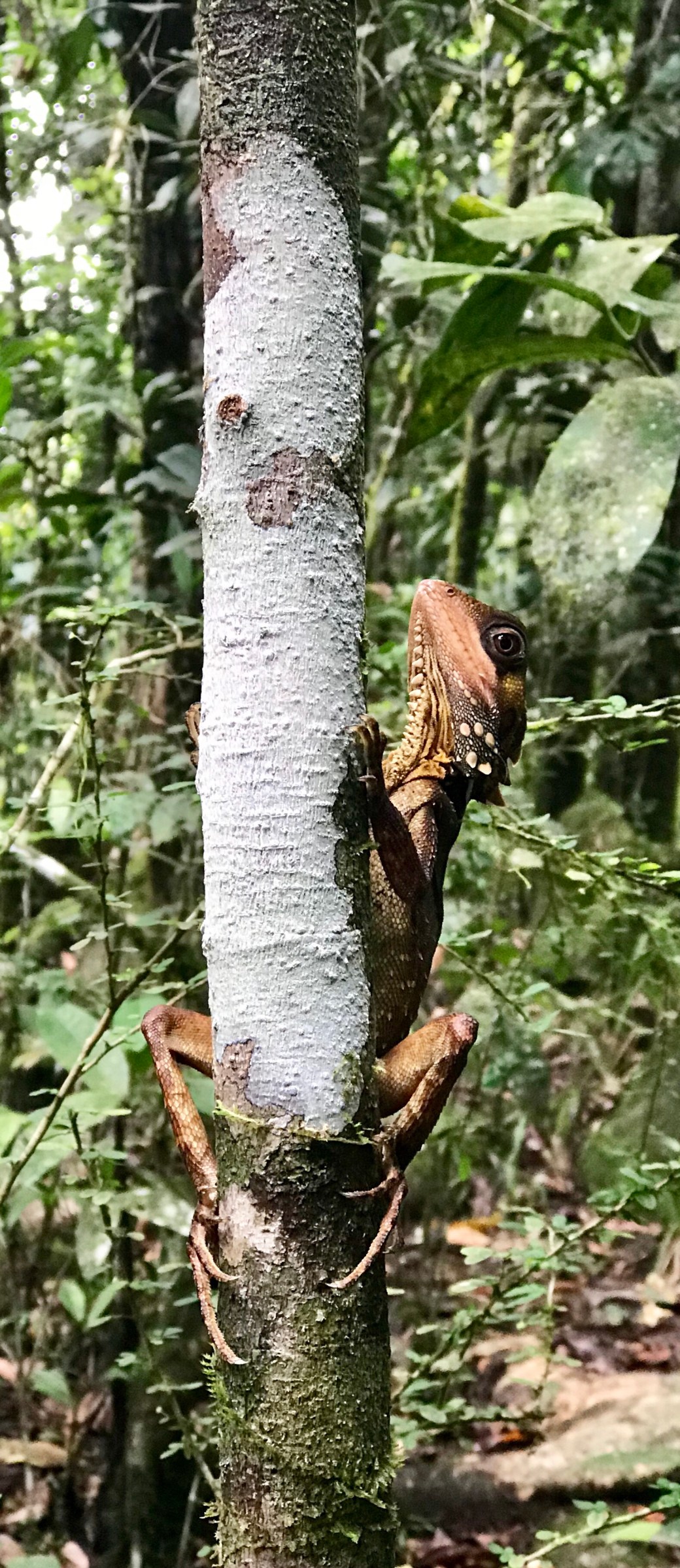
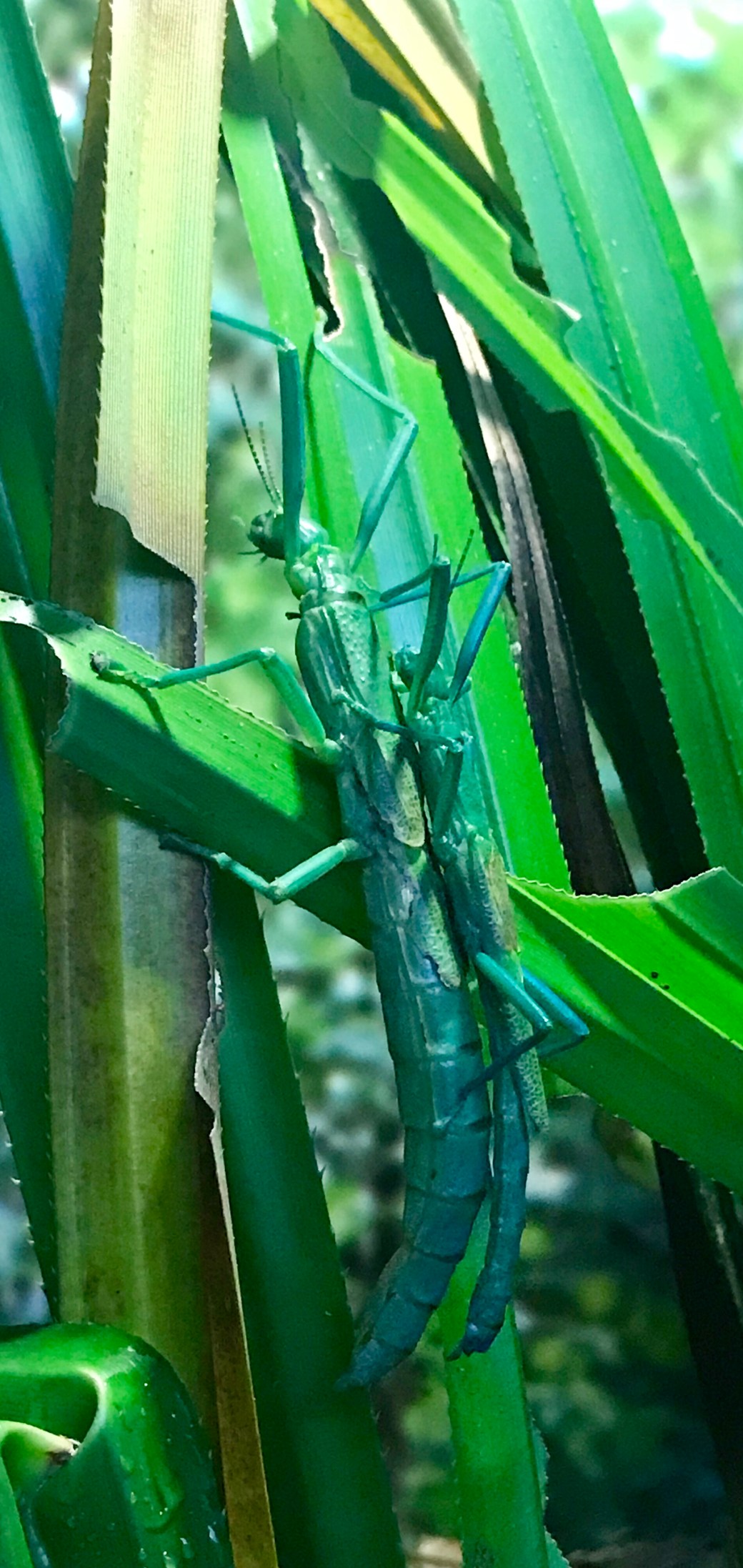 We were hoping to meet up with a famed but elusive cassowary but no such luck. 😦
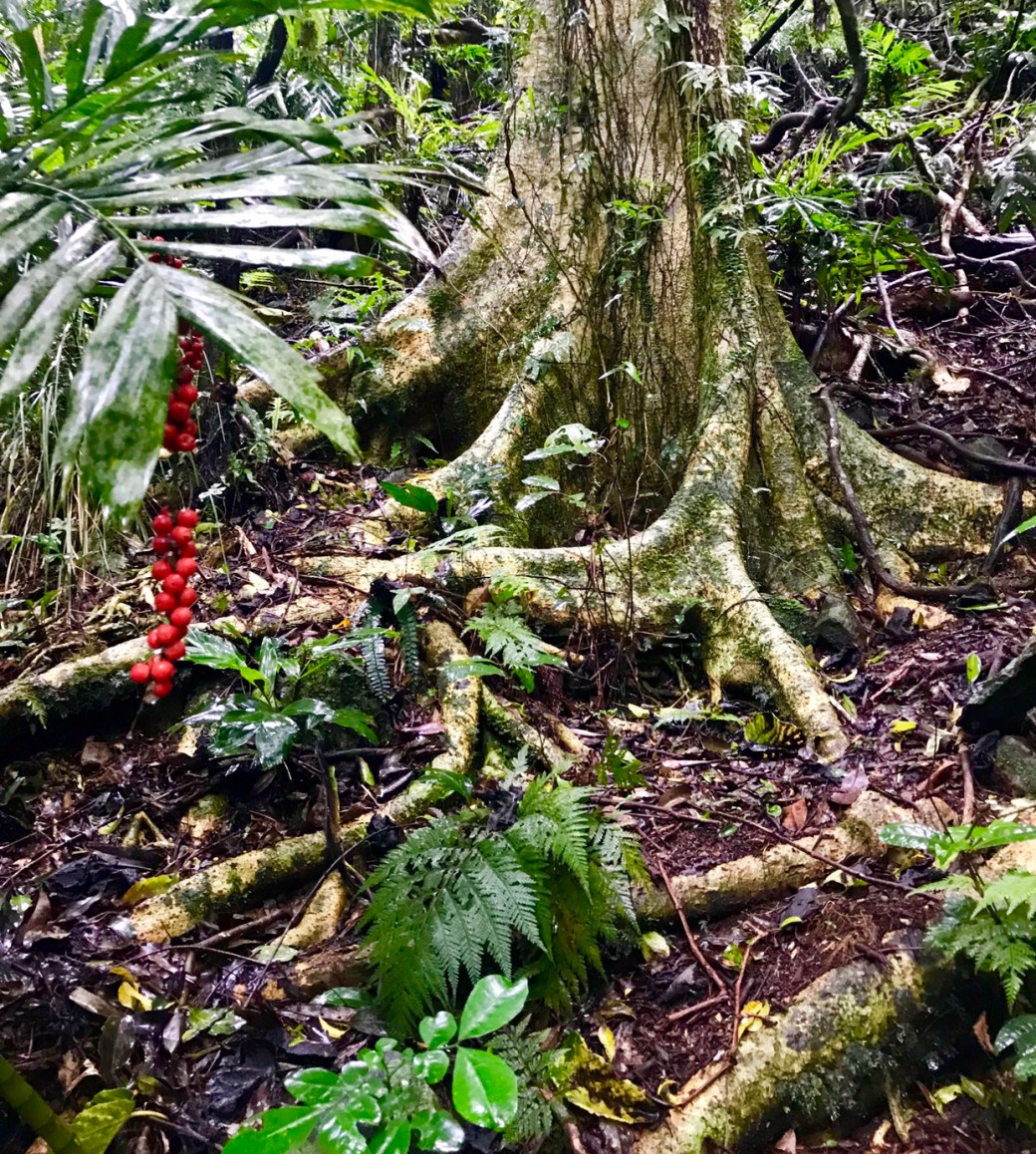 the thick softness of lush yellow-green mosses,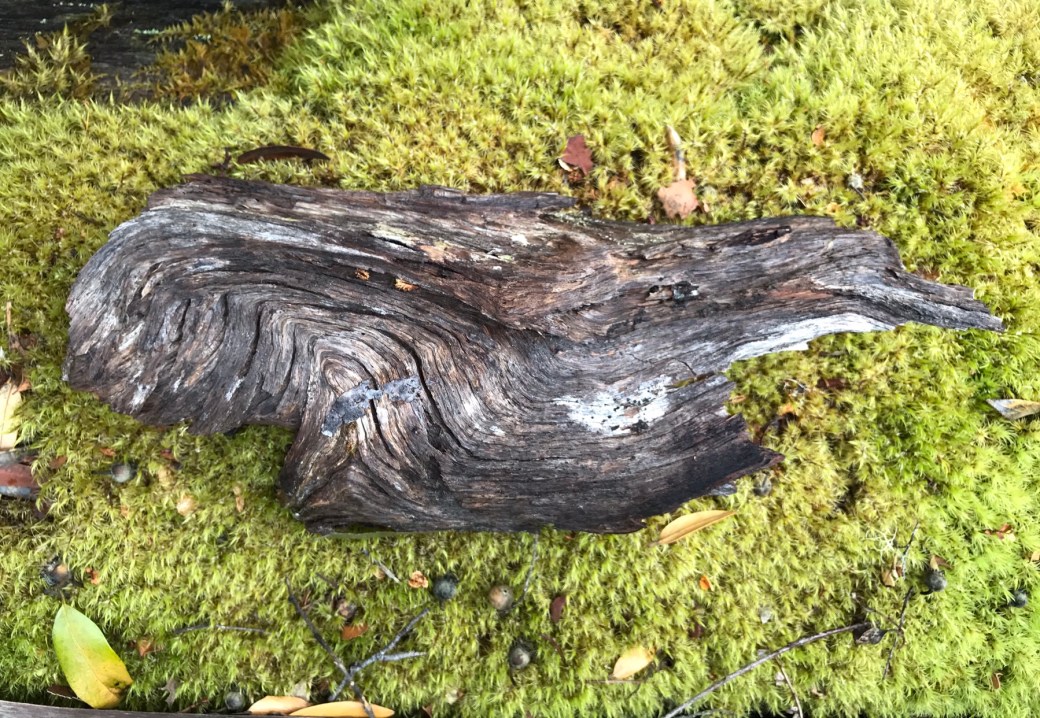
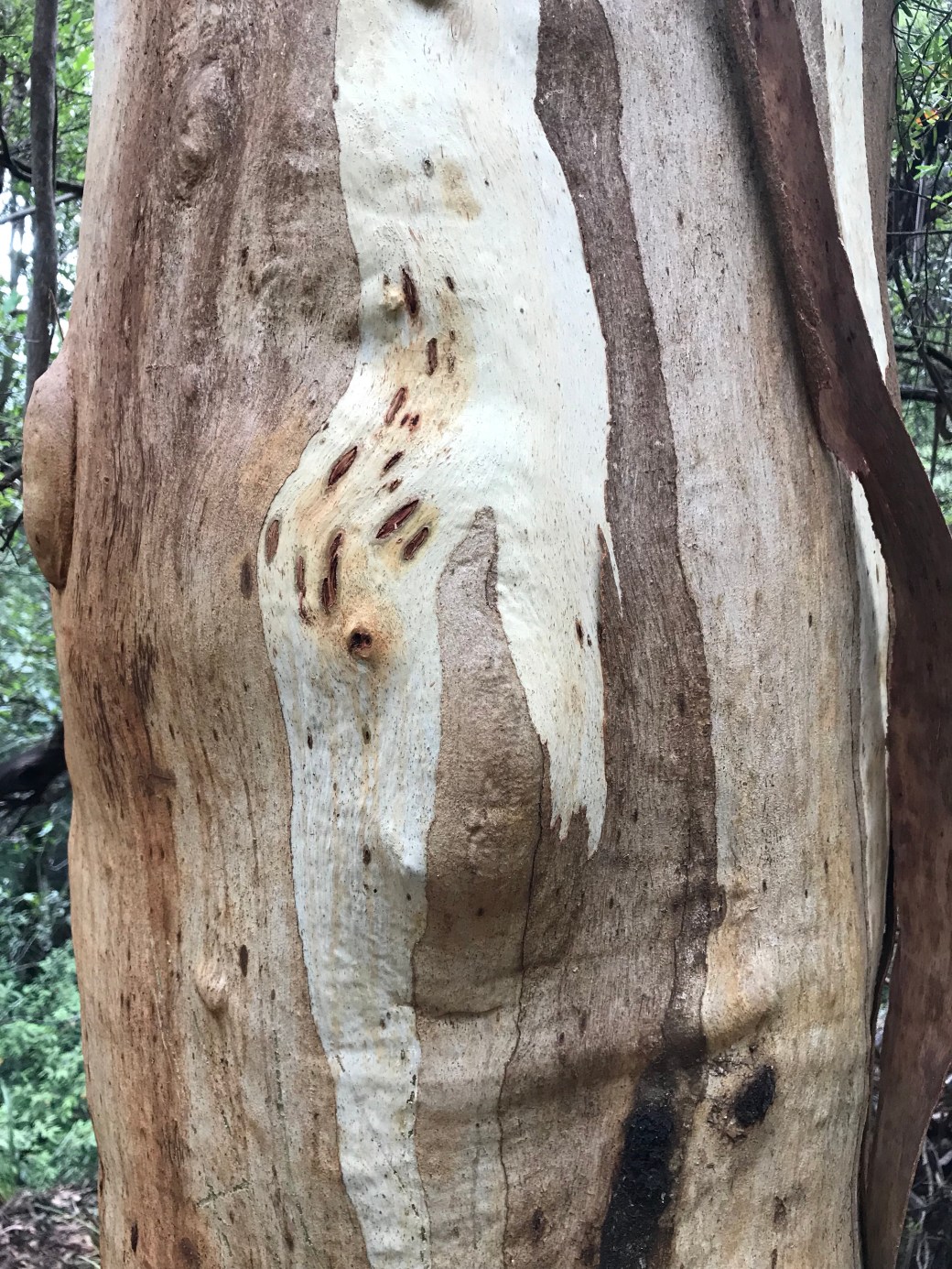
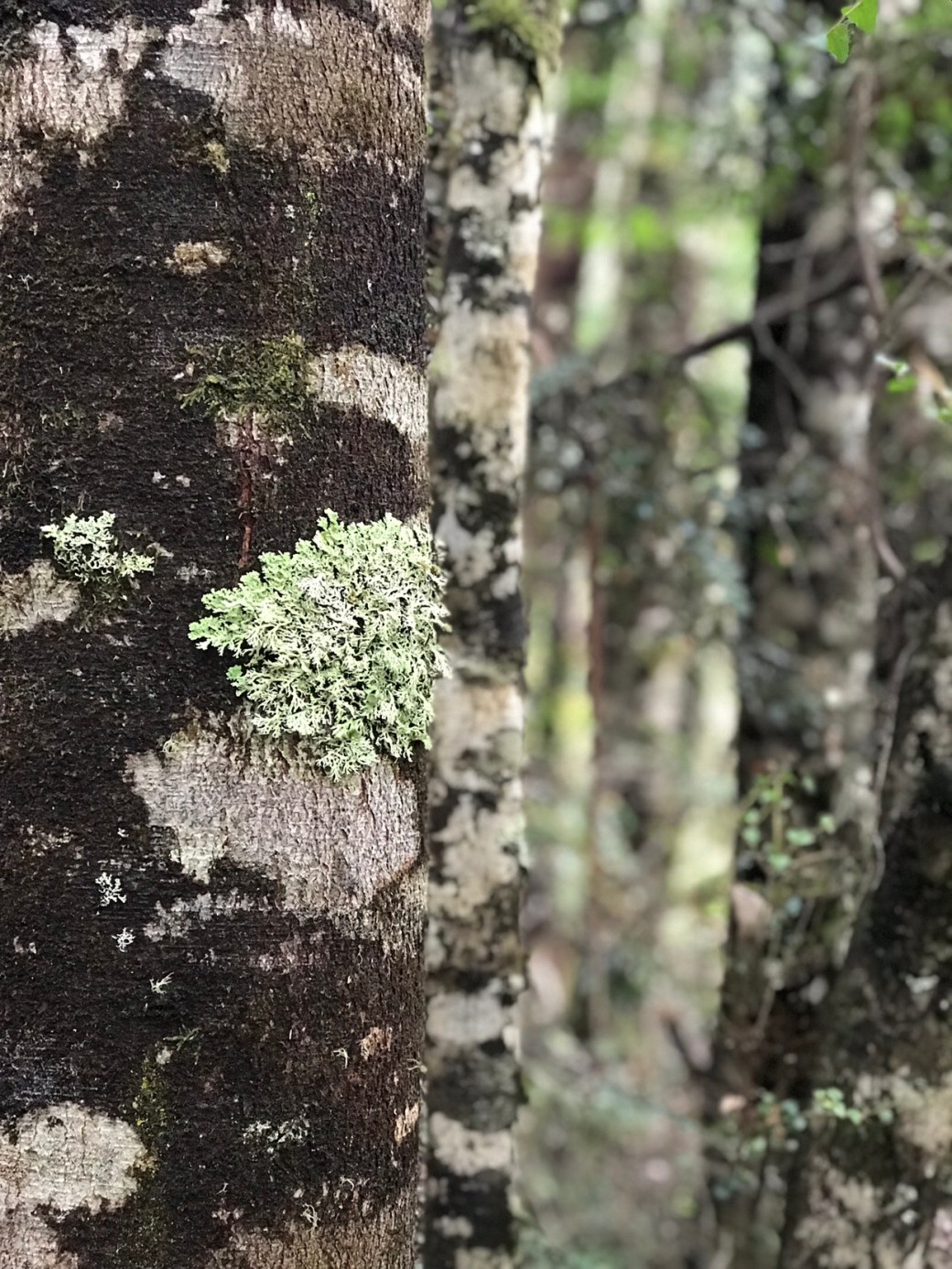 the textures and abstract patterns of bark inviting your touch,
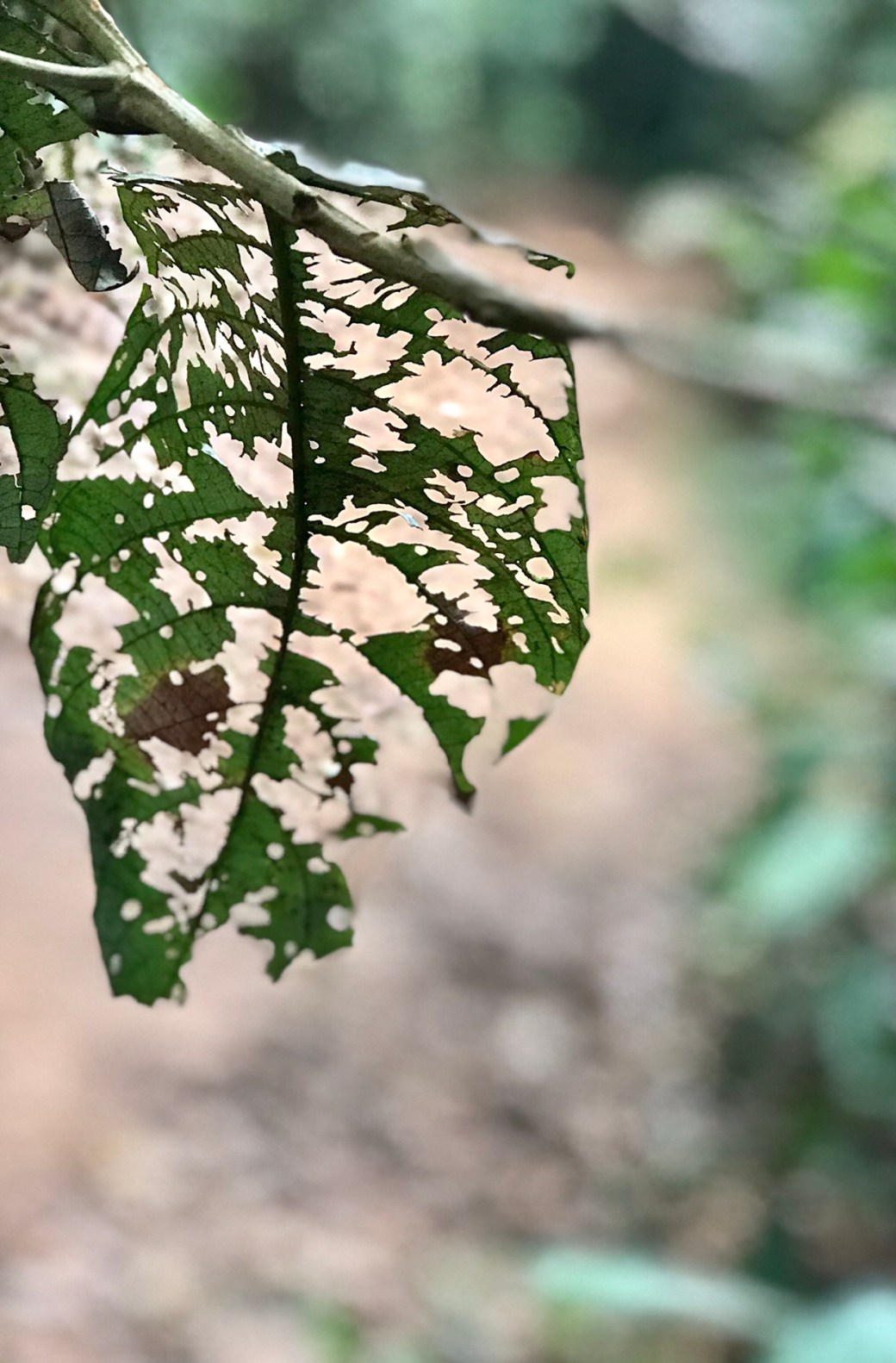
  the lacy pattern of decaying leaves…
 There had been others, more eloquent than us, called to express their awe about those same woods, captivating and inspiring us with their primal forces of the never ending cycles of life and death.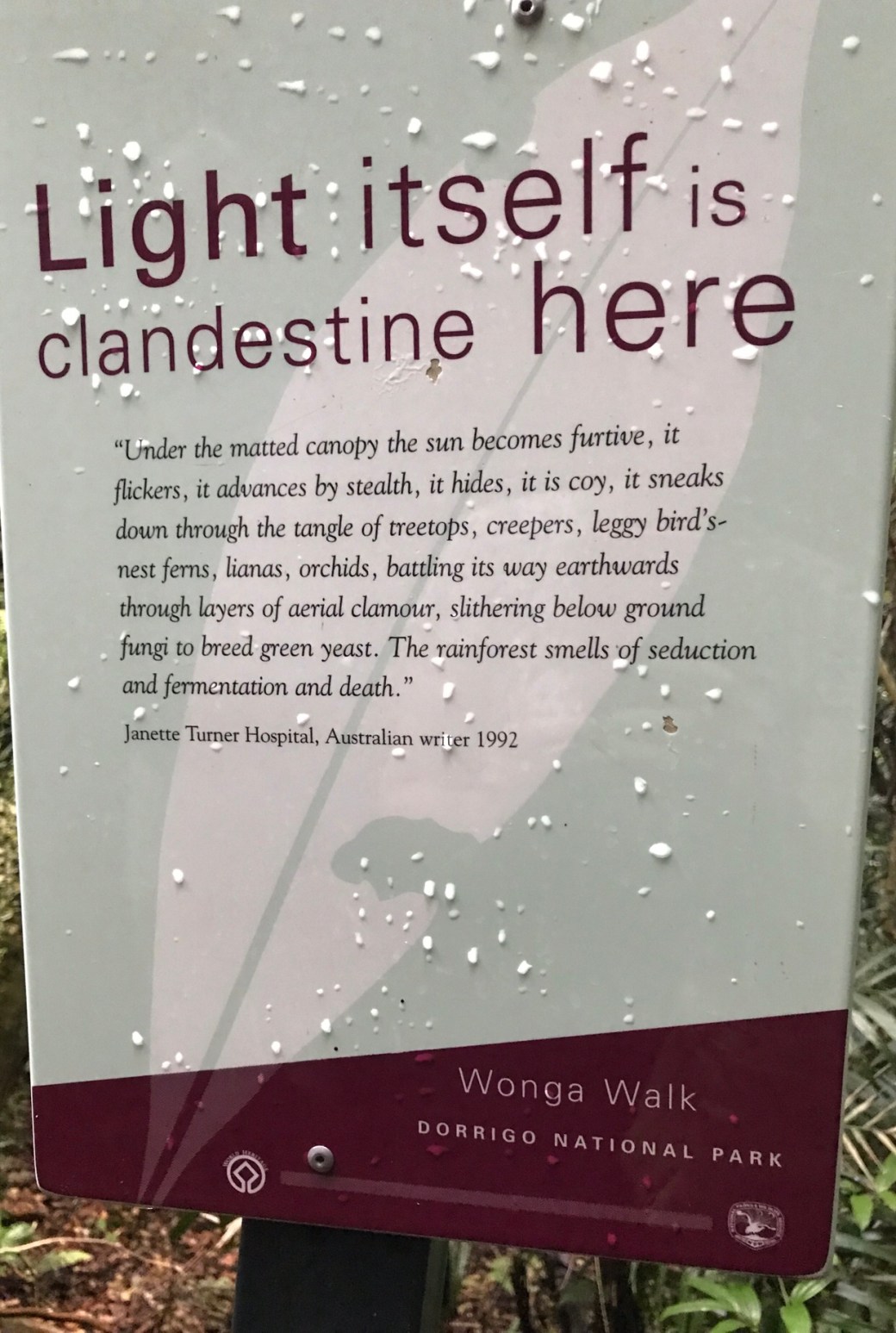
 Crazy Parents Travel